
Dry Eye Syndrome: Tear Deficiency and Artificial Tears

It feels like sand is rubbing against the inside of your eyelid. You blink rapidly, hoping for relief, but the grittiness just lingers. This is the hallmark experience of Dry Eye Syndrome, a condition that affects millions of adults globally, causing discomfort, blurred vision, and fatigue. While many assume dry eyes simply mean "not enough water," the reality is far more complex, involving a delicate balance of oils, water, and mucus that keeps the eye surface lubricated and protected. Understanding whether you have aqueous tear deficiency or evaporative issues is the first step to finding relief. Most people reach for over-the-counter drops immediately, but not all artificial tears are created equal. Some provide temporary hydration, while others address the root cause of rapid evaporation. Choosing the right treatment depends on knowing exactly what is failing in your tear film production cycle.
Key Takeaways
- Dry Eye Syndrome is multifactorial, involving both insufficient tear production (aqueous deficiency) and excessive tear evaporation (lipid layer failure).
- Evaporative dry eye accounts for approximately 86% of cases, often linked to Meibomian Gland Dysfunction rather than lack of water.
- Preservative-free artificial tears are recommended for frequent users to avoid corneal irritation from benzalkonium chloride.
- Screen time and age significantly increase risk, with average daily screen exposure contributing to a 28% higher likelihood of developing symptoms.
- Proper administration technique, such as tilting the head back and waiting five minutes between different drop types, maximizes efficacy.
How the Tear Film Actually Works
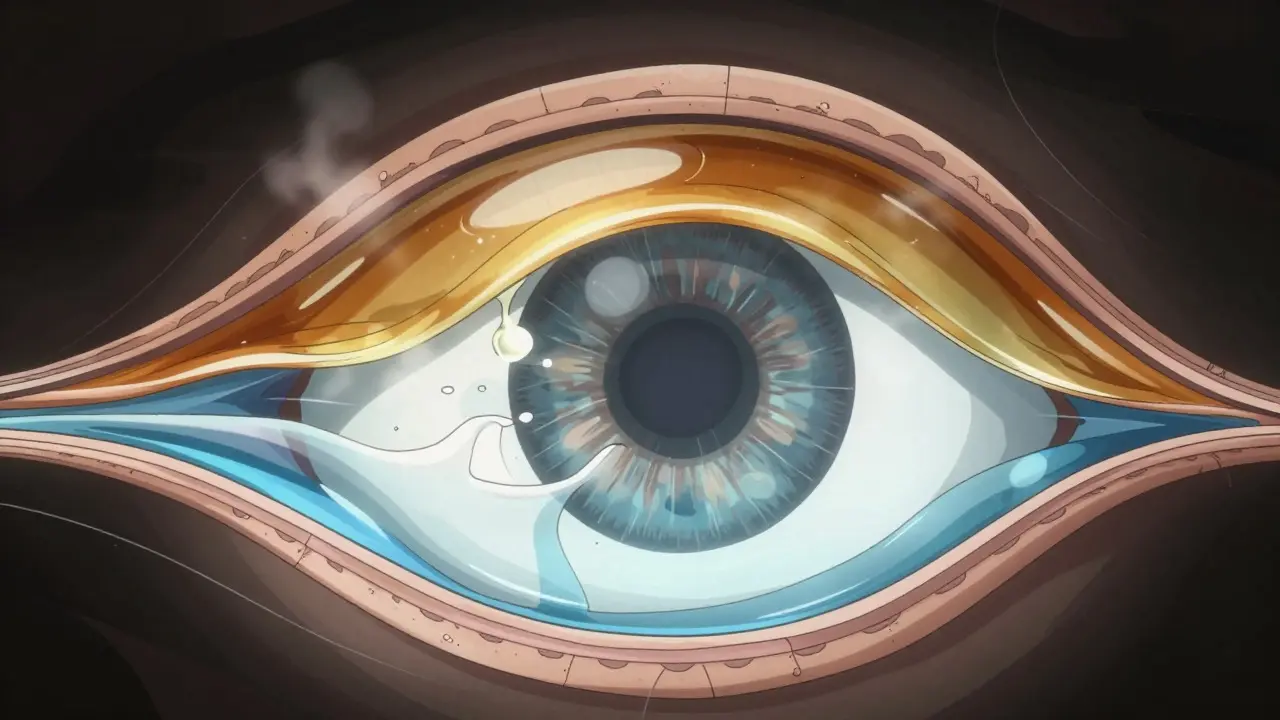
To understand why your eyes feel dry, you need to look at the structure of the tear film. It isn't just a single sheet of water; it consists of three distinct layers, each serving a specific function. The outermost layer is lipid (oil), produced by the Meibomian glands in your eyelids. This layer prevents tears from evaporating too quickly. Beneath that is the aqueous layer, which makes up the bulk of the tear volume and provides nutrients and oxygen to the cornea. The innermost layer is mucin, which helps the tear film adhere evenly to the surface of the eye.
When any of these layers fail, tear film instability occurs, leading to hyperosmolarity and inflammation. Normal tear osmolarity sits below 300 mOsm/L. In patients with dry eye disease, this value can rise to 316-360 mOsm/L. This increased salt concentration triggers an inflammatory response, releasing cytokines like IL-1 and TNF-alpha, which damage the ocular surface and create a vicious cycle of further irritation and tear breakdown.
Aqueous Deficiency vs. Evaporative Dry Eye
Not all dry eyes are created the same way. Clinicians categorize the condition into two primary pathophysiological mechanisms: aqueous tear-deficient dry eye (ADDE) and evaporative dry eye (EDE). Knowing which one you have changes the treatment approach entirely.
ADDE happens when the lacrimal glands don't produce enough of the watery component of tears. This type represents about 10-15% of cases. It is frequently associated with autoimmune conditions like Sjogren's syndrome, aging, or side effects from medications such as antihistamines. If you have ADDE, standard saline-based drops might help temporarily, but they won't fix the underlying production issue.
On the other hand, EDE is much more common, accounting for roughly 86% of diagnoses. Here, your eyes produce enough water, but it evaporates too fast because the lipid layer is weak or missing. This is usually caused by Meibomian Gland Dysfunction (MGD), where the oil glands get clogged or produce poor-quality oil. Interestingly, Dr. John Sheppard, Chairman of the Ocular Surface Disease Committee at the American Academy of Ophthalmology, notes that 60-70% of patients with evaporative dry eye actually present with excessive tearing. This reflex watering is the body's attempt to compensate for the unstable tear film, making diagnosis tricky if you only look at symptom frequency rather than tear quality.
| Feature | Aqueous Tear-Deficient (ADDE) | Evaporative (EDE) |
|---|---|---|
| Primary Cause | Lacrimal gland underproduction | Meibomian Gland Dysfunction / Lipid layer failure |
| Prevalence | 10-15% of cases | 85-90% of cases |
| Common Associations | Sjogren's syndrome, antihistamine use, aging | Blepharitis, rosacea, contact lens wear |
| Typical Symptom Profile | Consistent burning, foreign body sensation | Intermittent blurring, reflex tearing, worse in windy/dry environments |
| Best Initial Treatment | Preservative-free aqueous drops, cyclosporine | Lipid-containing drops, warm compresses, MGD therapy |
The Role and Limits of Artificial Tears
Artificial tears are the first line of defense for mild to moderate dry eye. They work by supplementing whatever component is missing-water for ADDE or stability for EDE. However, their effectiveness varies based on formulation. Standard saline drops offer minimal benefit because they lack viscosity agents that keep the liquid on the eye surface longer. Formulations containing carboxymethylcellulose or hyaluronic acid extend residence time, providing relief for several hours instead of seconds.
One critical factor is preservatives. Many commercial brands contain benzalkonium chloride (BAK) to prevent bacterial growth. While effective in small amounts, BAK can cause epithelial damage if used more than four times a day. For those requiring frequent dosing, preservative-free options are essential. Studies show that preservative-free formulations provide 37.2% greater symptom improvement in severe cases compared to preserved versions. Additionally, single-dose vials are recommended by the FDA for users applying drops more than four times daily to minimize chemical exposure.
Despite their popularity, artificial tears have limitations. They do not treat the underlying inflammation in moderate to severe cases. If you find yourself using drops every hour and still feeling gritty, you likely need anti-inflammatory therapy like cyclosporine or lifitegrast. Furthermore, 28% of patients discontinue artificial tears within six months due to inadequate relief, highlighting that drops alone are rarely a complete cure for chronic conditions.

Practical Tips for Better Relief
How you apply your drops matters as much as what you put in them. Incorrect technique leads to wasted medication and reduced efficacy. Here is how to maximize the benefit of your artificial tears:
- Tilt your head back 45 degrees and pull down your lower eyelid to create a pocket.
- Apply a single drop 1 cm away from the eye surface to avoid direct trauma to the cornea.
- Wait five minutes before applying a second drop or a different type of medication to allow absorption.
- If using multiple products, wait at least ten minutes between them to prevent interaction.
- Consider refrigerating certain viscous drops, which can increase residence time by 22% and provide a cooling sensation that soothes inflammation.
Beyond drops, lifestyle adjustments play a huge role. Since digital eye strain contributes to a 28% increased risk of DES, try following the 20-20-20 rule: every 20 minutes, look at something 20 feet away for 20 seconds. This encourages natural blinking, which spreads the tear film evenly. Also, ensure your environment has adequate humidity, especially during winter months when heating systems dry out indoor air.
When to See a Specialist
While over-the-counter solutions work for many, some signs indicate you need professional intervention. If your vision fluctuates by more than 0.5 diopters, or if you notice significant redness that doesn't resolve with rest, it’s time to see an optometrist or ophthalmologist. Severe corneal staining, graded 3 or 4 on the Oxford scale, suggests significant surface damage that requires prescription treatment. Punctal plugs, which block the tear drainage system to retain natural tears, are another option for those who don't respond to drops, though 23% of patients may experience spontaneous extrusion of the plug.
Newer technologies are also emerging. Neurostimulators like TrueTear have shown promise in increasing natural tear production by 31.2% in ADDE patients. These devices stimulate the nerves responsible for tear secretion, offering a non-invasive alternative for those with low production rates. As research continues, personalized management based on point-of-care osmolarity testing is becoming the standard of care, allowing doctors to tailor treatments precisely to your specific tear film deficiencies.
Are artificial tears safe to use every day?
Yes, but choose preservative-free formulas if you plan to use them more than four times a day. Preservatives like benzalkonium chloride can irritate the cornea with frequent, long-term use. Single-dose vials are the safest option for high-frequency application.
Why do my eyes water if I have dry eye syndrome?
This is a common paradox in evaporative dry eye. When the tear film becomes unstable and breaks up quickly, the eye surface becomes irritated. This triggers a reflex response where the lacrimal glands dump large volumes of watery tears to flush out the irritation. However, these reflex tears lack the necessary oil and mucus components, so they evaporate almost instantly, leaving the eye dry again.
What is the difference between dry eye and allergies?
Allergies typically cause itching, redness, and swelling, often affecting both eyes symmetrically and worsening in spring or around pets. Dry eye causes burning, grittiness, and blurred vision that improves with blinking. Allergy drops contain antihistamines, while dry eye drops focus on lubrication and stability. Sometimes, both conditions coexist, requiring a combination treatment plan.
Do contact lenses make dry eye worse?
Contact lenses can exacerbate dry eye symptoms because they absorb moisture from the tear film and reduce the rate of oxygen exchange. If you wear contacts and have dry eye, switch to daily disposables or silicone hydrogel lenses designed for comfort. Using compatible artificial tears specifically formulated for contact lens wearers can also help maintain lens hygiene and comfort throughout the day.
Can diet affect dry eye syndrome?
Yes, nutrition plays a role in tear quality. Omega-3 fatty acids, found in fish oil and flaxseed, help improve the quality of the lipid layer produced by the Meibomian glands. Staying hydrated is also crucial, as systemic dehydration can reduce aqueous tear production. Adding these nutrients to your diet may complement medical treatments and improve overall ocular surface health.