When you hear DEXA scan, you might think it’s just another medical test. But for millions of people, especially those over 50, it’s one of the most important health checks they’ll ever have. It doesn’t just measure bone density-it can tell you whether you’re at risk of breaking a bone before it even happens. And yet, many people leave the appointment confused, unsure what their T-score really means or why their doctor suddenly cares about their spine.
Bone loss doesn’t come with pain. No aches. No warning signs. That’s why it’s called a silent disease. You could be losing bone every year without knowing it-until a fall turns into a broken hip, or a cough cracks a vertebra. The DEXA scan is the only tool doctors rely on to catch this before it’s too late.
How a DEXA Scan Works
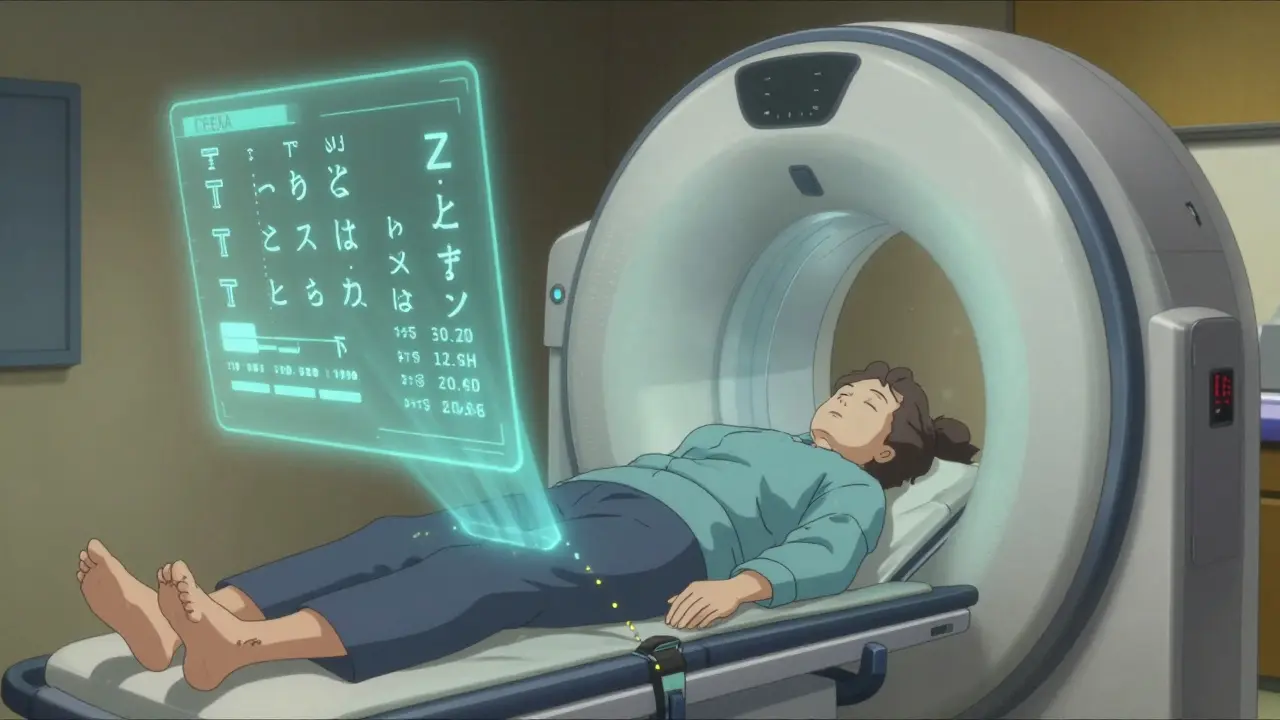
A DEXA scan uses two very low-dose X-ray beams to measure how dense your bones are. It’s not a full-body scan. You lie on a table while a machine passes over your lower spine and hip-the two spots most likely to break if your bones are weak. Sometimes, if you’ve had wrist fractures or are preparing for surgery, they’ll scan your forearm too.
The radiation? Less than what you get from natural background sources in two days. You could fly across the country and get more radiation than from this test. The whole thing takes about 10 minutes. No needles. No fasting. No discomfort. Most people say it’s easier than getting a blood pressure check.
The machine doesn’t just take pictures. It calculates how much mineral is packed into each square centimeter of bone. That number-bone mineral density (BMD)-gets turned into two scores: the T-score and the Z-score.
What Your T-Score Really Means
The T-score is what most people remember-or panic over. It compares your bone density to that of a healthy 30-year-old adult of the same sex and race. Why 30? Because that’s when most people reach peak bone mass. It’s the baseline.
Here’s how it breaks down:
- T-score of -1.0 or higher: Normal bone density. Your bones are holding up well.
- T-score between -1.0 and -2.5: Osteopenia. Your bones are thinner than normal, but not yet osteoporotic. This isn’t a diagnosis of disease-it’s a red flag.
- T-score of -2.5 or lower: Osteoporosis. Your bones are significantly weaker. Fracture risk jumps noticeably here.
Let’s say your T-score is -2.7. That’s osteoporosis. But that number alone doesn’t tell the whole story. Two people with the same T-score can have very different fracture risks. One might be 75, inactive, and on steroids. The other might be 60, active, and healthy. The score is the same, but the risk? Not even close.
That’s why doctors don’t just look at the T-score. They use a tool called FRAX.
FRAX: The Missing Piece
FRAX isn’t a machine. It’s a free online calculator developed by the World Health Organization. You plug in your age, sex, weight, height, whether you smoke, if you drink alcohol, if you’ve had a prior fracture, if your mom broke a hip, if you take corticosteroids… and it spits out your 10-year risk of a major fracture.
A T-score of -2.5 might mean a 15% risk of fracture in 10 years. But if you’re 80, smoke, and had a wrist fracture last year? That same T-score could mean a 40% risk. That changes everything. Treatment decisions hinge on this combination.
A 2021 study in the
Journal of Bone and Mineral Research showed FRAX improves fracture prediction by 15-22% when combined with DEXA results. Without it, doctors are guessing. With it, they’re making smart choices.
Why Other Tests Don’t Cut It
You might hear about ultrasound scans or peripheral DEXA machines at pharmacies or fitness centers. They’re cheaper. They’re faster. But they’re not reliable for diagnosing osteoporosis.
Peripheral DEXA scans your heel or finger. They’re okay for screening-but they can’t tell you if your spine or hip is at risk. And if you get a low reading there, you’ll still need a full DEXA to confirm.
Quantitative CT (QCT) gives 3D images and measures bone volume, not just density. It’s more detailed. But it uses 100 times more radiation than DEXA. It’s not used for routine screening. It’s reserved for complex cases.
DEXA remains the gold standard because it’s been tested against real-world outcomes-thousands of fractures over decades. No other test has matched its ability to predict who will break a bone.
Limitations and Gotchas
DEXA isn’t perfect. It has blind spots.
If you have severe arthritis, metal implants, or spinal fusion surgery, the scan can’t accurately measure bone density in those areas. The machine sees the metal or calcified tissue and thinks it’s bone. That can make your T-score look better than it is.
Also, DEXA measures density, not structure. Two people can have the same BMD, but one has spongy, fragile bone, and the other has thick, strong bone. That’s why newer tools like Trabecular Bone Score (TBS) are being added. TBS looks at the texture of the bone on the DEXA image itself-kind of like checking if a brick wall is solid or full of cracks. Studies show it improves fracture prediction by 12-18%.
And then there’s the issue of who gets tested.
In the U.S., Medicare covers DEXA scans every two years for women 65 and older, and men 70 and older. But only 38% of eligible women actually get screened. And the numbers drop sharply for Black and Hispanic women-only 22% and 18% respectively. That’s not just a gap in access. It’s a gap in survival.
What Happens After the Scan?
If your T-score is normal? You’re probably good. But if you’re over 50, have risk factors, or had a fracture after age 50, your doctor might still recommend a scan every few years.
If you have osteopenia? Lifestyle matters. Weight-bearing exercise. Enough protein. Vitamin D. No smoking. Limit alcohol. Sometimes, they’ll recommend calcium supplements. But not always. For many, just changing habits is enough to slow bone loss.
If you have osteoporosis? Treatment is usually started. Medications like bisphosphonates (Fosamax, Boniva) or injectables like Prolia can cut fracture risk by 40-70%. But they’re not for everyone. Side effects exist. Cost matters. Your doctor will weigh the risks.
One real case: A 68-year-old woman in Dublin had no symptoms. No pain. No history of falls. Her DEXA showed a T-score of -2.7. She started treatment. Two years later, a repeat scan showed her bone density had stabilized. She didn’t break a bone. She didn’t even know she was at risk.
Who Should Get Screened?
The guidelines are clear, but many people don’t know them.
- Women 65 and older
- Men 70 and older
- Postmenopausal women under 65 with risk factors (family history, low body weight, smoking, steroid use)
- Men 50-69 with risk factors
- Anyone who’s broken a bone after age 50
- Anyone with conditions linked to bone loss (rheumatoid arthritis, hyperthyroidism, long-term steroid use)
If you’re unsure, ask your doctor. Don’t wait for a fracture to happen.
Common Misconceptions
- “I’m young-I don’t need this.” Bone loss starts silently in your 40s. Prevention starts early.
- “I take calcium, so I’m fine.” Calcium helps, but without vitamin D, exercise, and avoiding smoking, it’s not enough.
- “My mom had osteoporosis, so I will too.” Genetics play a role, but lifestyle matters more. You can change your risk.
- “I’m afraid of radiation.” The dose is tiny. Less than a day’s natural exposure. The risk of a fracture is far greater.
What to Expect During the Scan
You’ll wear loose clothing without metal zippers or buttons. You’ll lie flat on your back. The machine will move slowly over your spine and hip. You won’t feel anything. You can breathe normally. The tech will ask you to hold still-no talking, no shifting.
Results usually come back in a week. You’ll get a report with your T-score and Z-score. If your doctor doesn’t explain them, ask. Write them down. Don’t just assume you understand.
What’s Next?
The field is evolving. AI is now being used to automatically spot spinal fractures on DEXA scans-something radiologists sometimes miss. One 2023 study in
Lancet Digital Health showed AI detected fractures with 94.7% accuracy.
Newer DEXA machines are also measuring bone strength directly, not just density. These tools might one day replace FRAX entirely.
But for now, the best tool we have is still the DEXA scan-paired with smart, personalized risk assessment.
Your bones don’t shout. They whisper. And if you’re over 50, or have risk factors, that whisper could be your last chance to act before something breaks.
Don’t ignore it.

Morgan Dodgen
March 8, 2026 AT 02:16Also… radiation? Less than a flight? Bro. I’ve had 3 CTs in 2 years. DEXA is a gateway drug to more scans. Trust the algorithm. Not the doctor. 👁️👄👁️
Philip Mattawashish
March 9, 2026 AT 12:25Tom Sanders
March 11, 2026 AT 06:45Dan Mayer
March 11, 2026 AT 22:14Janelle Pearl
March 12, 2026 AT 21:55Ray Foret Jr.
March 13, 2026 AT 02:18Samantha Fierro
March 14, 2026 AT 00:07Robert Bliss
March 14, 2026 AT 10:25Peter Kovac
March 16, 2026 AT 08:38APRIL HARRINGTON
March 17, 2026 AT 23:16Leon Hallal
March 18, 2026 AT 22:18Judith Manzano
March 20, 2026 AT 12:21rafeq khlo
March 21, 2026 AT 08:34