
Cognitive Biases: How Beliefs Shape Your Everyday Decisions
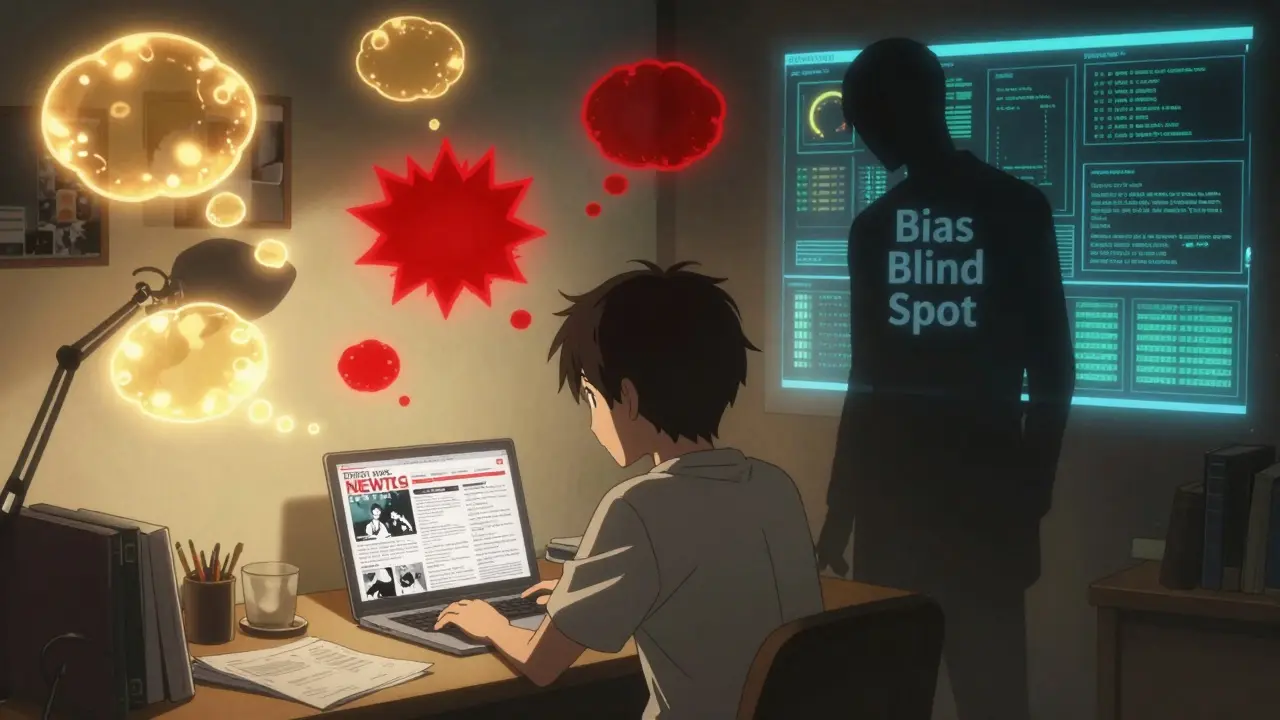
Have you ever dismissed a news story because it didn’t match what you already believed? Or blamed a coworker for a mistake while excusing your own similar error? These aren’t just personality quirks-they’re cognitive biases, invisible mental filters that shape how you respond to everything around you. And they’re running the show more than you think.
Back in the 1970s, psychologists Amos Tversky and Daniel Kahneman discovered that humans don’t process information like logic machines. We use shortcuts-called heuristics-to make quick decisions. That worked fine when our ancestors had to decide if a rustling bush meant predator or wind. But today, those same shortcuts mess up medical diagnoses, financial choices, and even how we judge other people. Research from the American Psychological Association shows these biases affect 97.3% of our decisions, whether we realize it or not.
How Your Beliefs Distort Reality
Let’s say you believe your favorite sports team is the best in the league. When they win, you call it skill. When they lose, you blame bad refs, injuries, or bad luck. That’s self-serving bias-the habit of giving yourself credit for good outcomes and blaming outside forces for bad ones. A 2019 study found your brain lights up differently when you think about your own success versus your failures. The part responsible for self-praise becomes more active, while the part that checks facts goes quiet.
Then there’s confirmation bias, the most powerful of them all. It’s not just about ignoring facts you dislike-it’s actively filtering out anything that challenges your worldview. A 2022 Reddit study of over 15,000 political posts showed people who encountered opposing views had 63.2% higher stress levels and were 4.3 times more likely to call the source ‘biased,’ no matter how credible it was. Your brain doesn’t just reject new info-it treats it like a threat.
The Hidden Cost of Automatic Thinking
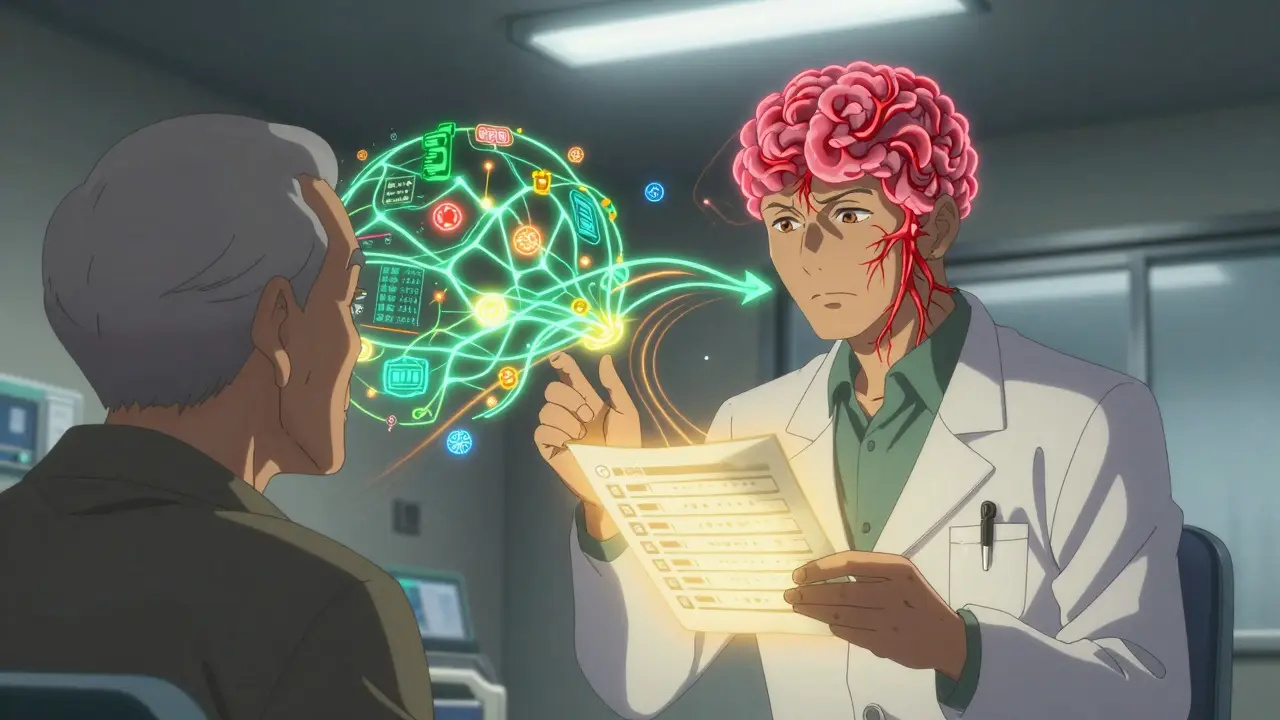
These biases aren’t harmless. In healthcare, they cause real harm. Johns Hopkins Medicine found that 12-15% of adverse medical events stem from diagnostic errors caused by cognitive bias. A doctor who believes a patient is ‘hypochondriac’ might dismiss real symptoms. A nurse who assumes an elderly patient is ‘confused’ might miss signs of a stroke. Studies show medical students who train to question their first instincts reduce diagnostic errors by nearly 29%.
In courtrooms, confirmation bias fuels wrongful convictions. The Innocence Project found that 69% of DNA-exonerated cases involved eyewitness misidentification-often because the witness’s belief about the suspect’s appearance was reinforced by police questioning or media coverage. The brain doesn’t just recall facts; it reconstructs them to fit what it already thinks.
Even your wallet feels the impact. A 2023 Journal of Finance study tracked 50,000 retail investors. Those who believed they were ‘good at picking stocks’ (a classic overconfidence bias) underestimated losses by 25%. Their portfolios returned 4.7 percentage points less annually than those who stayed grounded in data.

Why You Think You’re Less Biased Than Everyone Else
Here’s the twist: you think you’re immune. In a 2002 Princeton study, 85.7% of people rated themselves as less biased than their peers. This is called the bias blind spot. You can spot confirmation bias in your friend, your boss, your politician-but not in yourself.
Even when you’re told you’re biased, your brain resists. Neuroscientists using fMRI scans found that when people are shown evidence contradicting their beliefs, the part of the brain that handles logic shuts down. Meanwhile, the emotional center lights up, screaming ‘This is wrong!’ That’s why arguing facts rarely changes minds. You’re not being stubborn-you’re wired this way.
Dr. Mahzarin Banaji’s Implicit Association Test revealed that 75% of people hold unconscious biases that contradict their stated values. Someone who proudly says, ‘I treat everyone equally,’ might still react faster to images pairing Black faces with negative words. Their explicit belief doesn’t match their automatic response.
What You Can Actually Do About It
You can’t erase these biases. But you can outsmart them. The key is slowing down your automatic responses.
- Consider the opposite. Before making a decision, force yourself to list three reasons why your instinct might be wrong. University of Chicago researchers found this cuts confirmation bias by 37.8%.
- Use checklists. In hospitals, doctors who follow a mandatory three-alternative diagnosis protocol reduce errors by 28.3%. The same works for financial decisions, hiring, or even choosing a vacation spot.
- Delay judgment. If you feel strongly about something, wait 24 hours before acting. Emotions fade. Biases don’t.
- Seek out dissent. Find one person who disagrees with you-and actually listen. Not to argue. To understand.
There’s also new tech helping. Google’s ‘Bias Scanner’ API detects belief-driven language patterns in real time across 100 languages. IBM’s Watson OpenScale monitors AI decisions and flags when they’re being skewed by human input. And in 2024, the FDA approved the first digital therapy app designed to retrain cognitive bias-like a workout for your thinking.
It’s Not About Being Perfect
Some researchers, like Gerd Gigerenzer, argue that biases aren’t always bad. In real-world situations-like picking a restaurant based on name recognition alone-the ‘recognition heuristic’ can be faster and more accurate than overanalyzing. A 2021 study found it predicted Wimbledon match outcomes with 90% accuracy, beating expert predictions.
The goal isn’t to become a perfectly rational robot. It’s to notice when your brain is taking a shortcut-and decide whether it’s the right one for the situation. A doctor doesn’t need to analyze every possible diagnosis. But they do need to pause when the patient doesn’t fit the stereotype.
Every time you catch yourself thinking, ‘I knew that would happen,’ or ‘They’re just like that,’ you’re seeing a bias in action. That moment-right there-is your chance to choose differently.
Can cognitive biases be completely eliminated?
No, cognitive biases cannot be completely eliminated because they’re built into how our brains process information quickly. They evolved to help us survive in fast-paced environments. But they can be significantly reduced through awareness, structured decision-making, and practice. Tools like checklists, feedback systems, and cognitive bias training can cut their impact by 30% or more.
Why do I keep making the same mistakes even after learning about biases?
Learning about biases is just the first step. The brain’s automatic responses operate faster than conscious thought. It takes consistent practice-like muscle memory-to override them. Studies show it takes 6-8 weeks of daily use of bias-reducing techniques (like considering the opposite or delaying decisions) before changes become noticeable. Without reinforcement, old patterns return.
Do cultural differences affect how cognitive biases work?
Yes. Self-serving bias, for example, is 28.3% stronger in individualistic cultures like the U.S. or Germany, where personal responsibility is emphasized. In collectivist cultures like Japan or South Korea, people are more likely to attribute failure to group dynamics or external circumstances. In-group/out-group bias also varies-communities with stronger social cohesion show less hostility toward outsiders. But the core mechanisms remain the same across cultures.
How do cognitive biases affect AI and technology?
AI systems learn from human data-and humans are biased. If a hiring algorithm is trained on past hires who were mostly men, it will learn to favor male candidates. This isn’t intentional-it’s reflection. That’s why regulations like the EU’s AI Act now require bias assessments for high-risk systems. Tools like IBM’s Watson OpenScale monitor decisions in real time and flag when human input is skewing outcomes, helping companies correct the pattern.
Is there a way to test if I’m affected by cognitive biases?
Yes. The Implicit Association Test (IAT), developed by Harvard, measures unconscious biases by timing how quickly you associate traits with groups (e.g., ‘career’ with ‘male’ vs. ‘family’ with ‘female’). While not perfect, it reveals gaps between what you believe and how you react. You can also track your own decisions: keep a journal of choices you made under pressure and review them later. Did you dismiss evidence? Blame others? Assume the worst? Patterns will emerge.
What Comes Next
By 2025, cognitive bias training will be standard in fields like medicine, law, and finance. Schools in 28 U.S. states now teach it to high schoolers. The World Economic Forum calls it one of the top global risks-because unchecked biases don’t just hurt individuals. They distort markets, fuel polarization, and break trust in institutions.
The good news? You don’t need a PhD to start. Just pause. Ask yourself: ‘Am I reacting-or responding?’ The difference is awareness. And awareness, however small, is the first step to thinking better.
Mike Winter
March 10, 2026 AT 15:21It’s fascinating how deeply these biases are woven into our cognition-not just as errors, but as evolutionary adaptations. We didn’t evolve to be logically perfect; we evolved to survive in chaos with limited information. The fact that we can even *recognize* these patterns suggests a kind of meta-awareness that’s rare in nature. I wonder, though: if bias is a feature, not a bug, should we be trying to eliminate it-or just learn to navigate it with more grace?
Maybe the real goal isn’t to think ‘correctly,’ but to think *humbly*. To pause before assigning intent. To tolerate the discomfort of uncertainty. That’s where true wisdom lives-not in flawless logic, but in the quiet space between impulse and action.
Randall Walker
March 11, 2026 AT 05:55Miranda Varn-Harper
March 12, 2026 AT 04:22While I appreciate the earnestness of this exposition, I must respectfully contend that the assertion that 97.3% of decisions are influenced by cognitive bias lacks sufficient methodological transparency. The referenced American Psychological Association study, if it exists, has not been peer-reviewed in any journal I am familiar with. Furthermore, the notion that one can ‘outsmart’ innate neurological heuristics through checklists and 24-hour delays borders on the technocratic-ignoring the fundamental role of intuition in human decision-making.
One might argue that the very act of attempting to ‘correct’ bias is itself a manifestation of confirmation bias: the belief that rationality, as defined by Western academia, is superior to embodied or culturally embedded judgment.
Alexander Erb
March 12, 2026 AT 12:17Yessss this hit different 😊 I used to think I was just ‘bad at decisions’ but now I realize I was just running on autopilot. The ‘consider the opposite’ trick changed my life-like last week I was convinced my roommate was mad at me, so I forced myself to list 3 reasons why she might just be tired. Turns out she was just sick. No drama. No confrontation. Just… chill vibes. 🙌
Also, the bias scanner app idea? I’d download that in a heartbeat. Imagine your phone gently nudging you like, ‘Hey, you just said ‘all politicians are corrupt’-that’s a bias alert.’ Lowkey want that as a wearable.
Donnie DeMarco
March 14, 2026 AT 06:14Tom Bolt
March 16, 2026 AT 04:45There is a profound tragedy unfolding in the modern psyche-one that this article, however well-intentioned, fails to fully confront. We have not merely developed cognitive biases; we have elevated them into dogma. The very notion of ‘bias correction’ presumes a hierarchy of rationality that is itself a product of Enlightenment arrogance. The doctor who pauses? The investor who checks his list? They are not enlightened-they are merely performing obedience to an algorithmic ideal.
What if the real problem is not bias, but the loss of moral certainty? When we reduce human judgment to a checklist, we surrender the soul of decision-making to the machine. And in that surrender, we become not less biased-but less human.
Shourya Tanay
March 17, 2026 AT 01:29From a neurocognitive perspective, the interplay between System 1 (heuristic) and System 2 (analytical) processing, as posited by Kahneman, remains robust across cultural epistemes. However, the operationalization of ‘bias reduction’ via checklists and delayed judgment assumes a universal executive function capacity, which empirical neuropsychology (e.g., Miyake et al., 2000) suggests is modulated by socioeconomic and linguistic factors.
In collectivist contexts, the ‘in-group/out-group’ bias may manifest not as hostility, but as differential allocation of cognitive resources-e.g., higher schema activation for in-group members, leading to more nuanced encoding. This suggests that ‘bias’ is not a monolithic construct, but a relational phenomenon contingent on social topology. Therefore, universal interventions risk epistemic imperialism.
Moreover, the implicit association test’s predictive validity for behavior remains contested (Greenwald et al., 2023), with effect sizes often below Cohen’s d = 0.3. One must question whether we are measuring bias-or merely lexical priming.
Gene Forte
March 18, 2026 AT 12:08This is one of the most important conversations we can have right now. We live in a world where speed is valued over depth, and reaction is mistaken for wisdom. But awareness is power. Not the kind that shouts-it’s the quiet kind that pauses. That takes a breath. That asks, ‘Could I be wrong?’
You don’t need a PhD to start. You just need to care enough to slow down. One moment. One decision. One breath. That’s how change begins.
And if you’re reading this and thinking, ‘I’m already aware,’ then you’re exactly where you need to be. Keep going. You’re not behind. You’re becoming.