
Complex Regional Pain Syndrome: Burning Pain After Injury
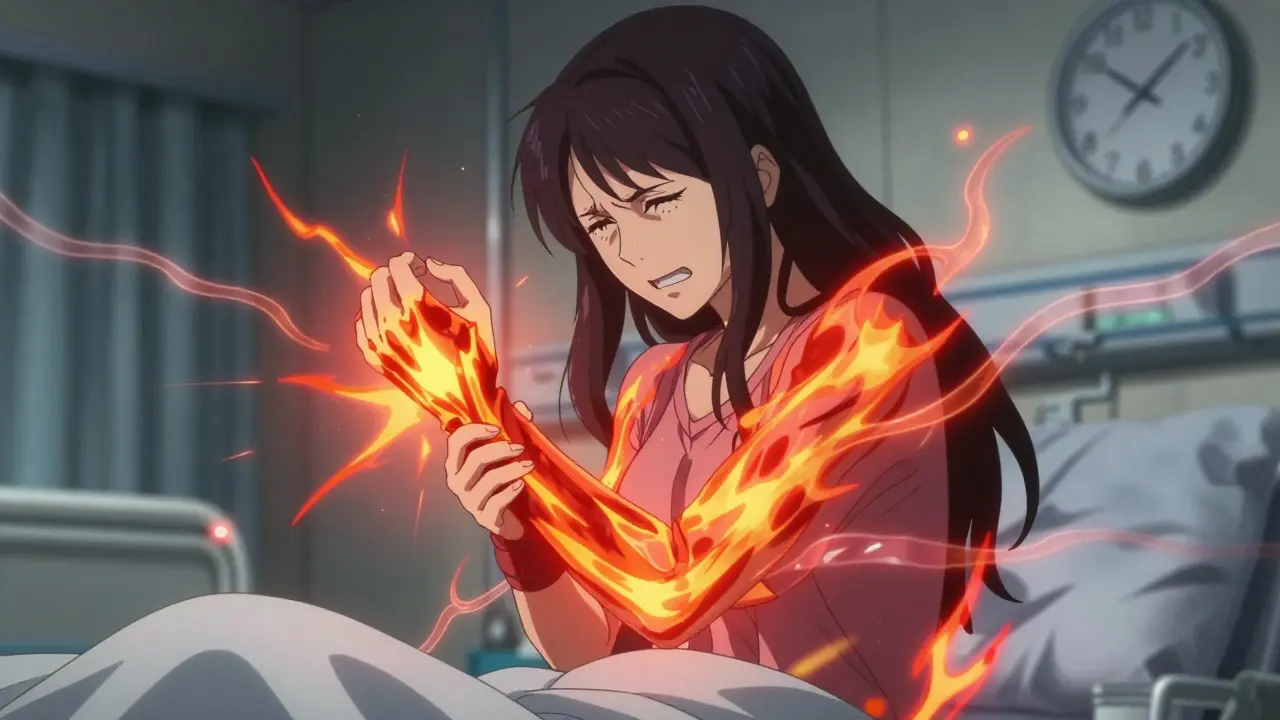
After a broken wrist, a sprained ankle, or even minor surgery, most people expect pain to fade over weeks. But for some, the pain doesn’t just stick around-it grows worse. It becomes a deep, unrelenting burning sensation, as if the skin is on fire from the inside. Even the lightest touch-a blanket, a breeze, or a sleeve brushing against the arm-can feel like a shock. This isn’t normal. This is Complex Regional Pain Syndrome (a chronic neurological condition that causes severe, disproportionate pain after an injury, often affecting an arm or leg), or CRPS.
CRPS doesn’t follow the rules of typical healing. You don’t need a major injury to trigger it. A simple fracture, a cut, a sprain, or even an injection can set it off. In fact, about 40% of cases start after a fracture, especially in the wrist. But here’s the twist: not everyone with a broken bone gets CRPS. Why some people do and others don’t remains one of the biggest mysteries in pain medicine.
What Does CRPS Actually Feel Like?
People with CRPS describe the pain in ways that sound extreme-even impossible. It’s not just soreness. It’s burning, stabbing, electric, or tearing. The pain doesn’t match the injury. A small cut leads to pain that feels like a third-degree burn. A sprained ankle causes pain that spreads up the leg, even if the ankle itself has healed.
It’s not just about pain. The body changes too. The skin over the affected area might become:
- Shiny, thin, or tight
- Red, purple, or blotchy
- Warmer or colder than the other side
- Swollen or sweaty
Some notice hair or nails growing faster-or suddenly stopping. Muscles twitch. Joints stiffen. Fine motor skills vanish. You might drop a glass because your fingers won’t cooperate. Tremors or spasms can make holding a cup impossible.
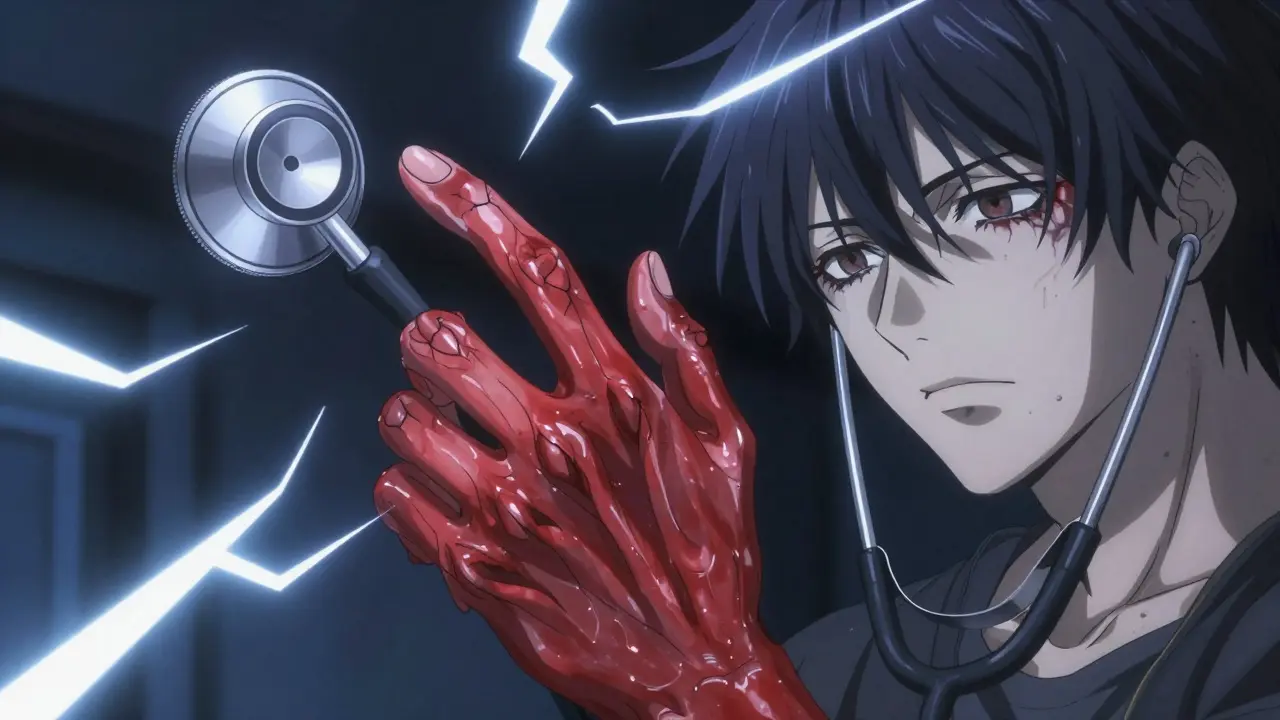
One of the most disturbing signs is allodynia-when something harmless, like a light touch, triggers intense pain. A doctor’s stethoscope, a breeze, or even a bedsheet can feel unbearable. This isn’t “being sensitive.” It’s your nervous system sending wrong signals, nonstop.
Why Does This Happen?
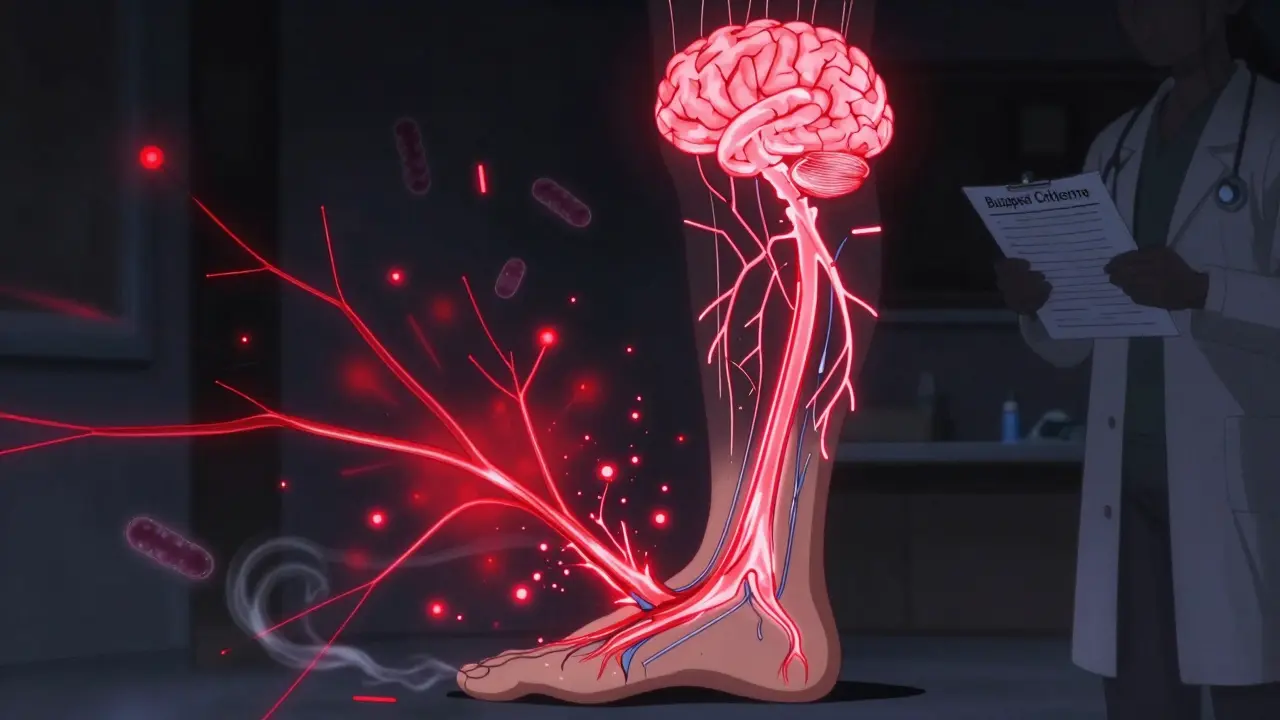
CRPS isn’t just “bad pain.” It’s a malfunction in your nervous system. Your body’s alarm system got stuck. Instead of turning off after the injury heals, it keeps screaming.
Three main things go wrong:
- Inflammation: In the early stages, your body releases inflammatory chemicals around the injured nerves. This causes swelling, redness, and heat.
- Nerve damage: In over 90% of cases, tiny nerve fibers-too small to see on an X-ray-get damaged. These fibers normally control pain signals and blood flow. When they’re injured, they misfire.
- Sympathetic nervous system overdrive: This is the part of your nervous system that handles stress responses. In CRPS, it gets stuck in “fight or flight” mode, making pain worse and blood vessels react abnormally.
Some research suggests CRPS might even have an autoimmune component. A 2022 study found specific antibodies in 30% of CRPS patients-antibodies that attack the body’s own nerve tissue. This could explain why symptoms spread beyond the injury site.
It’s not just one thing. It’s a chain reaction: injury → nerve damage → inflammation → nervous system chaos → brain misinterprets signals → pain becomes chronic.
Who Gets CRPS?
It’s not random. Certain patterns show up:
- Women are three times more likely to develop CRPS than men. Why? Researchers aren’t sure, but hormones and immune response differences may play a role.
- Ages 40 to 60 are most affected, but it can happen to teens and older adults too.
- Timing matters. Symptoms usually appear 4 to 6 weeks after the injury. If pain spikes after a cast is applied or a bandage feels too tight, that’s a red flag.
- It’s rare. Only about 20 in every 100,000 people get it each year. But because it’s often misdiagnosed, the real number might be higher.
There’s no genetic test for CRPS. No blood marker. No scan that shows it. That’s why so many people are told it’s “in their head” or “just anxiety.” But it’s real-and it’s physical.
How Is It Diagnosed?
There’s no X-ray, MRI, or blood test that confirms CRPS. Diagnosis relies on the Budapest Criteria, set by the International Association for the Study of Pain. To meet the criteria, you need:
- Pain that’s ongoing and disproportionate to the injury
- At least one symptom in three of these four categories:
- Sensory (burning, tingling, allodynia)
- Vasomotor (temperature changes, skin color shifts)
- Sudomotor/edema (sweating, swelling)
- Motor/trophic (weakness, tremors, hair/nail changes)
- At least one sign (observable by a doctor) in two or more categories
- No other condition explains the symptoms
Early diagnosis is everything. If CRPS is caught within the first 3 months, treatment has a much better chance of stopping it before it becomes permanent.
Treatment: What Actually Works?
CRPS doesn’t heal on its own for everyone. Some people improve slowly. Others live with pain for years. But treatment can change the course.
Physical therapy is the cornerstone. Not rest. Not avoidance. Movement. Gentle, guided movement helps retrain the nervous system. A physical therapist will work with you to slowly restore range of motion, strength, and coordination-even if it hurts. Avoiding movement makes stiffness and muscle loss worse.
Medications help, but they’re not magic:
- NSAIDs (like ibuprofen) can help in early stages if inflammation is high.
- Corticosteroids (like prednisone) may reduce swelling and pain in the first few weeks.
- Neuropathic pain drugs like gabapentin or pregabalin target misfiring nerves.
- Antidepressants like amitriptyline can help with both pain and sleep.
Nerve blocks involve injecting numbing medicine near the affected nerves. For some, this breaks the pain cycle, even temporarily. If it works, it gives your nervous system a reset.
Spinal cord stimulation is a more advanced option. A small device is implanted near the spine. It sends mild electrical pulses that block pain signals before they reach the brain. Many patients report 50% or more pain reduction.
Ketamine infusions are being tested in clinical trials. Low-dose ketamine can quiet the overactive nervous system. It’s not standard yet, but early results are promising.
What Doesn’t Work
Many treatments fail because they target the wrong thing:
- Just taking painkillers won’t fix nerve misfiring.
- Staying inactive leads to muscle loss and joint stiffness, making CRPS worse.
- Ignoring the emotional toll doesn’t help. Stress and anxiety feed the pain cycle.
CRPS isn’t a mental health issue-but it absolutely affects mental health. Depression, anxiety, and insomnia are common. That’s why treatment should include psychological support, not as a substitute, but as part of the whole plan.
Can It Go Away?
Some people do recover fully-especially if treatment starts early. About half of patients see major improvement within 1 to 2 years. But for others, pain lingers. It can change in intensity, but it doesn’t vanish.
That doesn’t mean hope is gone. Even in chronic cases, pain can be managed. Function can be restored. Quality of life can improve. The goal isn’t always “cured.” It’s “controlled.”
What Should You Do If You Suspect CRPS?
If you had an injury and now:
- Have burning, shooting, or electric pain that’s worse than expected
- Notice skin changes-color, texture, temperature
- Feel extreme sensitivity to touch
- Notice swelling, stiffness, or weakness that doesn’t improve
Don’t wait. Go to a pain specialist or neurologist. Bring a list of your symptoms and when they started. Mention CRPS by name. Ask if the Budapest Criteria apply.
Early action is your best defense. Delaying treatment by even a few months can turn a treatable condition into a lifelong one.
Can CRPS happen without an injury?
Yes. While most cases follow an injury, about 10% of people develop CRPS without any clear trauma. It can appear after surgery, a stroke, or even without any known trigger. The nervous system may react abnormally even without direct damage.
Is CRPS the same as neuropathy?
No. Neuropathy usually means nerve damage from diabetes, chemotherapy, or other causes, and pain is often numbness or tingling. CRPS is more complex-it involves inflammation, autonomic dysfunction, and brain misinterpretation of pain signals. It’s not just damaged nerves; it’s a system-wide malfunction.
Why does the pain spread beyond the injury site?
The nervous system is interconnected. When pain signals flood the brain repeatedly, it can start “remembering” the pain and sending it to nearby areas. This is called central sensitization. The brain’s pain map gets rewired, making the pain feel like it’s spreading.
Can stress make CRPS worse?
Absolutely. Stress triggers the sympathetic nervous system, which is already overactive in CRPS. Anxiety, lack of sleep, or emotional trauma can intensify pain signals. Managing stress through therapy, mindfulness, or pacing activities is part of treatment-not a bonus.
Are there any new treatments on the horizon?
Yes. Researchers are testing immunomodulatory drugs that target autoantibodies, advanced nerve stimulation devices, and personalized pain mapping using brain imaging. Ketamine infusions and low-dose naltrexone are being studied in clinical trials. The focus is shifting from general pain relief to targeting the specific biological mechanisms in each patient.
If you’re living with this pain, you’re not alone. But you need to act fast. The window for stopping CRPS before it becomes permanent is narrow. Don’t wait for it to get worse. Get help now.
Cory L
February 23, 2026 AT 05:13Man, I read this and thought-this is what happens when your body’s alarm system gets stuck on ‘fire drill’ mode. I had a sprained ankle last year, and one day I brushed my leg with a towel and nearly screamed. It wasn’t even hurt anymore. My PT called it CRPS. I thought I was being dramatic. Turns out, my nervous system was just being a drama queen. Now I do daily movement drills like my life depends on it. And honestly? It’s working. Not cured-but not ruling my life either.
Bhaskar Anand
February 23, 2026 AT 06:16Why is this even a thing? In India we have yoga, ayurveda, and centuries of wisdom-yet here you people are treating pain like it’s some sci-fi malfunction. No wonder your healthcare costs are insane. Just move. Stop medicating. Stop overthinking. Your body knows what to do. You’re just scared of discomfort. Pain is not a disease-it’s a signal. Learn to ignore it. Or better yet-learn to sweat it out.
William James
February 23, 2026 AT 13:25I’ve been thinking about this a lot lately-not just as a medical issue, but as a metaphor. We all have CRPS moments in life. That one wound that never healed, the emotional scar that flares up when someone says the wrong thing. Maybe the body just mirrors what the mind can’t say. Movement isn’t just physical-it’s a way of saying ‘I’m still here.’ I don’t know if science can prove that. But I feel it. And maybe that’s part of healing too.
David McKie
February 24, 2026 AT 01:32Oh for crying out loud. Another ‘mystery’ condition? Of course it’s real. But why is it so glorified? You’re telling me people are getting diagnosed with this because they felt a breeze and screamed? I’ve had broken bones, burns, and a hernia-none of them turned into a Hollywood pain saga. This is just modern medicine’s way of turning normal discomfort into a diagnosis so they can sell you drugs and devices. Ketamine infusions? Spinal implants? Please. You’re being exploited. This isn’t pain-it’s a marketing campaign.
Southern Indiana Paleontology Institute
February 24, 2026 AT 03:57CRPS? Sounds like a made-up acronym. I work in paleontology. We deal with real things-bones, fossils, time. This? This is just nerves being lazy. You break a bone, you rest. You don’t go running to a neurologist because your blanket feels ‘too rough.’ My cousin broke his wrist and went back to work in two weeks. No drama. No meds. Just grit. Stop coddling pain. It’s not a superhero origin story.
Anil bhardwaj
February 25, 2026 AT 16:24I had a cousin in Mumbai who got this after a minor fall. No one knew what it was. Took two years before someone in Bangalore said ‘CRPS.’ She’s okay now. Slowly. Movement helped. Not the meds. Not the injections. Just gentle walking. Every day. Even when it hurt. She didn’t give up. That’s the real lesson here. Not the science. The stubbornness. Keep going.
lela izzani
February 27, 2026 AT 10:56As a physical therapist, I’ve seen this too many times. People come in convinced they’re broken. The truth? Their nervous system is screaming because it’s been ignored for too long. The goal isn’t to eliminate pain overnight-it’s to retrain the brain. We start with 5 minutes of toe wiggles. Then 10. Then a gentle stretch. It’s slow. It’s frustrating. But it works. And the most powerful thing? Hearing someone say, ‘I didn’t realize I could move without crying.’ That’s the win.
Joanna Reyes
February 28, 2026 AT 00:51I’ve lived with CRPS for seven years now. I didn’t believe it at first either. I thought I was being dramatic, weak, anxious. I lost jobs. Friends. Sleep. I tried everything-meds, acupuncture, ice baths, hypnosis. Nothing worked until I found a specialist who didn’t treat me like a problem to fix but a person to understand. Physical therapy was the hardest thing I’ve ever done. Not because it hurt (though it did), but because I had to trust my body again. And I still have bad days. But I don’t feel alone anymore. And that’s everything.
Nerina Devi
February 28, 2026 AT 00:55I’m from Kerala, and we have this saying: ‘Pain doesn’t wait for understanding.’ I’ve seen people with CRPS in rural clinics-no MRI, no specialist, just family holding their hand and saying, ‘We’re here.’ That’s not medicine. But it’s healing. You don’t need a hospital to say, ‘I see you.’ Sometimes, that’s the first real treatment.
Dinesh Dawn
February 28, 2026 AT 08:05My brother had this after a tiny cut from a kitchen knife. Swelling, burning, turned his whole hand purple. Doctors shrugged. Then a nurse said, ‘Try warm water and gentle massage.’ He did it every night. Three months later, it was gone. No drugs. No fancy tech. Just patience and a warm towel. Sometimes the simplest thing is the right thing.
Vanessa Drummond
February 28, 2026 AT 19:48I hate how people romanticize this. ‘Oh, it’s just a misunderstood pain condition.’ No. It’s torture. It’s your body turning against you. I’ve had patients cry because a ceiling fan felt like a knife. That’s not ‘sensitivity.’ That’s neurological warfare. And yeah, ketamine helps. And yes, movement matters. But don’t sugarcoat it. This isn’t a ‘journey.’ It’s a war. And if you’re lucky, you survive it. Not everyone does. So stop pretending it’s inspirational. It’s brutal. And we need to stop pretending otherwise.