
Dialysis Access: Fistulas, Grafts, and Catheter Care - What You Need to Know
When you’re on hemodialysis, your body depends on a reliable way to get blood in and out of the machine. That’s where dialysis access comes in. It’s not just a tube or a needle site-it’s your lifeline. And not all access types are created equal. The choice you make-or your doctor makes for you-can affect how often you get sick, how long you stay in the hospital, and even how long you live. Let’s cut through the medical jargon and lay out exactly how fistulas, grafts, and catheters work, what they cost you in daily life, and why one option is quietly saving thousands of lives every year.
Why Your Access Matters More Than You Think
Think of dialysis access like the engine of your car. If the fuel line clogs, the engine dies. If it’s poorly built, it breaks down constantly. That’s what happens when your access fails. In 2013, a major study found that patients using catheters had 1.53 times higher risk of death than those with fistulas. That’s not a small difference. It means for every 100,000 people on dialysis using a catheter, about 84 more die each year than if they had a fistula. And the biggest reason? Infections. Catheters are the #1 source of bloodstream infections in dialysis patients. They’re inserted into large veins in your neck, chest, or groin-and they stay there. That’s a direct path for bacteria to enter your blood.
Meanwhile, fistulas-when they work-can last 10, 20, even 30 years. Grafts? Maybe 2 to 3. Catheters? Often just weeks before they need replacing. And the cost? The U.S. healthcare system spends an extra $1.1 billion a year just dealing with catheter-related hospital stays, infections, and replacements. That’s money that could go to better care, better technology, or even more dialysis machines. But it’s not just about money. It’s about your quality of life.
AV Fistula: The Gold Standard
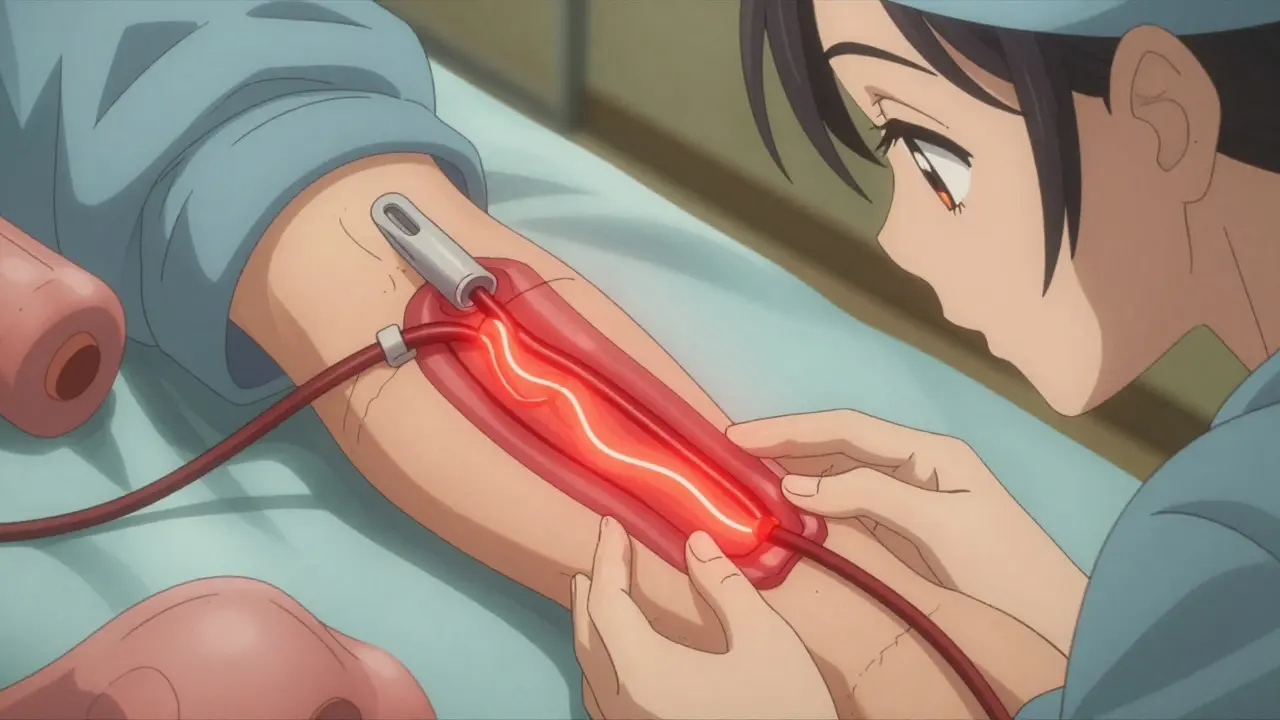
The arteriovenous (AV) fistula is the best option-if your body lets you have it. Surgeons connect an artery directly to a vein, usually in your non-dominant arm. The artery’s high-pressure blood rushes into the vein, making it bigger, stronger, and thicker over time. This process, called maturation, takes 6 to 8 weeks. During that time, you can’t use it for dialysis. That’s the trade-off: wait now, or suffer later.
Once matured, your fistula becomes your body’s natural access. Nurses stick needles into it like it’s just another vein. You feel a vibration-called a “thrill”-when blood flows through it. That’s your signal it’s working. No dressings. No cleaning. Just check for the thrill every day. If it’s gone, call your clinic. That’s often the first sign of a clot.
Studies show fistulas have the lowest infection rates, the fewest clots, and the longest lifespan. One patient in Dublin told me, “My fistula’s been going strong for seven years. I’ve only had one hospital trip because of it.” That’s rare with other access types. But here’s the hard truth: 30% to 60% of fistulas never mature. Especially in older patients, diabetics, or those with weak veins. That’s why vein mapping-a simple ultrasound scan-is the first step before surgery. It tells your team: “This vein can handle it,” or “Try another spot.”
AV Graft: The Middle Ground
If your veins aren’t strong enough for a fistula, the next option is an AV graft. Instead of connecting artery to vein directly, a synthetic tube-usually made of PTFE-is placed between them. It’s like building a bridge where nature didn’t. The big plus? Healing time is only 2 to 3 weeks. That’s huge if you need dialysis right away.
But grafts have problems. They clot more often. They get infected more easily. And they don’t last. About 30% to 50% of grafts need some kind of repair within the first year. That could mean a catheter inserted to clear a clot, or a procedure to widen a narrow section. Some patients need three or four of these interventions in a single year. It’s exhausting. And each time, you risk infection.
One man I spoke with had a graft for two years. He had six procedures. “I lost track of how many times I was poked,” he said. “I just wanted it to work. But it kept failing.” Still, grafts are better than catheters. The death risk is 18% lower than catheters and 18% higher than fistulas. For patients who can’t get a fistula, it’s the best alternative.
Catheter Care: Temporary? Maybe. Permanent? Too Often.
Central venous catheters are the last resort. They’re soft tubes inserted into a large vein-usually in your neck or chest-and left in place. They’re used for emergencies, or when no other access is possible. But too many patients stay on them permanently. Why? Because they’re easy to place. No surgery. No waiting. But they’re a ticking time bomb.
Every time you shower, you have to cover it. No swimming. No baths. Even a little moisture can mean infection. You need sterile technique every time you’re accessed for dialysis. Nurses wear gloves, masks, and gowns. You have to clean the caps with alcohol. One slip-up, and you’re in the hospital with sepsis.
And the numbers don’t lie. Catheters cause 2.12 times more fatal infections than fistulas. That’s 28 extra deaths per 100,000 patient-years. In 2023, the CDC reported that catheter-related bloodstream infections were still the leading cause of hospitalization among dialysis patients. And while newer catheters have antimicrobial coatings, they’re not magic. They still fail more often than any other access.
Yet, in the U.S., nearly 20% of dialysis patients still rely on catheters as their main access. In some countries, it’s even higher. The reason? Lack of access to specialists. Delayed referrals. Poor vein mapping. And, yes-racial disparities. Black patients are 30% less likely to get a fistula than white patients, even when their health is similar. That’s not a medical issue. That’s a system failure.
What You Can Do: Care, Check, Advocate
You don’t have to just accept whatever access you’re given. Here’s what you can do:
- Ask for vein mapping before any surgery. It’s non-invasive, painless, and tells your team what’s possible.
- Learn your access type. Know the difference between a thrill (fistula), a bulging tube (graft), and a catheter with caps.
- Check daily. Feel for the thrill. Look for redness, swelling, or pus. If anything feels off, call your clinic.
- Ask about pre-op exercise. Simple arm exercises before fistula surgery can improve maturation rates by up to 20%.
- Push for a fistula if you’re on a catheter. It’s not hopeless. Even if you’ve been on a catheter for months, a fistula can still be placed.
Patients who get proper education before their first dialysis session have 25% fewer complications in their first year. That’s huge. Knowledge is power. And your access is your first line of defense.
What’s Coming Next
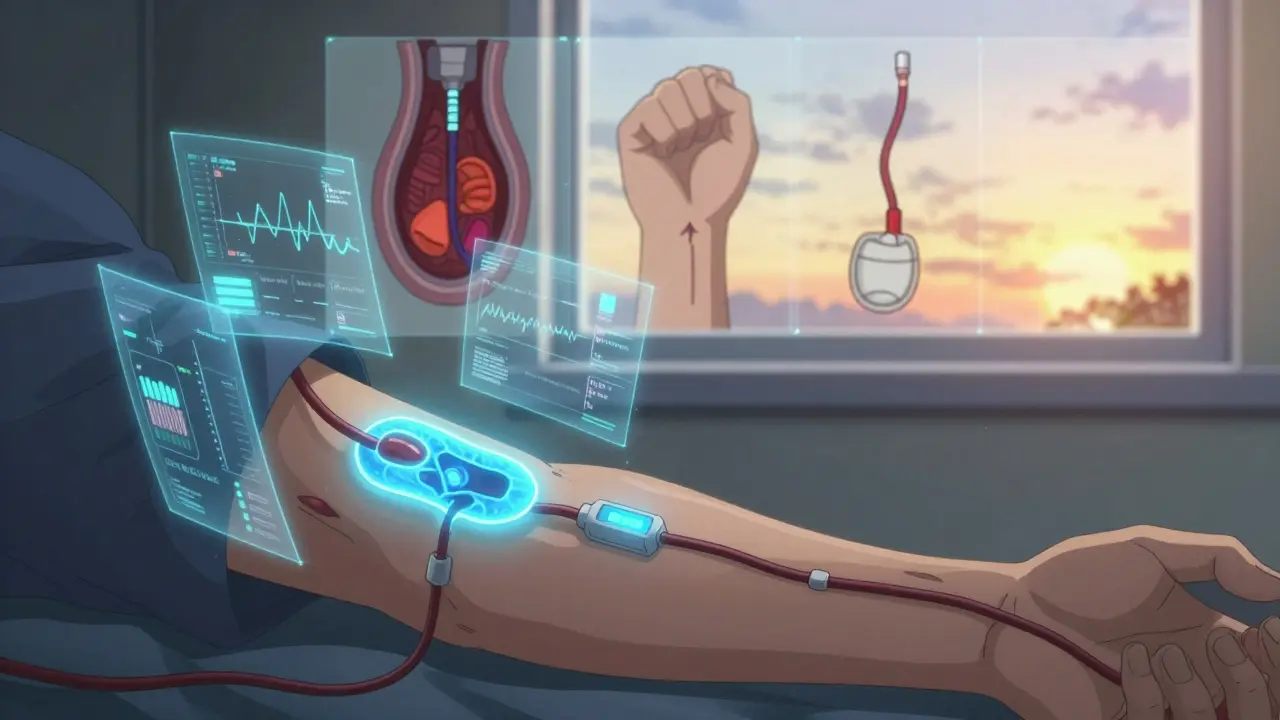
The field is changing. In 2022, the FDA approved the first wireless sensor for fistula monitoring-called Vasc-Alert. It tracks blood flow in real time and sends alerts if a clot is forming. Early results show a 20% drop in emergency clotting events. That’s life-changing.
And there’s new hope in bioengineered vessels. A company called Humacyte is testing a lab-grown blood vessel that can be implanted like a graft-but without the risk of clotting. It’s in phase 3 trials. If it works, it could replace grafts entirely for patients with no veins left.
Experts predict that by 2030, fistulas will make up 65% to 70% of permanent dialysis access. Catheters? Down to 15%. That’s progress. But it won’t happen without you asking questions. Without you demanding better. Without you knowing your options.
Final Thought
Dialysis access isn’t just a medical procedure. It’s a lifestyle. It’s your daily routine. Your safety. Your future. A fistula isn’t glamorous. It doesn’t come with a marketing video. But it’s the quiet hero of dialysis care. It’s the one that lets you live longer, healthier, and with fewer hospital visits. If you can get one, fight for it. If you can’t, know why. And if you’re stuck with a catheter-learn how to protect it like your life depends on it. Because it does.
What is the best type of dialysis access?
The best type is the arteriovenous (AV) fistula. It uses your own blood vessels, has the lowest risk of infection and clotting, and can last for decades. It’s the gold standard recommended by the National Kidney Foundation and the Kidney Disease Outcomes Quality Initiative (KDOQI). While it takes 6-8 weeks to mature, its long-term benefits far outweigh the wait.
Can you shower with a dialysis catheter?
You can shower with a catheter, but only if you protect it with a waterproof cover. Even a small amount of moisture can lead to infection. Bathing, swimming, and soaking in hot tubs are not safe. Many patients find this restriction difficult, which is one reason why catheters are discouraged for long-term use. Always follow your dialysis team’s instructions for cleaning and covering the site.
Why do some people need a graft instead of a fistula?
Some people have veins that are too small, too weak, or too damaged to support a fistula-common in older adults or those with diabetes or high blood pressure. In these cases, a graft (a synthetic tube connecting artery to vein) is used instead. While grafts heal faster (in 2-3 weeks), they’re more prone to clotting and infection than fistulas and typically last only 2-3 years.
How do you know if your fistula is working?
You can check by feeling for a "thrill"-a steady vibration or buzzing sensation-over the fistula site. You can also listen with a stethoscope for a "bruit," a rushing sound like wind. If the thrill or bruit disappears, or if the area becomes swollen, red, or painful, contact your dialysis center immediately. These can be signs of a clot or infection.
Are there new technologies improving dialysis access?
Yes. In 2022, the FDA approved Vasc-Alert, a wireless sensor that monitors blood flow in fistulas and alerts patients and clinicians if a clot is forming. Early trials showed a 20% reduction in emergency clotting. Researchers are also testing bioengineered blood vessels made from human tissue, which may replace synthetic grafts in the future. These innovations aim to reduce complications and extend access lifespan.
For patients who’ve been on dialysis for years, the access you have isn’t just a medical detail-it’s your daily reality. The right access means fewer hospital trips. Less pain. More time with family. More life. Don’t settle for what’s handed to you. Ask. Learn. Advocate. Your body is counting on it.
Aisling Maguire
March 1, 2026 AT 09:42Just had my 7th anniversary with my fistula this week. No infections, no hospital trips, just a little thrill every morning when I check it. Seriously, if you can get one, DO IT. It’s not glamorous but it’s the quietest hero in this whole mess.
Brandon Vasquez
March 2, 2026 AT 16:52My mom’s been on dialysis for 9 years. Fistula since day one. She checks it like clockwork. Never had a clot. Just feels like a normal part of her routine now. Glad this post laid it out so plainly.
Vikas Meshram
March 3, 2026 AT 20:18Actually the data is misleading. The 1.53x mortality risk is confounded by age, comorbidities, and selection bias. Fistula patients are generally healthier to begin with. Catheter users are often the sickest, oldest, or most comorbid. Correlation ≠ causation. Also, the $1.1B figure includes indirect costs like transportation and lost wages. That’s not purely medical.
Byron Duvall
March 4, 2026 AT 07:44Wait a minute. Who funds these studies? Big Pharma? Dialysis corporations? They make bank off catheters. They don’t want you to know fistulas are cheaper and safer. They’d rather keep you hooked on expensive monthly interventions. Ever wonder why vein mapping isn’t standard in every clinic? Coincidence? I think not.
Angel Wolfe
March 5, 2026 AT 09:38They’re lying to us. Catheters are being pushed because the government wants to track dialysis patients through RFID implants. That’s why they say ‘no swimming’-it’s to prevent you from removing the chip. And the ‘thrill’? That’s just the vibration from the nanobot in your vein. They want you dependent. Wake up. Look at the stats again. Why is the death rate so high in Black communities? Because they’re being targeted. This isn’t medicine. It’s control.
Sophia Rafiq
March 6, 2026 AT 15:56My nephrologist said ‘fistula first’ but then told me my cephalic vein was too thin. We did the mapping, confirmed it. Went with graft. Two years, three interventions. Felt like a pin cushion. Still better than catheter. Vasc-Alert sounds like a game-changer. Hope it’s covered by insurance.
Martin Halpin
March 6, 2026 AT 23:38Look, I get it, fistulas are ideal, grafts are okay, catheters are a nightmare. But let’s be real here. Most people don’t get to choose. You think I had the luxury of waiting 8 weeks for a fistula to mature when I was in sepsis and my creatinine was 14? No. I got a catheter because I was dying. And now I’m told I’m ‘low compliance’ because I can’t shower? Meanwhile, my insurance won’t cover the waterproof sleeves, my job doesn’t give me time off for vein mapping, and my primary care doc never even mentioned it until I was on dialysis for 3 months. This isn’t about individual choice. It’s about systemic abandonment. And now you want me to ‘advocate’? Honey, I’m trying to survive. Not write a policy paper.
Eimear Gilroy
March 8, 2026 AT 21:32Does anyone know if the Humacyte bioengineered vessels are being tested in Ireland? My cousin’s in Dublin and they said there’s a trial at St. James’s. Would love to hear from someone who’s in it. Also, how does the Vasc-Alert sensor attach? Is it implanted or external? Asking for a friend… who’s me.
Ajay Krishna
March 9, 2026 AT 19:23Thanks for writing this. My brother in Delhi is on dialysis and they’re using catheters because they say ‘no vein mapping here’. It’s heartbreaking. I’m sharing this with his care team. Maybe if we show them the data, they’ll push for better. Fistula isn’t just a medical term-it’s dignity. And dignity shouldn’t depend on your zip code.