
Estrogen Interactions with Warfarin: What You Need to Know About Drug Effects and INR Changes

Warfarin-Estrogen Interaction Calculator
How Estrogen Affects Your Warfarin Therapy
This tool helps estimate how estrogen may affect your warfarin therapy and INR levels. Based on clinical evidence from the article and published studies.
Estimated Effect
When someone takes warfarin to prevent dangerous blood clots, even small changes in their daily routine can throw off their treatment. One of the most common but often overlooked triggers? Estrogen. Whether it's from birth control pills, hormone replacement therapy, or menopausal treatments, estrogen can quietly alter how warfarin works in the body - sometimes making it less effective, other times increasing bleeding risk. This isn't just theoretical. Real patients have seen their INR jump from 2.4 to 4.3 in just five days after starting estrogen-containing contraceptives. And in another case, an INR dropped sharply when estrogen was added, catching even experienced doctors off guard. These aren't rare outliers. They're everyday clinical challenges that demand attention.
How Estrogen Changes Warfarin's Effect
Warfarin doesn't work the same way in everyone. Its job is to block vitamin K, which the body needs to make clotting factors. But how quickly it's broken down depends on liver enzymes - especially CYP2C9, CYP1A2, and CYP3A4. Estrogen compounds interact with these enzymes in unpredictable ways. Natural estradiol, like the kind your body makes, tends to induce certain enzymes, speeding up warfarin metabolism. That means the drug clears faster, and its effect weakens. Your INR might drop, raising your risk of clotting. Synthetic estrogens, like ethinyl estradiol in birth control pills, do the opposite. They inhibit enzymes, especially CYP1A2 and CYP2C19. This slows warfarin breakdown, letting it build up in the blood. INR rises. Bleeding risk goes up. The same class of drug - estrogen - can have opposite effects depending on its chemical structure. That’s why blanket statements like “estrogen increases bleeding risk” are misleading. It’s not about estrogen alone. It’s about which estrogen, how much, and who is taking it.Who’s at Risk? Real Numbers from Real Patients
The data doesn’t lie. A study of over 15,000 patients on warfarin found that women aged 18 to 45 who used estrogen-containing contraceptives had an 80% higher chance of their INR spiking above 4.0 - a level that doubles the risk of serious bleeding. Another analysis showed that 42% of pharmacists managing anticoagulation therapy had to adjust warfarin doses by 15-25% in the past year because of estrogen interactions. These aren’t edge cases. They’re routine. Consider this: a 28-year-old woman started a new birth control pill while already on 5 mg of warfarin. Her INR went from 2.4 to 4.3 in five days. Her doctor cut her dose to 3.5 mg. Within a week, her INR stabilized. No bleeding. No clot. Just a simple adjustment that prevented disaster. But it’s not always so clear-cut. Some patients report the opposite - their INR drops after starting estrogen. That’s because estrogen can also affect protein binding, vitamin K absorption, or even liver function indirectly. In one Reddit thread, a patient named BloodThinnerWarrior wrote: “My INR actually dropped when I started birth control pills. My hematologist was surprised.” That’s the problem. The effect isn’t consistent. It varies by person, by dose, by genetics.Genetics Play a Bigger Role Than You Think
Not everyone responds the same way to estrogen-warfarin interactions. Why? Genetics. Two key gene variants - CYP2C9*2, CYP2C9*3, and VKORC1 -1639G>A - change how your body handles warfarin. People with these variants clear warfarin 30-50% slower than average. If you have one of these variants and start taking estrogen, the risk of a dangerous INR spike is much higher. A 2017 study showed that patients with these genetic markers needed 30-50% lower warfarin doses just to stay in range. Add estrogen on top of that? You’re playing with fire. That’s why the International Warfarin Pharmacogenetics Consortium developed a dosing algorithm that includes genetic data. When used, it improves dosing accuracy by 30-35%. Yet, only a fraction of clinics routinely test for these genes. Most still rely on trial and error - and that’s risky.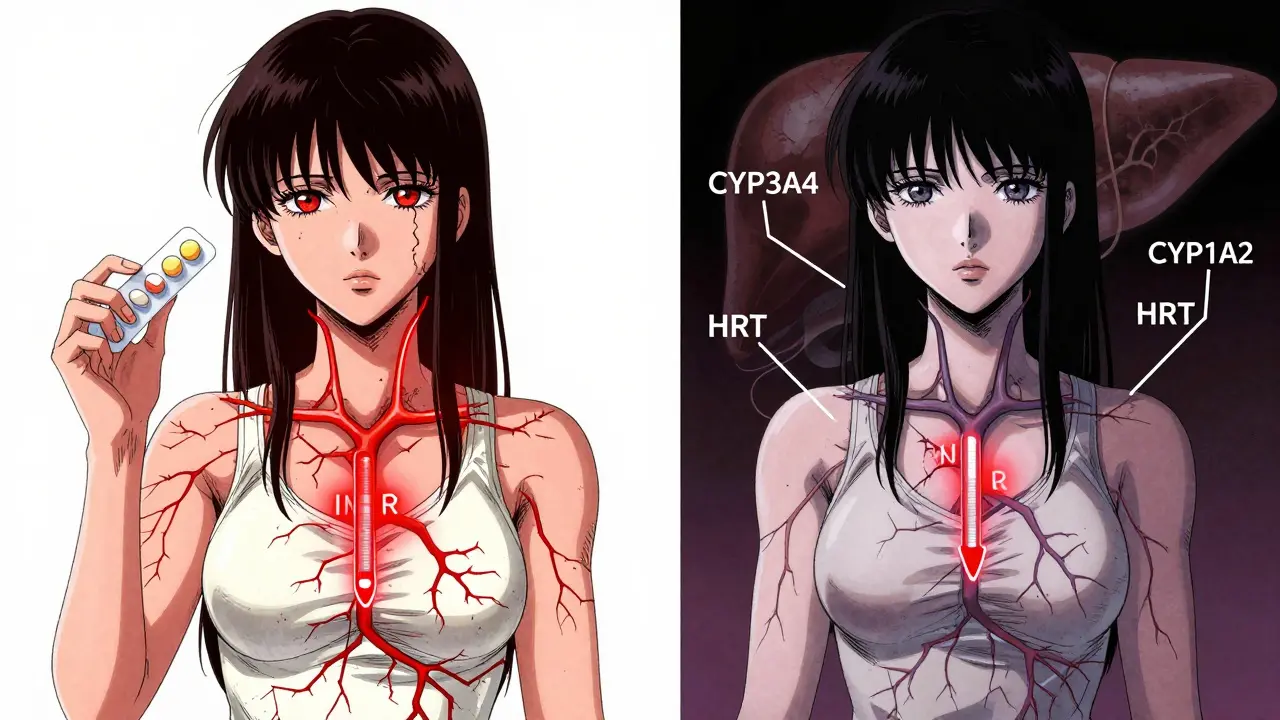
How This Compares to Other Drug Interactions
Estrogen isn’t the only drug that messes with warfarin. Antibiotics like ciprofloxacin and trimethoprim-sulfamethoxazole can boost warfarin levels by 2.5-3 times. Antidepressants like fluoxetine and fluvoxamine double the bleeding risk. Amiodarone? It can force warfarin dose reductions of 30-40%. So why does estrogen get special attention? Because it’s widespread. About 9.7 million U.S. women aged 15-49 use oral contraceptives. Another 1.5 million women over 50 use estrogen for menopause. That’s millions of people taking estrogen while on warfarin. And unlike antibiotics, which are taken for days or weeks, estrogen is often taken for years. That’s long-term exposure. That’s slow, silent risk. The good news? Most estrogen-warfarin interactions cause INR changes of only 0.5-1.5 units. That’s less dramatic than antibiotics, but still dangerous. A 0.5-unit INR rise can mean the difference between a safe 2.8 and a risky 3.3 - especially if you’re already near the upper limit. And because estrogen is taken daily, the effect builds up. It’s not a one-time spike. It’s a persistent shift.What Should You Do? Practical Steps for Patients and Providers
If you’re on warfarin and your doctor suggests starting estrogen - whether for birth control, menopause, or gender-affirming therapy - don’t assume it’s safe. Don’t assume it’s risky. Do this:- Get your INR checked within 3-5 days after starting estrogen.
- Check again at 7-14 days.
- Monitor for signs of bleeding: unusual bruising, nosebleeds, dark stools, headaches, or dizziness.
- If you stop estrogen, check your INR again. The effect can reverse.
- Keep your diet consistent. Vitamin K (in greens, soy, liver) can mask or worsen estrogen effects.
- Tell every new provider you’re on warfarin. Even dentists and ER doctors need to know.

Why DOACs Are Changing the Game
Direct oral anticoagulants (DOACs) like apixaban, rivaroxaban, and dabigatran have exploded in popularity. In 2013, only 15% of anticoagulant prescriptions were for DOACs. By 2022, that number jumped to 68%. Why? Fewer drug interactions. DOACs don’t rely on CYP enzymes the way warfarin does. Estrogen barely touches them. But DOACs aren’t a magic fix. They’re not safe for people with mechanical heart valves. They’re risky in severe kidney disease. They cost more. And they can’t be reversed easily if someone bleeds. That’s why warfarin is still used by over 2.5 million Americans - and will be for years to come. The American College of Cardiology expects 1.8 million warfarin users to still be on it in 2030. So if you’re one of them - or you care for someone who is - understanding estrogen interactions isn’t optional. It’s essential.What’s Next? The Future of Personalized Anticoagulation
The NIH is running a study called WARFARIN-PREDICT (NCT04567812) to build a tool that predicts how estrogen and other drugs will affect a person’s warfarin dose - using their genetics, age, weight, diet, and current meds. It’s not ready yet, but it’s coming. By 2025, we may have apps that alert your pharmacist if you start birth control while on warfarin. Clinics might routinely screen for CYP2C9 variants before even prescribing warfarin. Until then, the rules are simple: Monitor. Adjust. Communicate. Don’t assume. Don’t ignore. And don’t let estrogen slip under the radar.Can estrogen make warfarin less effective?
Yes. Natural estrogen, like estradiol, can speed up how fast your liver breaks down warfarin, lowering its effect. This can cause your INR to drop, increasing your risk of blood clots. This is more common with hormone replacement therapy than with birth control pills.
Do all birth control pills affect warfarin the same way?
No. Birth control pills containing ethinyl estradiol (a synthetic estrogen) are more likely to increase warfarin levels and raise INR, raising bleeding risk. Progestin-only pills have minimal interaction. Always check the estrogen content with your pharmacist or doctor before starting any new pill.
How soon after starting estrogen should I get my INR checked?
Get your INR tested within 3 to 5 days after starting estrogen therapy. A second check at 7 to 14 days is recommended. Changes can happen quickly, and waiting longer puts you at risk of either clotting or bleeding.
Is it safe to take estrogen if I’ve had a blood clot before?
It depends. If you’re on warfarin for a past clot, estrogen can interfere with your treatment. Some doctors avoid estrogen entirely in these cases. Others may allow it with very close monitoring and dose adjustments. Never start estrogen without consulting your anticoagulation specialist.
Why don’t more doctors test for genetic factors before prescribing warfarin?
Genetic testing improves dosing accuracy, but it’s not standard everywhere. Cost, access, and lack of awareness are barriers. Many clinics still rely on trial and error. But if you’ve had unstable INR levels or multiple dose changes, ask your doctor if genetic testing (CYP2C9 and VKORC1) might help.
SNEHA GUPTA
March 17, 2026 AT 01:30It's wild how something as common as birth control can silently mess with life-saving medication. I've seen patients on warfarin for atrial fibrillation get caught off guard after starting HRT - no symptoms, no warning, just a slow drift out of range. It's not just about the chemistry; it's about how we treat estrogen like a harmless add-on instead of a pharmacological wildcard. We need better systems, not just more monitoring.
Doctors still treat this like an edge case. It's not. It's routine. And the fact that we're still relying on trial-and-error dosing in 2025? That's negligence dressed up as tradition.
Gaurav Kumar
March 18, 2026 AT 02:25India has the highest number of warfarin users in the developing world - and zero standardized protocols for estrogen interactions. Meanwhile, the U.S. has AI-driven INR trackers and pharmacogenetic screening. We're still using paper logs while they're automating risk alerts. This isn't medical inequality - it's criminal negligence. If you're on warfarin in India and on birth control? You're playing Russian roulette with your clotting factors.
And yes - I'm angry. Because this isn't theoretical. My cousin almost bled out because her doctor said 'it's fine.' It's not fine. It's deadly.
David Robinson
March 19, 2026 AT 20:08Look. I get it. Estrogen messes with CYP enzymes. But let’s be real - how many people even know what CYP2C9 is? Most patients don’t. Most doctors don’t either. They just see ‘estrogen’ and think ‘birth control = safe.’
Here’s the truth: if you’re on warfarin and you start estrogen, you’re gambling. Not because it’s complicated - because we’ve made it complicated. We should just say: ‘Don’t mix them.’ Period.
And if you need estrogen? Switch to a DOAC. Done. No more guessing. No more INR checks. Just stop pretending this is a nuanced discussion. It’s not.
Jeremy Van Veelen
March 20, 2026 AT 14:52I read this and I just… cried.
Not because I’m emotional - because this is the kind of thing that kills people quietly. No headlines. No media frenzy. Just a woman in her 30s, on birth control, on warfarin after a DVT - and then… a nosebleed. Then a headache. Then a trip to the ER. Then a CT scan. Then a diagnosis: intracranial hemorrhage.
Her INR was 5.8. She didn’t know estrogen could do this. Her doctor didn’t know either.
We treat anticoagulation like a science. But we treat patient education like an afterthought. That’s not just negligence - it’s betrayal.
Laura Gabel
March 21, 2026 AT 00:03jerome Reverdy
March 22, 2026 AT 04:34Let’s not villainize estrogen here. The real issue is the fragmentation of care. You’ve got your anticoagulation clinic, your OB/GYN, your endocrinologist - and none of them talk to each other. The system isn’t broken - it’s just disconnected.
What if, when you fill a warfarin script, the pharmacy flags any new estrogen prescription? What if your EHR auto-alerts your hematologist when you get a new birth control refill? We have the tech. We just don’t use it.
Also - yes, genetics matter. But before we go full genomic, let’s at least get baseline INR checks built into every estrogen prescription. That’s low-hanging fruit. And it’s literally life-saving.
Stephen Habegger
March 22, 2026 AT 09:56Justin Archuletta
March 23, 2026 AT 06:34