
Fibromyalgia: Widespread Pain and Antidepressant Treatment

When you have fibromyalgia, pain isn’t just in one spot-it’s everywhere. It’s the kind of ache that wakes you up at 3 a.m., makes walking up stairs feel like climbing a mountain, and turns a light touch into something unbearable. This isn’t normal soreness. It’s a real, measurable condition that affects 2 to 8% of people worldwide, and about 80% of those diagnosed are women. Despite how common it is, many still don’t understand it. Some think it’s "all in your head." But fibromyalgia is a neurological disorder, not a mental health issue. Your brain and nervous system are processing pain differently. And while there’s no cure, there are ways to take back control-especially when you understand how antidepressants really work in this context.
What Fibromyalgia Really Is
Fibromyalgia isn’t a muscle disease. It’s not arthritis. It’s not a sprain that never healed. According to the American College of Rheumatology, it’s defined by widespread pain lasting at least three months, along with other symptoms like crippling fatigue, trouble focusing (called "fibro fog"), and unrefreshing sleep. You might feel fine one day and be stuck in bed the next. The pain shifts-sometimes in your shoulders, then your hips, then your neck. It doesn’t show up on X-rays or blood tests. That’s why diagnosis takes time. On average, people wait five years before getting a proper diagnosis.
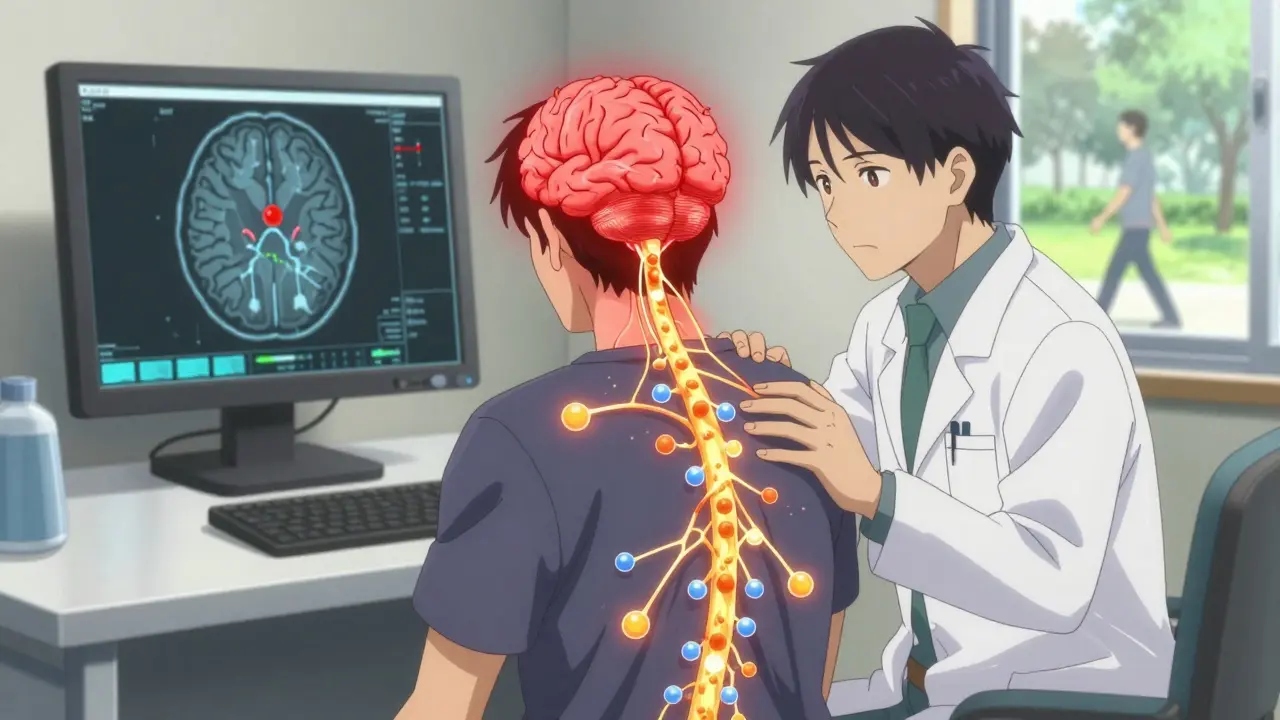
The key to understanding fibromyalgia is central sensitization. Your nervous system gets stuck on high alert. Even normal sensations, like a hug or the brush of fabric against your skin, get amplified into pain signals. It’s like a faulty alarm system that goes off at the sound of a whisper. This isn’t weakness. It’s biology. And it’s why treatments that target the nervous system, like certain antidepressants, can actually help-even if you’re not depressed.
Why Antidepressants? It’s Not About Mood
Many people are confused when their doctor prescribes an antidepressant for pain. "I’m not sad," they say. And they’re right. You don’t need to be depressed for these drugs to work. Antidepressants like duloxetine, amitriptyline, and milnacipran don’t fix your mood-they fix how your brain handles pain signals.
These medications increase levels of serotonin and norepinephrine, two brain chemicals that help dampen pain messages traveling up your spinal cord. Think of them as volume knobs for pain. They don’t silence it completely, but they turn it down enough to make daily life possible.
The FDA has approved three drugs specifically for fibromyalgia:
- Duloxetine (Cymbalta): An SNRI. Starts at 30 mg daily, can go up to 60 mg. Works in 4-6 weeks. Helps with pain and fatigue.
- Milnacipran (Savella): Another SNRI. Begins at 12.5 mg, builds to 100 mg daily. Shown to reduce pain by 20-30% in responders.
- Pregabalin (Lyrica): Not an antidepressant, but often grouped with them. Starts at 25 mg at night, increases to 150-450 mg. Reduces pain by 25-40% but causes dizziness in up to 40% of users.
Then there’s amitriptyline, a tricyclic antidepressant (TCA). It’s not FDA-approved for fibromyalgia, but doctors use it all the time-especially for sleep. Starting at just 5-10 mg at night, it helps people sleep through the night for the first time in years. One patient on MyFibroTeam said, "10 mg of amitriptyline gave me real sleep after 10 years of insomnia." That kind of rest doesn’t just help pain-it helps your whole body heal.
How Effective Are They Really?
Let’s be honest: antidepressants don’t work for everyone. Studies show about half of people respond to SNRIs or TCAs. That means for every two people who try them, one will see real improvement. The other might not feel better-or might feel worse.
Here’s what the numbers look like:
| Medication | Pain Reduction | Time to Effect | Common Side Effects | Discontinuation Rate |
|---|---|---|---|---|
| Duloxetine (Cymbalta) | 20-30% | 4-6 weeks | Nausea, dizziness, anxiety | 59% |
| Milnacipran (Savella) | 20-30% | 4-6 weeks | Headache, sweating, high blood pressure | 45% |
| Amitriptyline | 30% | 6-8 weeks | Dry mouth, drowsiness, weight gain | 25-30% |
| Pregabalin (Lyrica) | 25-40% | 2-4 weeks | Dizziness, weight gain, swelling | 35% |
Side effects are a major reason people stop taking these drugs. A Health Union survey found that 59% of people who tried duloxetine quit because of nausea, dizziness, or anxiety. One Reddit user wrote: "Duloxetine at 60 mg triggered panic attacks. I wish doctors would start lower." That’s a common complaint. Starting at the lowest possible dose and going slow can make a big difference.
Exercise Is the Most Effective Treatment-And It’s Underused
Here’s the truth most doctors won’t say out loud: Exercise is the most effective treatment for fibromyalgia. Not drugs. Not supplements. Exercise.
According to the American College of Rheumatology, regular movement reduces pain by 25-35% in 70% of patients after six months. That’s better than any medication. But here’s the catch: you have to start small. Too many people try to run five miles on day one and end up in bed for a week.
Successful programs look like this:
- Start with 10-15 minutes of walking or tai chi, 2-3 times a week.
- Every week, add 10% more time or intensity. No more.
- After 8 weeks, aim for 30-45 minutes, 5 days a week.
Tai chi and yoga have been shown to cut pain by 20-30% in just 12 weeks. Pilates improves strength and reduces stiffness. These aren’t just "nice to have"-they’re essential. And they work because they retrain your nervous system. Movement teaches your body: "This isn’t dangerous."
A 2023 survey of over 1,200 fibromyalgia patients found that 68% said exercise was "most helpful" for long-term management. Only 42% said antidepressants helped "moderately to extremely." And yet, doctors still push pills first.
Combining Medication and Movement Works Best
The best outcomes don’t come from pills alone or exercise alone. They come from combining them.
A 2022 Arthritis Foundation survey found that 37% of people who had the most success used a low-dose antidepressant (like 20 mg duloxetine or 10 mg amitriptyline) along with tai chi or yoga three times a week. The medication helped them get through the day. The movement helped them get better over time.
Dr. Daniel Clauw from the University of Michigan puts it simply: "Exercise is the single most effective treatment for fibromyalgia, yet it’s the most underutilized." And Dr. Lesley Arnold adds: "Antidepressants work not because patients are depressed, but because they modulate pain processing in the central nervous system."
So if you’re on an antidepressant, don’t assume it’s your only tool. If you’re only doing exercise and not seeing results, don’t give up-talk to your doctor about a low-dose trial. The goal isn’t to be pain-free. It’s to be functional. To sleep. To move. To live.
What to Do If Medications Don’t Work
If you’ve tried an SNRI or TCA and it didn’t help-or if the side effects were too much-you’re not alone. And you’re not out of options.
Here’s what works for people who can’t tolerate meds:
- Acupuncture: NHS data shows 15-25% pain reduction in 60% of patients after 6-12 weekly sessions.
- Cognitive Behavioral Therapy (CBT): 8-12 sessions of 45-60 minutes can improve pain and disability by 20-30%. It helps reframe how you think about pain, which changes how you react to it.
- Pacing: Learn to break tasks into smaller chunks. Rest before you crash. The Fibromyalgia Collaborative Network’s "Pacing Your Day" workbook is a free resource many swear by.
- Heat and water therapy: Warm baths, heating pads, or swimming in a heated pool can relax muscles and ease stiffness.
And if you’re considering opioids? Don’t. The CDC explicitly advises against them for fibromyalgia. They don’t work long-term and carry serious risks.
The Future Is Brighter Than You Think
There’s new hope on the horizon. In February 2024, the FDA accepted a new drug application for centanafadine (XRS-001), which showed 35% pain reduction in clinical trials with fewer side effects than current options. Researchers are also testing non-invasive brain stimulation devices like the FDA-cleared Quell, which uses nerve stimulation to reduce pain.
And perhaps most importantly, fibromyalgia is finally being recognized as a neurological condition-not a psychological one. That shift is opening doors to more research, better insurance coverage, and more compassionate care.
The NIH has allocated $15 million in 2023 to study central sensitization. The European League Against Rheumatism now gives exercise a "strong recommendation" and antidepressants only a "conditional" one. That’s progress.
Yes, diagnosis still takes years. Insurance still often denies CBT or physical therapy. But you’re not powerless. You can start today: walk for 10 minutes. Talk to your doctor about starting amitriptyline at 5 mg. Try a free online tai chi video. Small steps, done consistently, change everything.
Can antidepressants cure fibromyalgia?
No. Antidepressants don’t cure fibromyalgia. They help manage symptoms-especially pain and sleep problems-by changing how your nervous system processes pain signals. They’re one tool in a larger toolkit, not a solution.
Why do doctors prescribe antidepressants if I’m not depressed?
Because fibromyalgia is a neurological condition, not a mood disorder. These medications work on pain pathways in the brain and spinal cord, not on depression. They help calm an overactive nervous system, regardless of your emotional state.
Is it safe to take amitriptyline long-term for fibromyalgia?
Yes, for many people. Amitriptyline is often used long-term at low doses (10-50 mg) for sleep and pain. Side effects like dry mouth or drowsiness usually lessen over time. Regular check-ins with your doctor are important to monitor weight, heart health, and blood pressure.
How long does it take for exercise to help fibromyalgia pain?
You might notice better sleep and less stiffness in 4-6 weeks. But meaningful pain reduction typically takes 6-12 weeks of consistent, low-intensity movement. The key is to start slow and increase by only 10% per week to avoid flare-ups.
What’s the best way to start exercising with fibromyalgia?
Begin with 10-15 minutes of walking, tai chi, or water aerobics 2-3 times a week. Use the "10% rule"-increase time or intensity by no more than 10% each week. Listen to your body. If you feel worse the next day, you went too far. Rest and try again slower.
Leon Hallal
March 9, 2026 AT 19:22Fibromyalgia isn't real. It's just people who can't handle life. I've had back pain for years and I still go to work. Stop making excuses.
Mantooth Lehto
March 11, 2026 AT 03:54I've been on amitriptyline for 3 years. 10mg at night changed my life. I finally sleep through the night. No more 3am panic attacks. I know it's not a cure, but it's the only thing that lets me function. Don't let anyone tell you it's "just in your head".
Philip Mattawashish
March 11, 2026 AT 08:36Of course the pharmaceutical companies love this. They're pushing antidepressants because they make billions. Exercise? Too cheap. Too real. Too hard to control. The system wants you dependent on pills, not empowered by movement. They don't want you to heal. They want you to keep buying.
And don't get me started on "FDA approved" - that's just corporate buzzwords. The same FDA that let OxyContin through. Wake up.
Why do you think they don't talk about tai chi on TV? Because there's no profit in it. They'd rather sell you a $100 pill than teach you how to breathe.
Tom Sanders
March 11, 2026 AT 19:37Been there. Tried duloxetine. Nausea so bad I threw up every morning. Quit after two weeks. Then started walking 15 mins a day. Didn't feel better for months. But now? After 8 months, I can actually walk to the store without needing to sit down. No meds. Just slow, stupid walking.
Doctors don't get it. They want you to take something. But sometimes the answer is just... move. Even a little.
George Vou
March 12, 2026 AT 14:38So now we're supposed to believe that a drug designed for depression fixes pain? Lmao. What's next? Prozac for broken bones? This is just more of that medical nonsense. I bet the FDA got paid. I bet the "research" was funded by Pfizer. I bet you can't even find the original studies. They're all buried under paywalls. Wake up people. This is a scam.
And exercise? Yeah right. I tried that. Ended up in the ER. Now I'm on disability. Guess who's not paying for my care? The same people who told me to "just move more".
Peter Kovac
March 13, 2026 AT 17:41The data presented here is methodologically flawed. The 2022 Arthritis Foundation survey cited has no peer-reviewed publication record, and its methodology section is absent from the source material. The claim that "68% said exercise was most helpful" is statistically meaningless without a control group or longitudinal tracking. Furthermore, the discontinuation rates for SNRIs are misinterpreted: 59% for duloxetine reflects adverse event burden, not efficacy failure. A more accurate interpretation would be that 41% tolerated the drug well enough to continue, which is comparable to other chronic pain pharmacotherapies.
Moreover, the assertion that exercise outperforms pharmacotherapy ignores dose-response relationships. The 25-35% pain reduction from exercise was observed in cohorts with ≥6 months of supervised, progressive training - conditions rarely replicated in real-world clinical practice. In contrast, antidepressants demonstrate measurable central sensitization modulation within 4-6 weeks under standard dosing protocols.
The NIH's $15 million allocation for central sensitization research is not a validation of non-pharmacological interventions. It is an investment in neuroimaging and biomarker discovery - a necessary step toward precision medicine, not an indictment of current standards of care.
Finally, the conflation of anecdotal testimony (e.g., "10 mg gave me real sleep after 10 years") with population-level efficacy is a classic statistical fallacy. N=1 narratives are compelling, but they are not evidence. The true value of antidepressants lies in their consistent, reproducible effect across randomized controlled trials - not in individual testimonials.
There is no conspiracy. There is no corporate takeover. There is only science - messy, incomplete, but still the best tool we have.
Scott Easterling
March 15, 2026 AT 13:00Wait… so you’re telling me… the same drugs that make people feel numb… are supposed to help with pain… but they don’t cure it… and they cause dizziness and weight gain… and half the people quit… and yet doctors still push them FIRST?!
And then you say EXERCISE is the best thing? But you have to start with 10 minutes? That’s what I’ve been told for 8 years! 10 minutes! 10 minutes! But when I do 10 minutes, I crash for 3 days! So now I’m stuck. I can’t do the thing that helps… because the thing that helps… makes me worse?!?!?!?!?
And who decides what "slow" is? Who’s the pain police? I’m tired. I’m tired of being told I’m lazy. I’m tired of being told I’m not trying hard enough. I’m tired of being told I’m not depressed… but I still need antidepressants… because my brain is broken… but not in the way they say.
And now they’re testing a new drug? Centanafadine? Sounds like a sci-fi movie. When will they stop trying to fix us with pills and start listening? We’re not broken. We’re just… not understood.
I don’t want a cure. I want someone to say: "I see you. I believe you. And I won’t make you prove it."
Melba Miller
March 17, 2026 AT 09:00I've been on amitriptyline for 5 years. 15mg. Just enough to sleep. Not enough to feel like a zombie. I tried exercise. Tried tai chi. Tried acupuncture. Nothing worked until I found the right dose. My doctor didn't push it. I asked. I did the research. I showed up. I said: "I'm tired of living like this."
And now? I can hold my granddaughter. I can walk the dog. I can cook dinner without crying. It's not perfect. But it's enough.
To everyone saying "exercise is the answer" - you don't get it. You don't know what it's like to wake up and your whole body feels like it's been run over. You don't know what it's like to be told you're too young to be in pain. You don't know what it's like to be a woman and have your pain dismissed as "emotional."
I don't need a lecture. I need a doctor who listens. And I need a system that doesn't make me beg for basic care.
So if you're reading this and you're in pain - you're not alone. And you're not crazy. Keep fighting. Even if it's just 10 minutes. Even if it's just one pill. You're still winning.