
Generic vs Brand Drug Labor Costs: The Hidden Economics of Production

When you pick up a prescription, the price tag often tells a story that has nothing to do with the actual cost of making the pill. You might wonder why a brand-name drug costs $100 while its generic counterpart costs just $5, even though they contain the same active ingredient. The answer lies deep within the pharmaceutical manufacturing, which involves complex economic structures where labor costs differ significantly between generic and brand-name production. While research and development (R&D) gets all the headlines for driving up brand prices, the reality of factory floors reveals a different dynamic. Labor in generic production is leaner, more automated, and heavily optimized for scale, whereas brand-name initial production carries a heavier burden of specialized labor required for novel processes.
The Core Difference: Scale vs. Novelty
To understand the labor cost gap, we first need to look at what each type of manufacturer is actually doing. A brand-name drug is a new molecular entity developed by a company that invested billions in discovery and clinical trials. During the initial production phase, these drugs often require highly specialized equipment and processes that have never been used before. This novelty demands a workforce of high-level engineers, chemists, and quality assurance experts who are constantly tweaking and validating the production line. In contrast, a generic drug is a copy of an existing drug with the same dosage, safety, effectiveness, and intended use. Because the formula is known, the process is standardized. Generic manufacturers don’t need to invent the wheel; they just need to roll it out efficiently.
This fundamental difference creates a stark contrast in labor allocation. For brand-name drugs during their initial launch phases, labor can account for 30-40% of total manufacturing costs. These workers are engaged in complex problem-solving, regulatory documentation for new entities, and setting up unique supply chains. Generic manufacturers, however, benefit from established protocols. Their labor costs typically sit between 15-25% of total manufacturing expenses. They aren’t paying for innovation; they are paying for execution. The BCG’s 2019 benchmark study highlights this efficiency, noting that generic small-molecule manufacturers allocate only about 30% of their Cost of Goods Sold (COGS) to internal manufacturing, compared to higher overheads in biopharma sectors dealing with novel biologics.
The Power of Economies of Scale
If you run a factory that produces one unique item per day, your labor cost per unit is astronomical. If you produce a million identical items, that cost drops dramatically. This is the engine behind generic drug pricing. The BCG study found that generic manufacturers achieve a 27% unit cost reduction every time the volume per manufacturing site doubles. Compare that to the 17% reduction seen in biopharma companies producing complex, low-volume therapies. This isn’t just about buying materials in bulk; it’s about labor productivity.
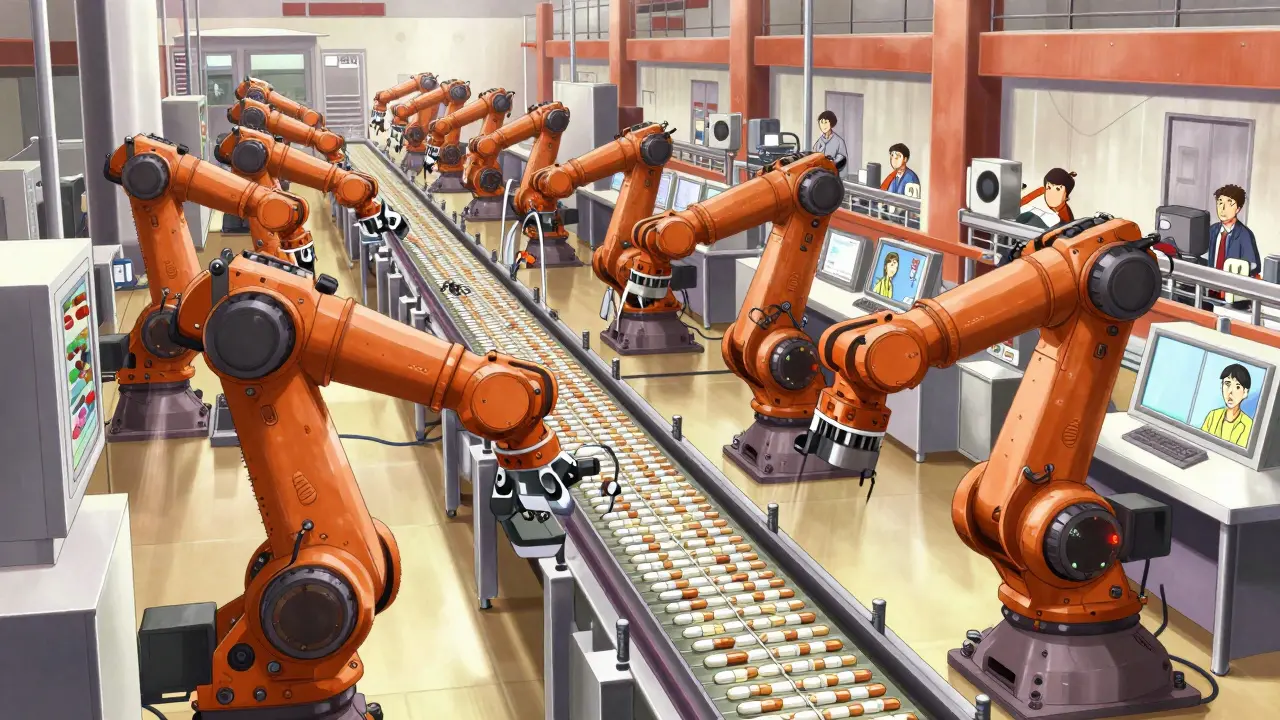
When a generic manufacturer ramps up production, they don’t necessarily hire twice as many people. Instead, they automate. They streamline workflows. They train staff to handle repetitive tasks with extreme precision. The data shows that generics producers see unit costs drop by 45% every time the number of units doubles, compared to 29% for biopharma manufacturers. This means that as demand for a generic drug increases-which it often does, since nine out of ten prescriptions in the U.S. are for generics-the labor cost per pill shrinks rapidly. Brand-name drugs, especially in their early years, lack this volume advantage. They are producing fewer units with more complex oversight, keeping labor costs per unit high.
Quality Control: The Hidden Labor Intensity
You might think that because generic drugs are cheaper, they cut corners on quality. That’s a misconception. In fact, quality control (QC) is one of the most labor-intensive parts of generic production. According to DrugPatentWatch’s 2023 analysis, QC processes alone account for more than 20% of total generic drug production costs. This includes rigorous testing of raw materials, in-process materials, and final products, plus meticulous documentation for batch traceability.
Why is this so labor-heavy? Because regulators like the FDA require generic manufacturers to prove their product is bioequivalent to the brand name. Every batch must be tested, documented, and verified. This creates a significant "Cost of Quality" (COQ). This COQ includes prevention costs (training staff), appraisal costs (inspection and testing), and failure costs (rework or scrap). For a medium-sized generic firm (20-500 employees), maintaining these compliance systems costs approximately $184,000 annually, according to a 2017 FDA analysis. When you add program participation fees and new drug application costs, the financial burden is real. However, because generic manufacturers produce such high volumes, they can spread these fixed labor costs across millions of pills, diluting the impact on the final price. Brand-name manufacturers also face strict QC, but their lower initial volumes mean these labor costs hit harder on a per-unit basis.
Geographic Arbitrage and Global Labor Markets
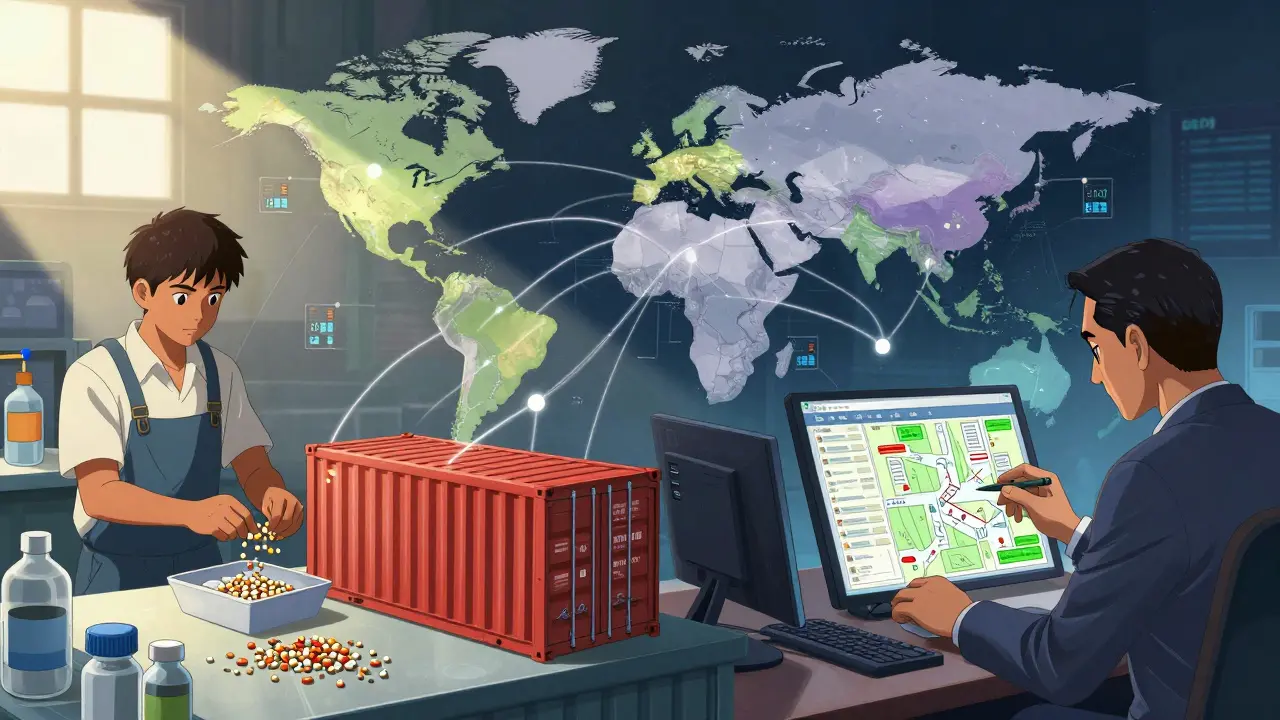
Where a drug is made matters just as much as how it is made. Labor costs are not uniform globally. Prosperous America’s 2023 analysis revealed that Active Pharmaceutical Ingredient (API) production in India and China is approximately 42% cheaper than in U.S. facilities. This geographic arbitrage is a massive factor in keeping generic labor costs low. Many generic manufacturers source their APIs from these regions, leveraging lower wage structures and established industrial clusters.
However, this isn’t always about pure efficiency. The HHS Office of the Assistant Secretary for Planning and Evaluation noted in 2021 that these international cost advantages often reflect "subsidies, lax labor and environmental standards, and scale dominance" rather than superior technology. This creates a structural distortion in the market. For a U.S.-based generic manufacturer, competing with these global labor rates is difficult. As a result, many domestic generic producers shift toward contract manufacturing organizations (CMOs). By outsourcing production, they convert fixed labor costs into variable expenses. This allows them to optimize labor utilization based on demand fluctuations without carrying the overhead of a large permanent workforce. Biosimilar business units, for instance, spend 42% of their COGS on CMOs, compared to 28% for small-molecule units, showing a strategic move away from direct labor employment.
The Pressure Cooker: Pricing and Supply Risks
The race to the bottom in generic pricing puts immense pressure on labor. The FDA’s 2023 report on generic competition confirms that as more competitors enter the market, prices drop significantly. But there’s a catch. The FDA warns that this intense focus on lowering costs may pressure companies to adopt strategies that compromise manufacturing quality. What does that look like in practice? It could mean reducing staffing levels, hiring less experienced personnel, or cutting back on training budgets.
This is a dangerous trade-off. The BCG study notes that manufacturers who invest in prevention-training staff to produce high-quality batches with fewer deviations-actually save money in the long run through reduced rework and faster QC release times. But when margins are razor-thin, short-term cuts to labor are tempting. This dynamic contributes to supply disruptions and shortages, which we’ve seen increasingly in recent years. When a generic manufacturer underinvests in its workforce to keep prices low, the system becomes fragile. A single deviation in production can halt output, leading to shortages that affect patients nationwide.
Comparison: Labor Cost Structures
| Factor | Brand-Name Drugs (Initial Phase) | Generic Drugs |
|---|---|---|
| Labor % of Total Manufacturing Cost | 30-40% | 15-25% |
| Primary Labor Focus | Process validation, R&D support, novel setup | Execution, QC testing, volume optimization |
| Impact of Doubling Volume | 17% unit cost reduction | 27% unit cost reduction |
| Quality Control Burden | High per-unit due to low volume | High absolute, but diluted by high volume |
| Geographic Strategy | Often domestic or high-compliance regions | Frequent use of low-cost API sources (India/China) |
| Outsourcing (CMO) Usage | Moderate | High (up to 42% for biosimilars) |
FAQ: Understanding Generic Drug Economics
Why are generic drugs so much cheaper than brand-name drugs?
Generic drugs are cheaper primarily because they avoid the massive R&D costs associated with creating new molecules, which can exceed $2.6 billion per drug. Additionally, generic manufacturers benefit from economies of scale, lower labor costs due to standardized processes, and often source ingredients from regions with lower production expenses. Competition among multiple generic manufacturers also drives prices down further.
Do generic drugs use less labor to produce?
Yes, relatively speaking. Labor accounts for 15-25% of total manufacturing costs for generics, compared to 30-40% for brand-name drugs during initial production. This is because generic production is highly automated and standardized, requiring fewer specialized engineers and more routine operational staff. However, quality control remains a significant labor component for both types.
Is the lower cost of generic drugs due to lower quality?
No. Generic drugs must meet the same strict FDA standards for safety, purity, and potency as brand-name drugs. The lower cost comes from efficiencies in scale, simplified packaging, and the absence of marketing and R&D expenses. Quality control is actually a major cost driver for generics, accounting for over 20% of production costs, ensuring they are bioequivalent to the original.
How does geographic location affect drug production costs?
Production in countries like India and China can be up to 42% cheaper than in the U.S., largely due to lower labor wages and different regulatory environments. Many generic manufacturers leverage this by sourcing Active Pharmaceutical Ingredients (APIs) from these regions, which significantly reduces their overall cost structure and allows for lower consumer prices.
What risks come with the pressure to lower generic drug prices?
Intense price competition can pressure manufacturers to cut costs in ways that risk supply stability. This might include understaffing, using less experienced personnel, or reducing maintenance on equipment. These shortcuts can lead to production failures, increased rework, and ultimately, drug shortages that affect patient access to essential medications.
Do generic manufacturers outsource more than brand-name companies?
Yes, particularly in certain segments. Generic manufacturers and biosimilar developers increasingly rely on Contract Manufacturing Organizations (CMOs) to convert fixed labor costs into variable expenses. For example, biosimilar units spend 42% of their COGS on CMOs, allowing them to scale labor up or down based on demand without the overhead of a large permanent workforce.