
Hemochromatosis: Understanding Iron Overload and Phlebotomy Treatment
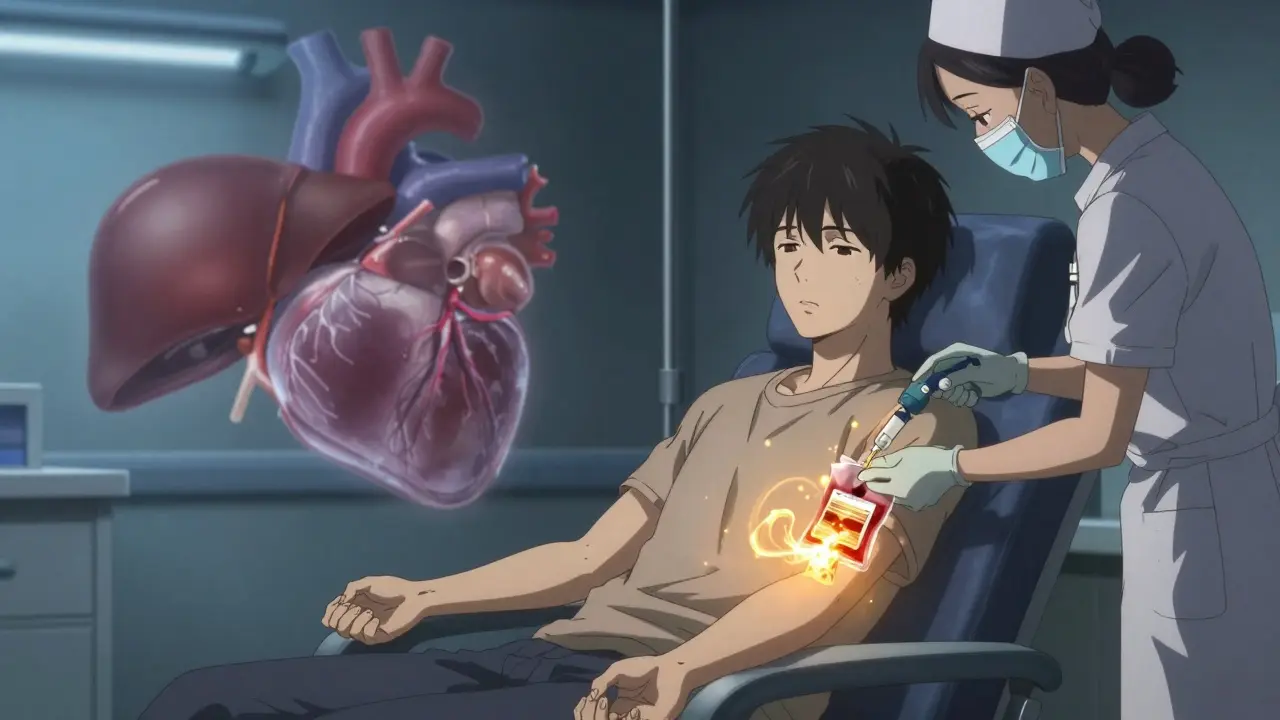
Hemochromatosis isn’t just high iron-it’s a silent, genetic thief that slowly poisons your liver, heart, and pancreas. Most people don’t know they have it until their organs are already damaged. By the time fatigue, joint pain, or darkened skin show up, years of iron buildup have already taken place. The good news? If caught early, this condition is one of the easiest serious diseases to treat. All it takes is a simple, low-cost procedure: removing blood.
What Exactly Is Hemochromatosis?
Hemochromatosis is a genetic disorder where your body absorbs way too much iron from food. Normally, your gut absorbs just enough iron to replace what you lose daily. But in hemochromatosis, that system breaks down. Your body keeps absorbing iron-even when it’s already full. Over time, that extra iron piles up in your liver, heart, pancreas, and joints.
This isn’t something you get from eating too much red meat. It’s inherited. About 90% of cases are caused by two copies of a mutated gene called HFE, specifically the C282Y mutation. If you’re of Northern European descent-Irish, Scottish, Welsh, or Scandinavian-you’re at higher risk. One in 200 people in the U.S. carries two copies of this gene. But not everyone with the gene gets sick. Men are five to ten times more likely to show symptoms than women, mostly because women lose iron through menstruation until menopause.
How Does Iron Overload Damage Your Body?
Iron isn’t the problem-it’s the excess. Your body doesn’t have a natural way to get rid of extra iron. So it stores it in your organs. The liver takes the first hit. Over time, iron builds up in liver cells, triggering inflammation. That leads to fibrosis, then cirrhosis. Once cirrhosis sets in, your risk of liver cancer jumps dramatically.
But it doesn’t stop there. Iron also damages the pancreas, leading to diabetes in about 25% of untreated cases. It messes with your heart rhythm and can cause heart failure. It lowers testosterone, causing loss of libido and erectile dysfunction in men. And it settles in your joints, especially the knuckles of your hands, causing pain that feels like arthritis.
Skin changes are another red flag. About 45% of patients develop a bronze or grayish tint to their skin-not from sun exposure, but from iron deposits in the skin itself. It’s one of the clearest visual signs, but it usually appears late.
How Is It Diagnosed?
Most doctors don’t think of hemochromatosis right away. Fatigue, joint pain, and low sex drive are common complaints. They’re often blamed on stress, aging, or depression. That’s why it takes an average of 5 to 7 years for people to get diagnosed.
The first step is blood tests. Two key numbers matter:
- Transferrin saturation-this tells you how much iron is floating in your blood. Above 45% is suspicious. Above 60% is a strong indicator.
- Serum ferritin-this measures stored iron. In men, over 300 ng/mL is high. In women, over 200 ng/mL. Levels above 1,000 ng/mL mean serious liver damage is likely already happening.
If those numbers are high, the next step is genetic testing for the HFE gene mutations. Finding two C282Y copies confirms the diagnosis in most cases. You don’t need a liver biopsy anymore. MRI scans can now measure liver iron accurately and safely.
Phlebotomy: The Simple Cure
Phlebotomy is the treatment. It’s the same as donating blood-but it’s medical, not voluntary. Every time you give 450-500 mL of blood, you remove about 200-250 mg of iron. That’s how you drain the excess.
The process has two phases:
- Induction phase: You get a phlebotomy once a week until your ferritin drops to 50-100 ng/mL. For someone with ferritin over 2,000 ng/mL, this can take 12 to 18 months and 30 to 60 sessions.
- Maintenance phase: Once your iron is under control, you switch to less frequent sessions-every 2 to 4 months-to keep ferritin in the safe range.
It’s cheap. Most insurance covers it. Many blood banks will do therapeutic phlebotomy for free or a small fee. It’s also safe. You don’t get weak from it. Most people feel better after a few sessions-more energy, less joint pain, better sleep.
What Happens If You Don’t Treat It?
Untreated hemochromatosis is deadly. If your ferritin stays above 1,000 ng/mL for years, you have a 50-75% chance of developing cirrhosis. Once cirrhosis is there, your 10-year survival rate drops to 60%. If you develop liver cancer on top of it, survival plummets further.
Diabetes from iron damage is permanent. Heart damage can lead to sudden arrhythmias. And once your liver is scarred, no amount of phlebotomy can reverse it. That’s why early diagnosis is everything. If you catch it before ferritin hits 1,000, you can prevent almost all long-term damage.
Why Do So Many People Go Undiagnosed?
Because the symptoms are vague. Doctors aren’t trained to think of hemochromatosis unless you’re already very sick. Primary care providers rarely order transferrin saturation tests-even though it’s the earliest and most reliable sign.
Patients report seeing three to five doctors before someone says, “Maybe it’s iron overload.” One Reddit user, after 8 years of pain, found his ferritin was 2,850 ng/mL. He needed 62 phlebotomies. That’s not unusual.
Another barrier? Maintenance. Once symptoms go away, people stop coming in. They think they’re cured. But iron keeps building up. Without regular blood removal, it creeps back. That’s why long-term adherence is critical.
Alternatives to Phlebotomy
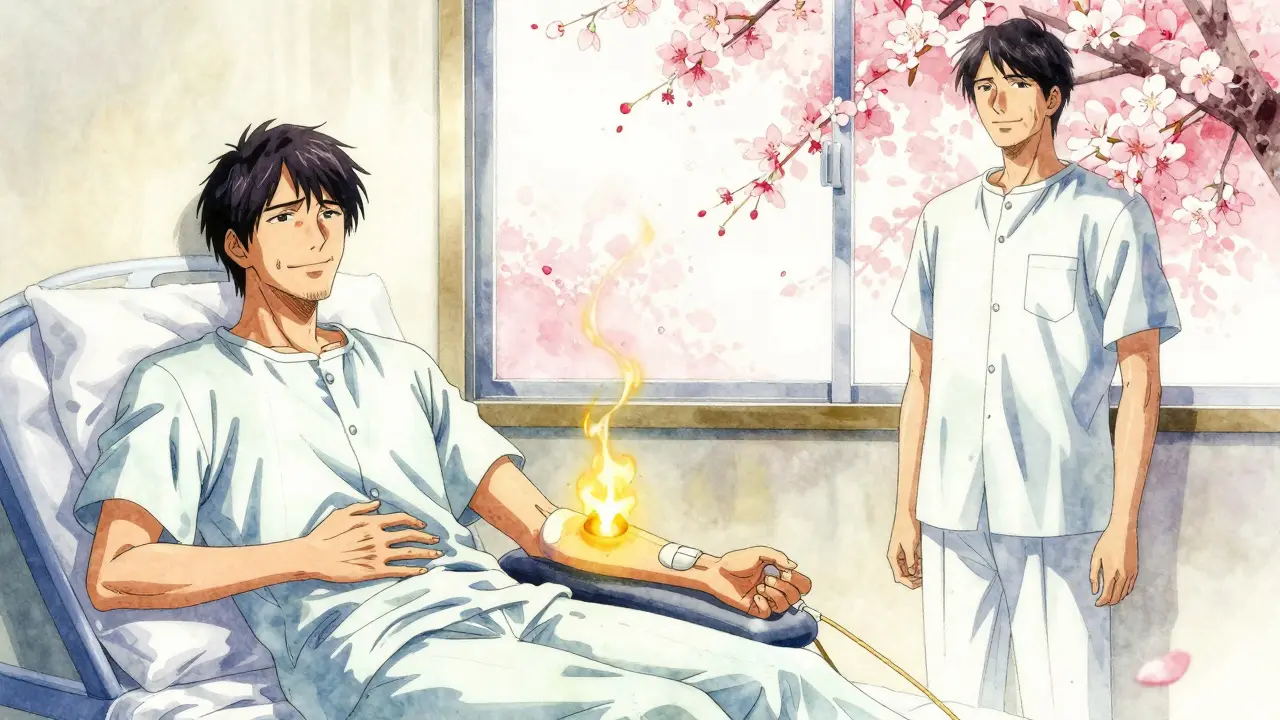
Not everyone can tolerate regular blood draws. Older patients with poor veins, people with anemia, or those with heart failure can’t handle weekly phlebotomies.
For them, iron chelators like deferasirox or deferoxamine are options. These are oral or injected drugs that bind to iron and flush it out through urine or stool. But they’re expensive-$25,000 to $35,000 a year-and come with side effects like nausea, kidney stress, and liver toxicity. They’re also less effective than phlebotomy at removing iron from the liver.
There’s new hope on the horizon. A drug called PTG-300, a hepcidin mimetic, is in clinical trials. It tricks the body into thinking it has enough iron, so it stops absorbing more. Early results show a 53% drop in transferrin saturation in just 12 weeks. But it’s not approved yet. For now, phlebotomy is still the gold standard.
Family Screening Saves Lives
Hemochromatosis is inherited. If you’re diagnosed, your siblings, children, and parents should be tested. About 70% of cases are found through family screening after one person is diagnosed.
Genetic testing now costs $150-$300-down from over $1,000 in the early 2000s. It’s fast, simple, and covered by many insurance plans. Testing first-degree relatives is one of the most cost-effective public health moves in medicine. A single test can prevent decades of suffering and thousands of dollars in future medical bills.
What You Can Do Now
If you have unexplained fatigue, joint pain, or low libido-and you’re of Northern European descent-ask your doctor for two simple blood tests: transferrin saturation and serum ferritin. Don’t wait for symptoms to get worse.
If you’ve been diagnosed, stick with your phlebotomy schedule. Even if you feel fine. Iron doesn’t care how you feel. It’s still building up.
If you’ve had liver disease, diabetes, or heart problems with no clear cause, get tested. You might be one of the 85-90% of iron overload cases that are actually hemochromatosis.
This isn’t a rare disease. It’s one of the most common genetic disorders in the U.S. And it’s one of the easiest to fix-if you catch it early.
Can you get hemochromatosis from eating too much iron?
No. Hemochromatosis is genetic. Even if you eat a lot of red meat or take iron supplements, you won’t develop this condition unless you have the HFE gene mutations. But eating excess iron can make symptoms worse if you already have it.
Is phlebotomy safe for older adults?
Yes, as long as you’re not severely anemic or have unstable heart disease. Many people over 70 undergo regular phlebotomy without issues. If veins are hard to access, a specialist in therapeutic phlebotomy or a hematology clinic can help. The key is to start early before complications arise.
Can women get hemochromatosis?
Absolutely. Women with two copies of the C282Y mutation will develop iron overload, but usually later than men-often after menopause when they stop losing iron monthly. Symptoms in women are often mistaken for menopause-related fatigue or arthritis, leading to delayed diagnosis.
Does alcohol make hemochromatosis worse?
Yes. Alcohol increases iron absorption and damages the liver. If you have hemochromatosis, drinking alcohol significantly raises your risk of cirrhosis and liver cancer. Doctors recommend complete abstinence.
Can you donate blood if you have hemochromatosis?
In the U.S., most blood banks don’t accept therapeutic phlebotomy donations, even though the blood is healthy. But some states allow it under special programs. Check with your local Red Cross or hospital hematology department. Many clinics offer free or low-cost therapeutic phlebotomy specifically for hemochromatosis patients.
What’s the life expectancy with hemochromatosis?
If treated before liver damage occurs, life expectancy is normal. Studies show 95% of patients diagnosed early live as long as people without the condition. If cirrhosis is already present, survival drops to about 60% over 10 years. Early detection is the only thing that changes the outcome.
RAJAT KD
January 10, 2026 AT 05:26Just got my ferritin checked after years of fatigue-2,800 ng/mL. Turns out I’ve had this since birth. Phlebotomy every week for 14 months. Now I sleep like a baby. Why isn’t this routine screening?
Jerian Lewis
January 11, 2026 AT 12:12People who ignore this are just being reckless. You think it’s ‘just fatigue’? No. It’s your liver turning to slag. If you’re of European descent and lazy about health, you deserve what you get. Get tested. Or don’t. But don’t act surprised when you’re on a transplant list.
tali murah
January 12, 2026 AT 04:55Oh wow. Another ‘miracle cure’ post. Let me guess-next you’ll tell us vitamin D cures cancer and yoga fixes diabetes. Phlebotomy? That’s just glorified blood donation. And yet somehow, Big Pharma doesn’t want you to know about it? Right. Because it’s free. And that’s the real conspiracy: medicine can’t monetize simple solutions.
Pooja Kumari
January 12, 2026 AT 08:44I’m from India and I’ve never heard of this until now, but wow. My dad had unexplained liver issues for years-they called it ‘idiopathic cirrhosis.’ He passed at 58. I just got my genes tested yesterday. Two C282Y copies. I’m 32. I’m terrified. But also… relieved? Like, finally, an answer. I’m scheduling my first phlebotomy tomorrow. I don’t care if it’s weekly-I’ll do it. I don’t want to be another statistic. My mom’s getting tested too. And my brother. And my cousin. This isn’t just mine-it’s ours. And if one of us gets caught early, maybe we all survive. I’m crying while typing this. I didn’t know it could be this simple. Just… take blood. That’s it. No pills. No surgery. Just… blood.
Aron Veldhuizen
January 13, 2026 AT 09:25Let’s be honest: the entire narrative here is built on a false premise. Hemochromatosis isn’t ‘easily treatable’-it’s easily *managed*. And only if you’re lucky enough to live in a country with access to free healthcare, insurance, and competent physicians. In rural America? Good luck finding a clinic that does therapeutic phlebotomy. In India? Forget it. The ‘simple cure’ only works if you’re privileged enough to be diagnosed before your organs fail. This isn’t medicine-it’s a luxury. And the fact that you’re framing it as a victory is tone-deaf.
Ian Long
January 14, 2026 AT 09:31I’ve been doing phlebotomy for 6 years. I started at ferritin 3,100. Now I’m at 85. I feel 20 years younger. But honestly? The hardest part isn’t the blood draws-it’s the guilt. My sister has the gene too. She won’t get tested. Says she’s ‘too busy.’ I get it. Life gets in the way. But if you’re reading this and you’re of Northern European descent and have unexplained fatigue? Do it. For yourself. For your kids. For your mom who might’ve died too early. It’s not selfish to save your own life.
Jacob Paterson
January 15, 2026 AT 18:55Anyone else notice how this post conveniently omits that phlebotomy causes anemia in 12% of long-term patients? Or that iron chelators are being studied because phlebotomy isn’t always safe? Or that 40% of people with C282Y homozygosity never develop symptoms? This isn’t a cure-it’s a precautionary overreaction. You’re scaring people into getting blood drawn like it’s a religious ritual. Chill. Not everyone needs it.
Johanna Baxter
January 17, 2026 AT 16:17I did 52 phlebotomies. I cried the first time. I cried the last time. I didn’t know I was dying until I started feeling alive again. My husband left me because I was ‘always tired.’ My boss thought I was lazy. My doctor said ‘it’s anxiety.’ I almost believed them. Then I found this subreddit. Now I’m 300 pounds lighter (emotionally) and my skin isn’t gray anymore. I’m not a hero. I just didn’t give up. If you’re reading this and you’re scared? I was too. Do it anyway.
Patty Walters
January 19, 2026 AT 10:53Hey, just wanted to say-don’t panic if your ferritin’s high. I had 1,800 and thought I was toast. My doc said ‘start weekly, see how you feel.’ After 10 sessions, I had more energy than I did in my 20s. Also, if you’re nervous about veins? Ask for a phlebotomist who specializes in therapeutic draws. They’re magic. And yeah, it’s weird to sit there and watch your blood go into a bag… but you’re literally saving your life. And it’s free at my local hospital. Seriously, just go. You’ve got nothing to lose but the iron.
Jenci Spradlin
January 20, 2026 AT 03:49My mom had this. She didn’t know till she was 62. Liver transplant at 65. She’s alive now, but barely. If she’d known at 40? She’d be hiking in the Rockies. Don’t wait. Get tested. Even if you feel fine. Iron doesn’t knock. It just… steals.
Phil Kemling
January 20, 2026 AT 15:03What’s fascinating isn’t the treatment-it’s the silence. A genetic condition that kills slowly, silently, and yet remains obscure. Why? Because it doesn’t fit the narrative of modern medicine: expensive, complex, patentable. Hemochromatosis is a mirror. It shows us how medicine rewards complexity over simplicity, profit over prevention. We’ve built systems that ignore the obvious. We diagnose cancer with $10,000 scans but ignore a $15 blood test that could prevent it. We don’t just have a disease here-we have a moral failure. And the cure? It’s sitting in a blood bank. Waiting. For someone brave enough to ask for it.