
How Drug Ads Make People Prefer Brand Names Over Cheaper Generics

Every time you see a TV ad for a new prescription drug, it’s not just selling a pill-it’s shaping what you think about every other pill in that same category. You might not realize it, but those cheerful people hiking in the mountains, laughing with grandchildren, or dancing in the kitchen? They’re not just selling a brand name. They’re making you believe that generic drugs are somehow less effective, less safe, or just not good enough.
The U.S. and New Zealand are the only two countries in the world that let drug companies advertise prescription medicines directly to patients. In 2020, pharmaceutical companies spent over $6.5 billion on these ads. That’s more than ten times what they spent in 1996. And it’s working. Every dollar spent on these ads brings in more than $4 in sales. But here’s the twist: most of the drugs being pushed in these ads aren’t the cheap, generic versions your doctor might actually recommend.
Ads Don’t Just Sell Brands-They Change What Doctors Prescribe
It’s not just patients who are influenced. Doctors are too. In one study, researchers sent actors into doctor’s offices pretending to be patients. Some asked for a specific brand-name drug they’d seen on TV. Others asked for a general treatment. Those who named a branded drug got a prescription 80% of the time-even when the doctor thought it wasn’t the best choice. When patients didn’t name a drug, prescriptions dropped to 30%.
That’s not because doctors are weak. It’s because they’re under pressure. Patients walk in with a script in their head: “I saw this on TV, and I want it.” And if the doctor says no, the patient might just go somewhere else. So even if a generic version is just as effective and costs a quarter of the price, the doctor often writes the brand-name prescription anyway.
The Spillover Effect: How Ads Boost Generics Without Saying Their Name
Here’s something counterintuitive: advertising for brand-name drugs actually increases prescriptions for generics too. Why? Because when patients hear about a drug for high cholesterol or depression, they start asking for treatment in that category-even if they don’t know the name of the specific brand. So if you see an ad for Lipitor, you might walk in and say, “I think I need something for my cholesterol.” Your doctor then prescribes a generic statin like atorvastatin. That’s called the “spillover effect.”
Studies show that for every 10% increase in advertising for a branded drug, prescriptions for the whole drug class go up by about 5%. And about 70% of that increase comes from new patients starting treatment. That sounds good, right? More people getting help. But here’s the catch: those new patients are less likely to stick with their medication. They’re more likely to stop taking it after a few months. That means more money spent, but not necessarily better health.
Why You Don’t Remember the Risks
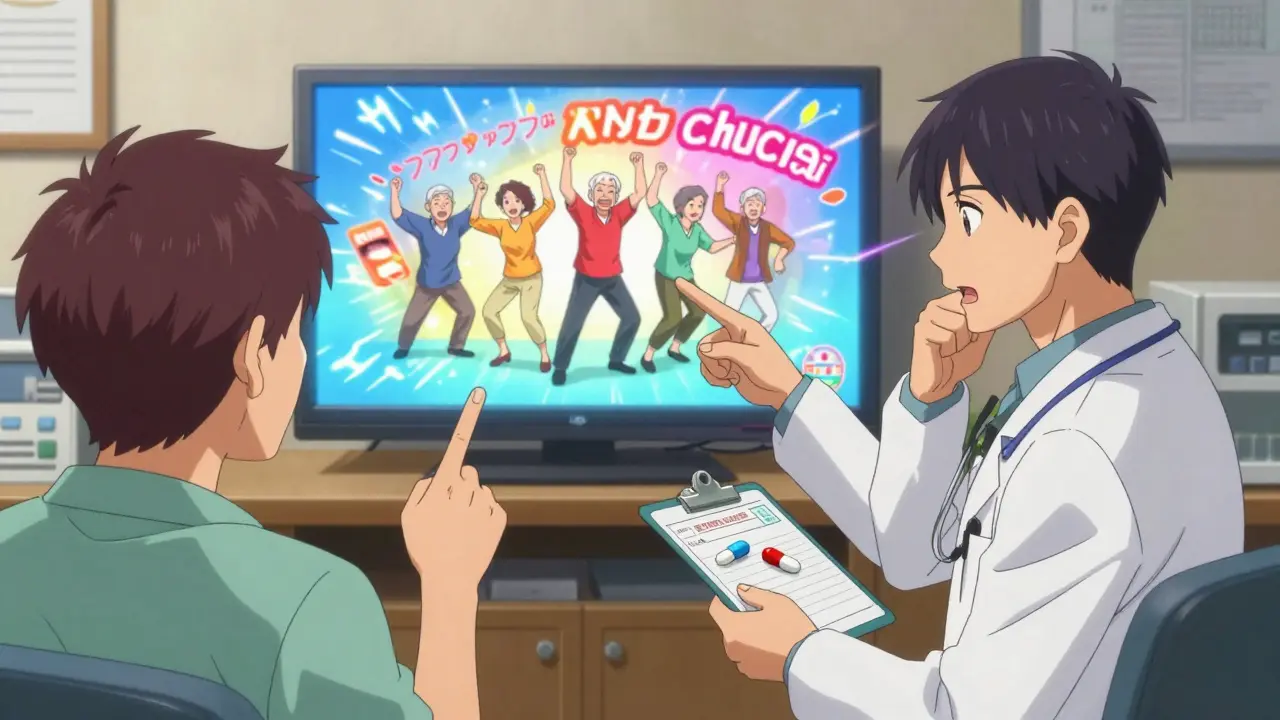
Drug ads are carefully designed. They show people having fun. They use bright colors, upbeat music, and warm lighting. The side effects? They’re buried under a voiceover that’s too fast to really process. The FDA studied this. They found that even after watching an ad four times, most people still couldn’t accurately remember the risks. Benefits stuck in memory better. Risks? They faded.
And here’s the problem: generics don’t get ads like this. So when you hear about a brand-name drug with all the happy visuals, you assume it’s superior. But the active ingredient in a generic drug is identical. The FDA requires it. The only differences are the filler ingredients, the shape of the pill, or the color. Not the effectiveness.
Emotions Over Evidence
One research team analyzed 230 drug ads and found something telling: the average ad showed people enjoying life for 15 seconds. The time spent explaining side effects? Less than 2 seconds. The visuals are meant to trigger emotion-not logic. You don’t walk away thinking, “What’s the risk-benefit ratio?” You walk away thinking, “I want to feel like that person.”
And when you feel that way, you’re less likely to accept a generic. Even if your doctor says it’s the same thing. Even if it saves you $100 a month. The ad made you feel like the brand was better. That feeling doesn’t go away just because the science says otherwise.
Generics Are Just as Safe-But No One Tells You That
Generic drugs go through the same FDA approval process as brand-name drugs. They have to prove they deliver the same amount of active ingredient into your bloodstream at the same rate. They’re tested for purity, stability, and effectiveness. In fact, many generics are made in the same factories as the brand-name versions.
But you’ll never see a commercial saying, “Our generic version of this drug is identical in every way.” Why? Because it doesn’t sell. It doesn’t create desire. It doesn’t make you feel like you’re choosing something special. And that’s the whole point of the marketing.
The Cost Isn’t Just Financial
When people take brand-name drugs because of ads, it doesn’t just cost more money. It strains the whole system. Insurance companies pay more. Taxpayers pay more through Medicare and Medicaid. And when people stop taking their meds because they can’t afford them, their health gets worse. That leads to hospital visits, emergency care, and long-term complications.
One study found that patients who started treatment because of an ad were 20% more likely to quit within six months. That’s not because they didn’t need the drug. It’s because they didn’t understand why they were taking it. They didn’t have a relationship with the medication-they had a relationship with the ad.
What Can You Do?
You can’t stop the ads. But you can stop letting them make your health decisions for you.
- When you see an ad for a drug, ask your doctor: “Is there a generic version?”
- Ask: “Is this the best choice for me-or just the most advertised?”
- Don’t assume brand = better. Generics are the same drug, just cheaper.
- Look up the active ingredient. If you see the same name on the generic label, it’s the same medicine.
- If your doctor says no to a brand-name drug, ask why. Are they basing it on science-or just what they think you want?
The truth is, most of the time, the generic is the smarter choice. It’s not a compromise. It’s the exact same treatment. But you won’t know that unless you ask. And you won’t ask unless you realize the ad was trying to sell you more than a pill-it was trying to sell you a feeling.
Why This Matters Beyond Your Prescription
This isn’t just about cholesterol pills or antidepressants. It’s about how marketing shapes our trust in medicine. When we start believing that the most expensive option is the best, we lose faith in science. We start thinking that if it’s not flashy, it’s not good enough.
And that’s dangerous. Because medicine doesn’t work on advertising budgets. It works on biology. And biology doesn’t care if your pill is blue or white. It only cares if it has the right chemical inside.
The next time you see a drug ad, pause. Ask yourself: Who benefits if I take this? The company? Or me?
James Hilton
December 28, 2025 AT 21:39Mimi Bos
December 29, 2025 AT 21:08Julius Hader
December 31, 2025 AT 19:02Payton Daily
January 1, 2026 AT 04:49Kelsey Youmans
January 2, 2026 AT 01:53Debra Cagwin
January 3, 2026 AT 22:22sonam gupta
January 5, 2026 AT 14:02Ryan Touhill
January 5, 2026 AT 14:05Teresa Marzo Lostalé
January 6, 2026 AT 16:30