
How to Protect Your Privacy When Disposing of Medications
When you throw away an empty pill bottle, you might think you’re just cleaning up. But if you haven’t removed your name, address, prescription number, or diagnosis from the label, you’re leaving behind a treasure trove of personal health data. Someone could use that information to steal your identity, get prescriptions in your name, or even sell your drug history on the black market. The privacy risks aren’t theoretical - they’re happening right now.
Why Prescription Labels Are a Privacy Risk
Prescription bottles aren’t just containers. They’re mini medical records. The label includes your full name, date of birth, pharmacy name, doctor’s name, medication name, dosage, refill dates, and sometimes even the condition you’re being treated for - like depression, HIV, or chronic pain. That’s enough for a thief to impersonate you at a pharmacy or file fraudulent insurance claims. A 2021 study in the Journal of the American Pharmacists Association found that 42% of prescription bottles thrown in the trash still had readable labels. In 2023, the FDA confirmed that over 68% of patients don’t properly remove personal info before tossing bottles. That’s more than two out of three people leaving their health data exposed.What the Law Says About Medication Privacy
Under the Health Insurance Portability and Accountability Act (HIPAA), healthcare providers and pharmacies are required to protect your Protected Health Information (PHI) - even after you’ve used the medication. That includes making sure labels on empty containers can’t be read by anyone else. While the law focuses on institutions, it also sets the standard for what you should do at home. The HHS Office for Civil Rights has called improper disposal of prescription labels one of the top 10 privacy risks in healthcare today. In 2023 alone, 17 healthcare facilities were fined a total of $4.2 million for failing to properly dispose of PHI, including unredacted pill bottles.Best Method: Drug Take-Back Programs
The safest, most private way to dispose of medications is through a drug take-back program. These are run by law enforcement agencies like the DEA and are available year-round at pharmacies, hospitals, and police stations. The DEA’s National Prescription Drug Take Back Day collected over 821,000 pounds of unused medications between 2010 and 2022. The April 2024 event had 6,000 collection sites across all 50 states. When you drop off your meds here, you don’t need to remove the label. The entire container is sealed, destroyed, and incinerated under federal supervision. No one sees your name. No one can trace it back to you. According to a 2024 Pharmacy Times poll, 89% of people who used take-back programs felt “very confident” about their privacy.Mail-Back Kits: A Private Alternative
If there’s no drop-off location nearby, mail-back envelopes are a strong second choice. Companies like Walgreens, CVS, and DisposeRx offer prepaid envelopes that let you send your medications directly to a secure disposal facility. You pay between $2.99 and $6.99 per envelope. The best part? You can keep the label on. The envelope is tamper-proof and sealed before it leaves your house. Once it reaches the facility, everything inside is destroyed - medications and labels alike. The EPA confirms these programs meet federal privacy and environmental standards. They’re especially useful for people in rural areas or those with mobility issues.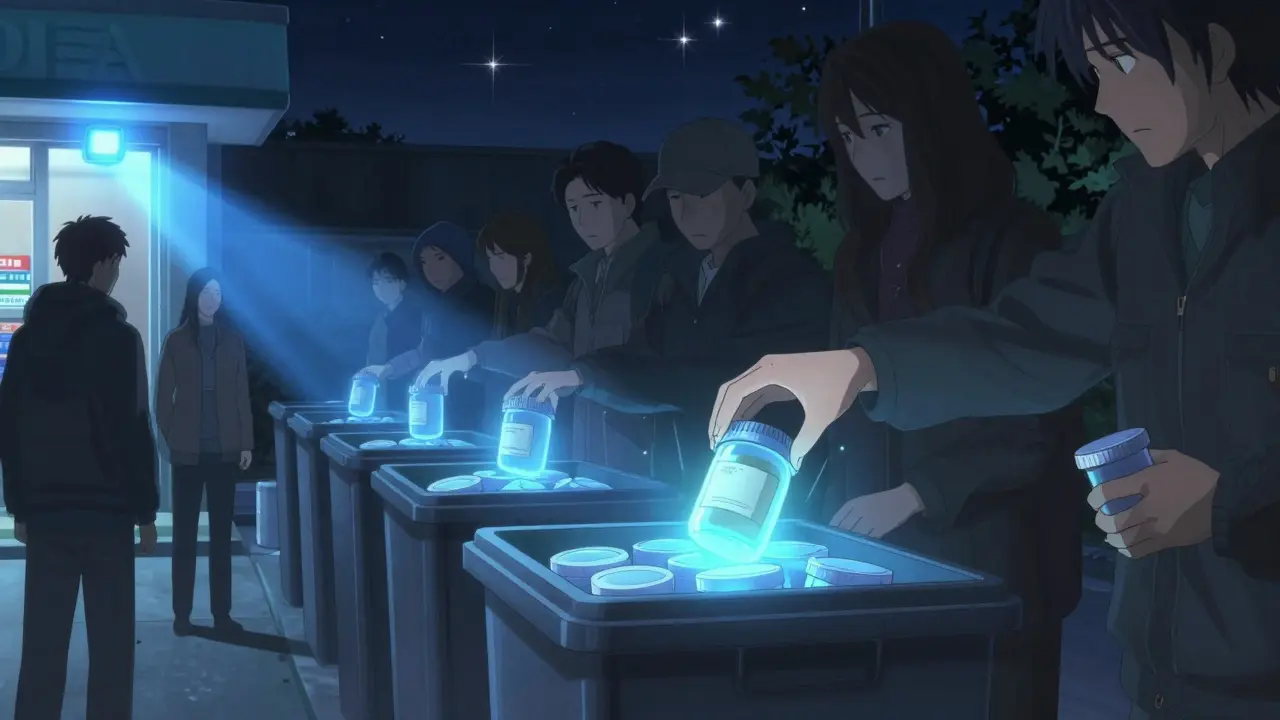
At-Home Disposal: How to Do It Right
If you must dispose of meds at home, follow the FDA’s five-step process - and don’t skip the privacy steps:- Take pills out of the original bottle.
- Mix them with something unappetizing - used coffee grounds, cat litter, or dirt. This makes them unappealing to kids, pets, or scavengers.
- Put the mixture in a sealed container like a jar or plastic bag with a lid.
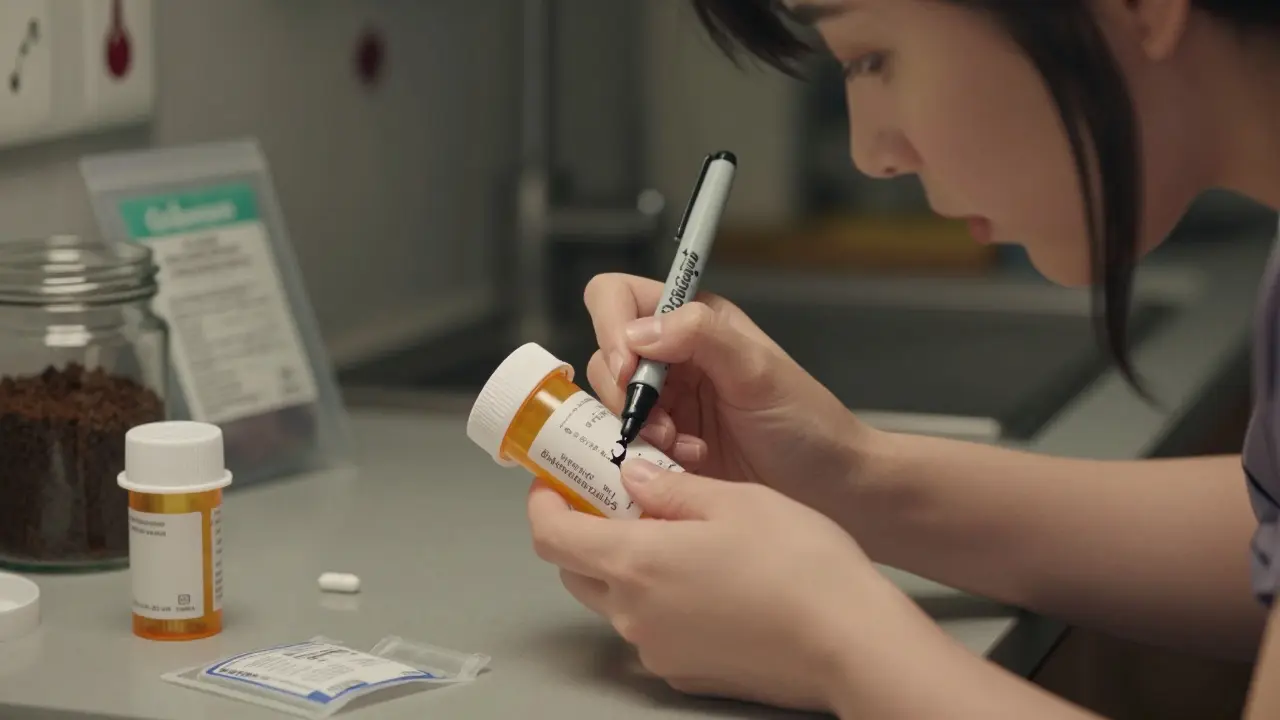
- Remove or destroy the label on the empty bottle. Use a permanent marker to black out every line of text. Or cover it with duct tape. Scratching with a key works too - but only if you get every letter.
- Throw both the mixture and the blanked-out bottle in the trash.
What Not to Do
Never flush medications unless they’re on the FDA’s Flush List. Only 15 drugs - mostly potent opioids like fentanyl patches and certain painkillers - are safe to flush because they’re so dangerous if accidentally ingested. Flushing everything else pollutes waterways. The EPA estimates 3.2 million pounds of pharmaceuticals enter U.S. water systems each year. Also, don’t just toss the bottle with the label still readable. That’s the #1 mistake people make. A Reddit thread from November 2023 showed that 63% of users admit they sometimes forget to scratch off their info. One user on Drugs.com lost $1,200 to insurance fraud after someone used her old oxycodone bottle to get more pills.Tools That Help
You don’t have to do this by hand. Sharpie Industrial markers ($4.99 per pack) are designed to permanently mark plastic and glass. They’re smudge-proof and fade-resistant. For a more automated solution, DisposeRx’s deactivation pouches ($1.50-$3.00 each) neutralize the medication and allow you to throw away the bottle without worrying about the label - because the pills are chemically destroyed inside the pouch. The pouch itself is then sealed and tossed. Many users call it the “one-step solution.” There’s also a free app from DisposeRx that tells you if your medication is on the FDA Flush List. Just scan the label or type in the drug name.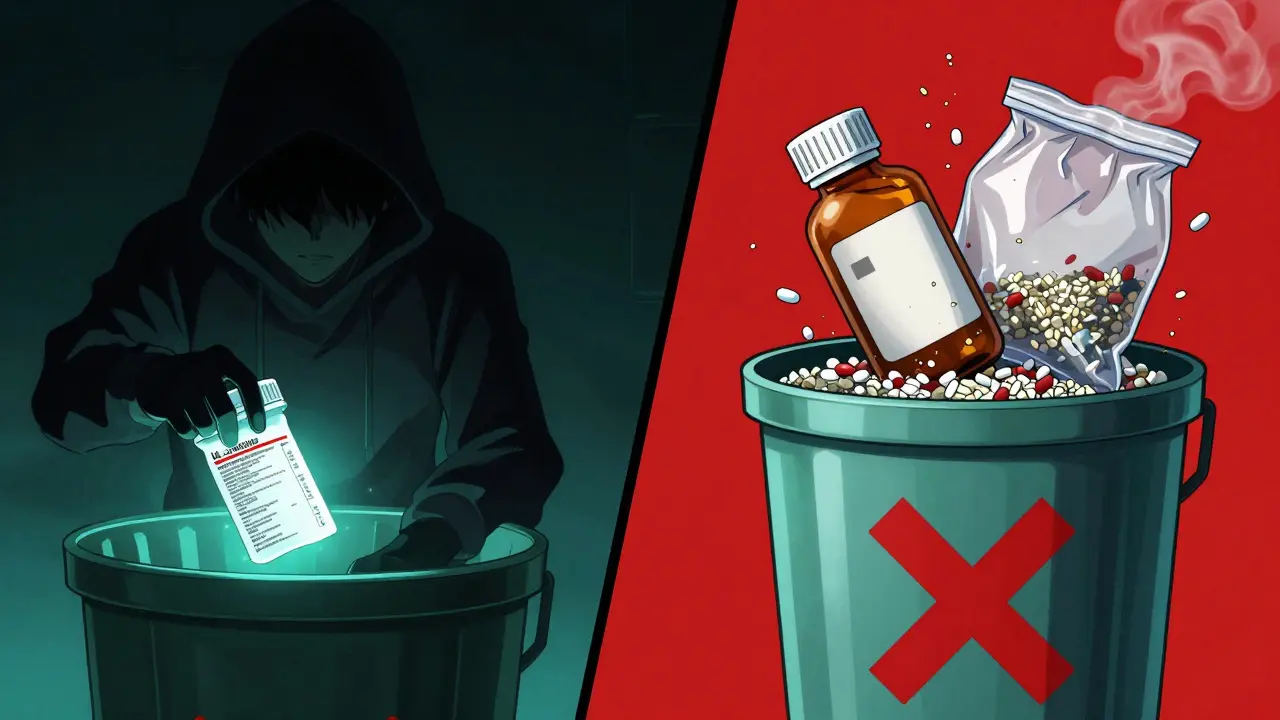
Why Most People Get It Wrong
The problem isn’t lack of awareness - it’s complexity. A Kaiser Family Foundation survey in late 2022 found that 37% of adults over 65 felt confused about how to properly dispose of meds. Removing labels from plastic bottles is hard - 47% of users in a 2023 University of Michigan study couldn’t peel them off cleanly. And many don’t know which drugs require special handling. Only 28% of patients could correctly identify which meds belonged on the FDA Flush List. That’s why education matters. The DEA’s free pamphlets and pharmacy staff training have reduced disposal errors by 65% in clinics that use them.What’s Changing in 2025 and Beyond
The market is catching up. The global pharmaceutical waste management industry is expected to grow to $3.12 billion by 2030, driven in part by privacy concerns. Chain pharmacies now offer take-back programs in 87% of locations - up from 62% in 2019. In 2024, the bipartisan Safe Drug Disposal Act proposed $50 million annually for community programs with mandatory privacy protections. By 2027, experts predict 40% of major pharmacies will install smart kiosks that automatically destroy labels and pills in one step. The next update to HIPAA disposal rules, expected in 2025, will likely include specific technical standards for how to make PHI unreadable - meaning even more clarity for patients.Final Checklist: Your Privacy Action Plan
- ✅ Use a take-back program if one is available.
- ✅ If not, use a mail-back envelope.
- ✅ If doing it at home: remove pills, mix with coffee grounds or cat litter, seal in a container.
- ✅ Destroy every word on the label - don’t just scratch off your name.
- ✅ Never flush unless it’s on the FDA’s Flush List.
- ✅ Keep a list of your medications and disposal dates - helps you track what’s been cleared.
Protecting your privacy when you throw away medicine isn’t optional. It’s a basic step in protecting your identity, your finances, and your health. It takes five minutes. But it could save you from months of fraud, stress, and medical bills. Don’t wait for someone else to fix it. Do it yourself - the right way.
Can I just throw away my pill bottle without removing the label?
No. Leaving the label intact puts your personal health information at risk. Thieves can use your name, address, and prescription details to steal your identity or get controlled substances in your name. Always remove or completely cover the label with permanent marker, duct tape, or by scratching it off before throwing it away.
Are drug take-back programs safe and free?
Yes. DEA-authorized take-back programs are free and secure. They’re run by law enforcement and licensed disposal facilities. Your medications are collected anonymously and destroyed under federal supervision. No one sees your name or prescription details. You can find a nearby drop-off site at dea.gov or through your local pharmacy.
Which medications should I flush down the toilet?
Only medications on the FDA’s Flush List - currently 15 drugs, mostly powerful opioids like fentanyl patches, oxycodone ER, and buprenorphine. These are dangerous if accidentally ingested by children or pets. Flushing prevents harm in emergencies. For all other medications, use take-back, mail-back, or at-home disposal methods instead. Check the FDA’s current list at fda.gov.
Do I need to remove the label from the pill bottle if I’m using a disposal pouch?
No - but only if you’re using a product like DisposeRx. These pouches chemically destroy the medication inside, so the label becomes irrelevant. You can toss the entire pouch with the label still on. But if you’re mixing pills with coffee grounds in a separate container, you must still destroy the label on the original bottle.
Why can’t I just recycle my empty pill bottles?
Most recycling programs don’t accept pill bottles because they’re made of mixed plastics and may still contain residue. Even if they’re empty, the label with your personal info could be read by someone handling the recycling. Always remove and destroy the label before recycling - and even then, check with your local facility. Many recommend tossing them in the trash after de-identifying the label.
How do I know if a medication is on the FDA Flush List?
Check the FDA’s official Flush List at fda.gov/drugs/safer-disposal-of-medicines/flush-list. You can also use the free DisposeRx app - just scan the prescription label or type in the drug name. If you’re unsure, ask your pharmacist. Never flush unless you’re certain the drug is on the list.
Amy Ehinger
January 15, 2026 AT 17:05Just last week I tossed a bottle without thinking and then panicked for an hour. I went back to the trash, dug it out, and used a Sharpie like the post said. Feels weird to be so paranoid, but honestly? Better safe than sorry. I’ve got a little bin under my sink now just for empty bottles until I can get to a take-back drop-off.
Nat Young
January 16, 2026 AT 12:43Let’s be real - this whole privacy thing is overblown. Who’s gonna steal your old oxycodone bottle and use it to commit fraud? You think criminals are out there cross-referencing pharmacy labels like they’re doing forensic accounting? Most of these ‘risks’ are manufactured by companies selling $6 mailer envelopes. The real threat is corporate data mining, not your neighbor digging through your trash.
Jami Reynolds
January 17, 2026 AT 15:52Actually, you’re both wrong. The DEA’s take-back program is a government surveillance tool disguised as privacy protection. Every time you drop off a bottle, they log the location, time, and prescription ID - and it’s all tied to your pharmacy’s database. The FDA Flush List? It’s a smokescreen. They only include opioids because they want to control addiction narratives. Meanwhile, antidepressants and blood pressure meds get tossed in landfills where they leach into groundwater and alter fish behavior. This isn’t about privacy - it’s about control.
Crystel Ann
January 18, 2026 AT 17:37I really appreciate how thorough this post is. I used to just toss bottles until my mom got her identity stolen through a prescription label - it took her 11 months to fix everything. Now I keep a small jar with a Sharpie next to my medicine cabinet. Five minutes once a month saves so much stress. You’re not being paranoid - you’re being smart.
Niki Van den Bossche
January 19, 2026 AT 12:27Ah, the banality of biomedical dispossession. We’ve reduced the sacred ritual of bodily stewardship to a performative act of label obliteration - a neoliberal cipher for agency in an age of algorithmic subjugation. The pill bottle, once a vessel of therapeutic transcendence, is now a carcass of commodified vulnerability, its inked hieroglyphs a testament to the pharmakon’s double-edged sovereignty. To erase the label is not to protect identity - it is to perform the ritual of self-erasure demanded by the biopolitical machine. And yet… we comply. Because to do otherwise is to invite chaos. Or worse - indifference.
Jan Hess
January 20, 2026 AT 17:40Love this guide. I started using the DisposeRx pouches after my sister got hit with insurance fraud. One step and done. No more stressing over markers or duct tape. I even got my dad to use them - he’s 78 and hates doing anything complicated. Now he just drops the pouch in the trash like it’s nothing. Simple wins. We should all be doing this.
Haley Graves
January 22, 2026 AT 16:11For anyone still tossing bottles with labels - stop. Right now. It’s not just about fraud. It’s about dignity. Your health data isn’t trash. It’s yours. If you’re worried about the time, set a reminder on your phone for the first Sunday of every month. Five minutes. One bottle. One less thing someone can use against you. You’ve got this.
RUTH DE OLIVEIRA ALVES
January 23, 2026 AT 18:26It is imperative to acknowledge that the dissemination of Protected Health Information, even in the context of discarded pharmaceutical containers, constitutes a potential violation of the foundational tenets of the Health Insurance Portability and Accountability Act. While the onus for compliance is frequently placed upon the individual, institutional responsibility remains unequivocal. Pharmacies, as custodians of PHI, ought to provide complimentary, pre-labeled, tamper-evident disposal receptacles at point-of-pickup - thereby obviating the necessity for patient-initiated de-identification. The current paradigm, which relies upon consumer diligence, is not merely inefficient - it is ethically indefensible. A systemic solution, not a behavioral one, is required.