
Isoniazid Interactions: Managing Hepatotoxicity and Drug Risks
Isoniazid Risk Estimator
Instructions: Select the options that apply to your situation to see how different factors contribute to liver stress while on Isoniazid.
Risk Assessment
Select factors above to calculate your potential risk profile based on article data.
⚠️ Critical Symptoms
Regardless of score, stop medication and seek help if you experience:
- Persistent nausea/vomiting
- Abdominal pain
- Dark urine / Clay-colored stools
- Jaundice (Yellow skin/eyes)
Starting tuberculosis (TB) treatment often means starting a regimen that includes Isoniazid, also known as INH. This medication has been a cornerstone of TB therapy since the early 1950s. It is highly effective at killing Mycobacterium tuberculosis. However, it comes with a significant warning label: liver damage, or hepatotoxicity, is its most serious risk. You are not just taking a pill; you are introducing a prodrug into your body that requires specific metabolic processing to work safely.
The danger isn't just the drug itself. It is how Isoniazid interacts with your unique genetics and other medications you might be taking. If you are prescribed Isoniazid, understanding these interactions is critical for your safety. This guide breaks down why some people suffer severe liver injury while others do not, how common drugs can turn dangerous when mixed with INH, and what steps you can take to monitor your health effectively.
Why Your Liver Might React to Isoniazid
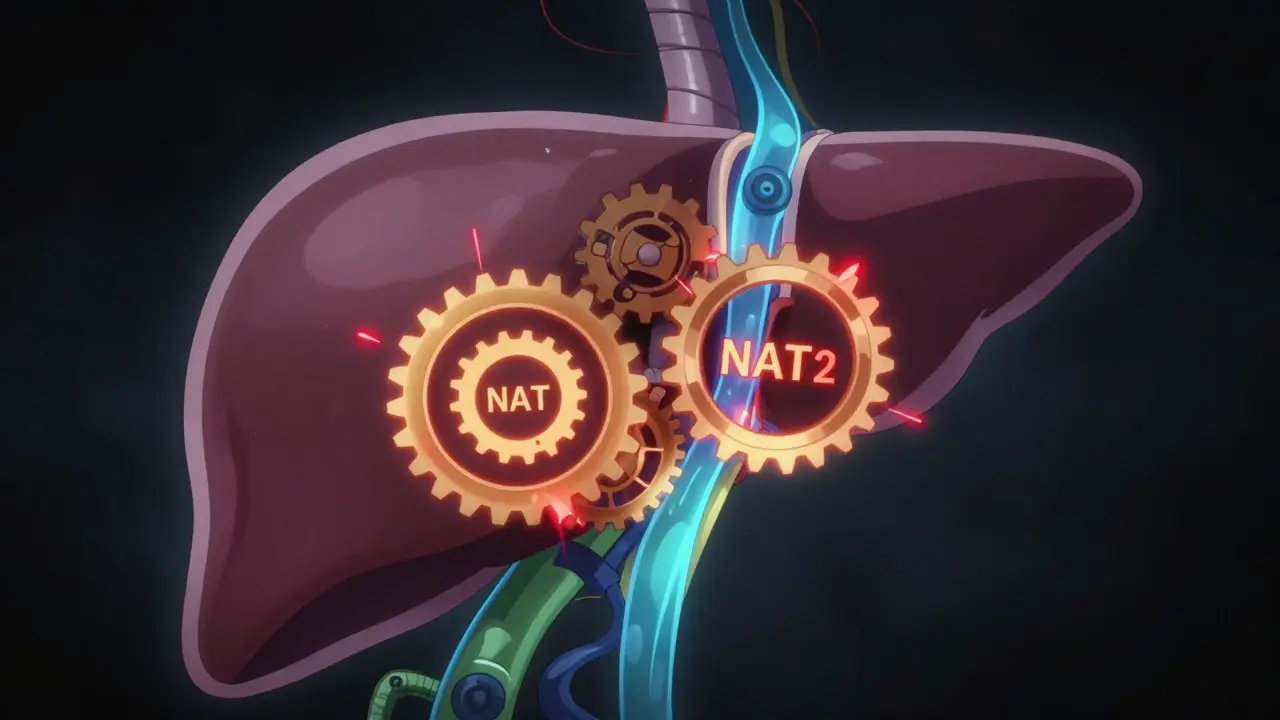
To understand the risk, we have to look at how your body processes Isoniazid. Once you swallow the tablet, your liver enzymes break it down. The key player here is an enzyme called N-acetyltransferase 2 (NAT2). This enzyme converts Isoniazid into inactive metabolites. But here is the catch: NAT2 activity varies wildly from person to person due to genetics.
People fall into two main categories: fast acetylators and slow acetylators. Fast acetylators process the drug quickly, keeping blood levels lower. Slow acetylators process it slowly, leading to higher concentrations of the drug in their blood for longer periods. According to research published in the Journal of Antimicrobial Chemotherapy, slow acetylators make up a large portion of patients who experience hepatotoxicity. In one study of 85 adult TB patients, slow acetylators accounted for 96% of the liver injury cases.
| Phenotype | Prevalence (Europe/North America) | Drug Exposure (AUC) | Hepatotoxicity Risk |
|---|---|---|---|
| Slow Acetylators | 40-70% | High (28.5 mg·h/L) | Significantly Elevated |
| Fast Acetylators | 30-60% | Low (19.8 mg·h/L) | Lower |
If you are a slow acetylator, your liver is exposed to more of the toxic intermediate metabolites, such as hydrazine and acetylhydrazine. These substances cause oxidative stress and mitochondrial dysfunction in liver cells. While mild elevation of liver enzymes occurs in up to 20% of patients, true clinical hepatitis-where you feel sick-is less common but far more serious. Symptoms include nausea, vomiting, abdominal pain, and eventually jaundice (yellowing of the skin and eyes). If you notice dark urine or clay-colored stools, seek medical attention immediately.
The Dangerous Duo: Rifampin and Pyrazinamide
Rarely is Isoniazid used alone. Standard TB treatment usually involves a combination of drugs, most notably Rifampin (RFP) and Pyrazinamide (PZA). This combination is necessary to prevent resistance, but it drastically increases the strain on your liver.
Rifampin acts as an inducer for certain liver enzymes, specifically CYP3A4 and CYP2E1. By activating these enzymes, Rifampin accelerates the conversion of Isoniazid into its toxic metabolites. Essentially, Rifampin speeds up the production of the very compounds that damage your liver. Studies show that the standard two-month intensive phase of TB treatment (using Isoniazid, Rifampin, Pyrazinamide, and Ethambutol) carries a hepatotoxicity risk of 10-20%. Compare this to monotherapy with Isoniazid, which has a risk of only 2-5%.
Pyrazinamide adds another layer of complexity. It is independently hepatotoxic. When combined with Isoniazid and Rifampin, the cumulative effect can overwhelm the liver's ability to repair itself. The American Thoracic Society notes that this triple threat creates a "metabolic hepatocellular idiosyncratic reaction." If you have pre-existing liver conditions, such as chronic hepatitis B or C, or if you consume alcohol regularly, this risk skyrockets. Doctors may adjust your regimen, perhaps extending the duration of safer drugs or using alternative agents like Moxifloxacin, to protect your liver.

Common Medications That Clash with Isoniazid
Beyond TB drugs, Isoniazid interacts with several common medications found in many households. These interactions can lead to toxicity or reduced efficacy of either drug. Here are the most critical ones to watch out for:
- Anticonvulsants (Phenytoin and Carbamazepine): Isoniazid inhibits the cytochrome P450 enzymes (CYP2C and CYP2E) responsible for breaking down these seizure medications. This inhibition can cause phenytoin and carbamazepine levels in your blood to rise by 55-57%. High levels of these drugs can lead to dizziness, confusion, and even life-threatening neurological issues. If you take these meds, your doctor will likely monitor your blood levels closely and adjust the dosage downward.
- Disulfiram: Both Disulfiram and Isoniazid can cause peripheral neuropathy (nerve damage). Taking them together significantly increases this risk. Furthermore, both drugs can affect the liver, compounding the potential for hepatotoxicity. It is generally advised to avoid this combination unless absolutely necessary.
- Metoclopramide: Isoniazid can increase the concentration of metoclopramide in the brain, raising the risk of extrapyramidal symptoms (movement disorders like tremors or rigidity). Dosage adjustments are often required.
- Corticosteroids: Isoniazid can reduce the effectiveness of steroids like prednisone by increasing their metabolism. Conversely, steroids might alter Isoniazid levels. Patients on long-term steroid therapy need careful monitoring of both their underlying condition and their TB treatment response.
Protecting Your Nerves: The Role of Vitamin B6
Liver damage isn't the only side effect. Isoniazid interferes with the activation of Pyridoxine (Vitamin B6). Without enough active B6, your nerves can become damaged, leading to peripheral neuropathy. Symptoms start as tingling or numbness in your hands and feet and can progress to weakness and pain.
This risk is particularly high for slow acetylators, older adults, pregnant women, and people with diabetes or renal failure. To counteract this, doctors routinely prescribe Pyridoxine supplements alongside Isoniazid. The standard dose is 25-50 mg daily. Do not skip this supplement. It is a simple, effective way to prevent long-term nerve damage. If you are already taking B6 for other reasons, let your doctor know to avoid excessive intake, though toxicity from B6 is rare compared to deficiency.

Monitoring and Mitigation Strategies
So, how do you stay safe? Vigilance is key. The Centers for Disease Control and Prevention (CDC) and other health bodies recommend specific monitoring protocols. Before you start treatment, you should have baseline liver function tests (LFTs). This establishes a reference point for your liver enzymes (ALT and AST).
During treatment, you don't necessarily need monthly blood tests if you feel fine, but you must be hyper-aware of your body. Report any of the following to your healthcare provider immediately:
- Persistent nausea or vomiting
- Loss of appetite
- Abdominal pain
- Unusual fatigue
- Dark urine or yellowing of the skin/eyes
If your ALT levels exceed 5 times the upper limit of normal (ULN) with symptoms, or 8 times ULN without symptoms, treatment is typically paused. In most cases, liver function recovers within 4-8 weeks after stopping the drug. Some newer regimens, like the WHO-recommended 4-month rifapentine-moxifloxacin protocol, aim to reduce exposure to Isoniazid, potentially lowering hepatotoxicity risk by 30-40%. Ask your doctor if you are eligible for these shorter, potentially safer alternatives.
Genetic testing for NAT2 polymorphisms is available and mandated by the European Medicines Agency in high-risk populations. While not yet standard everywhere, knowing your acetylator status could allow for personalized dosing. If you are a known slow acetylator, your doctor might opt for a lower dose or a different regimen entirely.
Frequently Asked Questions
Can I drink alcohol while taking Isoniazid?
It is strongly advised to avoid alcohol while on Isoniazid. Alcohol is processed by the same liver enzymes and causes similar types of liver stress. Combining alcohol with Isoniazid significantly increases the risk of hepatotoxicity. Even moderate drinking can tip the balance toward liver injury, especially if you are a slow acetylator or taking other hepatotoxic drugs like Rifampin.
How long does it take for Isoniazid-induced liver damage to heal?
In most cases where treatment is stopped promptly upon detection of elevated liver enzymes, recovery is complete within 4 to 8 weeks. Mild cases may resolve faster. However, severe cases involving acute liver failure require intensive care and can have permanent consequences. Early detection through symptom monitoring is crucial for a full recovery.
What are the signs of peripheral neuropathy from Isoniazid?
Early signs include tingling, burning, or numbness in the fingers and toes. As it progresses, you may experience muscle weakness, difficulty walking, or sharp pains. If you notice these symptoms, contact your doctor immediately. Increasing your Vitamin B6 (Pyridoxine) supplementation may help, but medical evaluation is necessary to rule out other causes.
Is genetic testing for NAT2 status recommended for everyone?
Currently, routine genetic testing for NAT2 status is not standard practice in all countries, though it is encouraged in high-risk populations by agencies like the EMA. It is most useful for patients with a history of liver disease, those of certain ethnic backgrounds with high rates of slow acetylation, or those who have previously reacted poorly to Isoniazid. Discuss the availability and utility of this test with your specialist.
Can I take over-the-counter painkillers with Isoniazid?
Use caution with acetaminophen (paracetamol), as it is also metabolized by the liver and can contribute to hepatotoxicity when combined with Isoniazid. NSAIDs like ibuprofen are generally safer for the liver but can irritate the stomach. Always consult your doctor before adding new medications, including OTC drugs, to your regimen to avoid unexpected interactions.