
Liver Function Tests Explained: ALT, AST, Bilirubin, and What They Really Mean
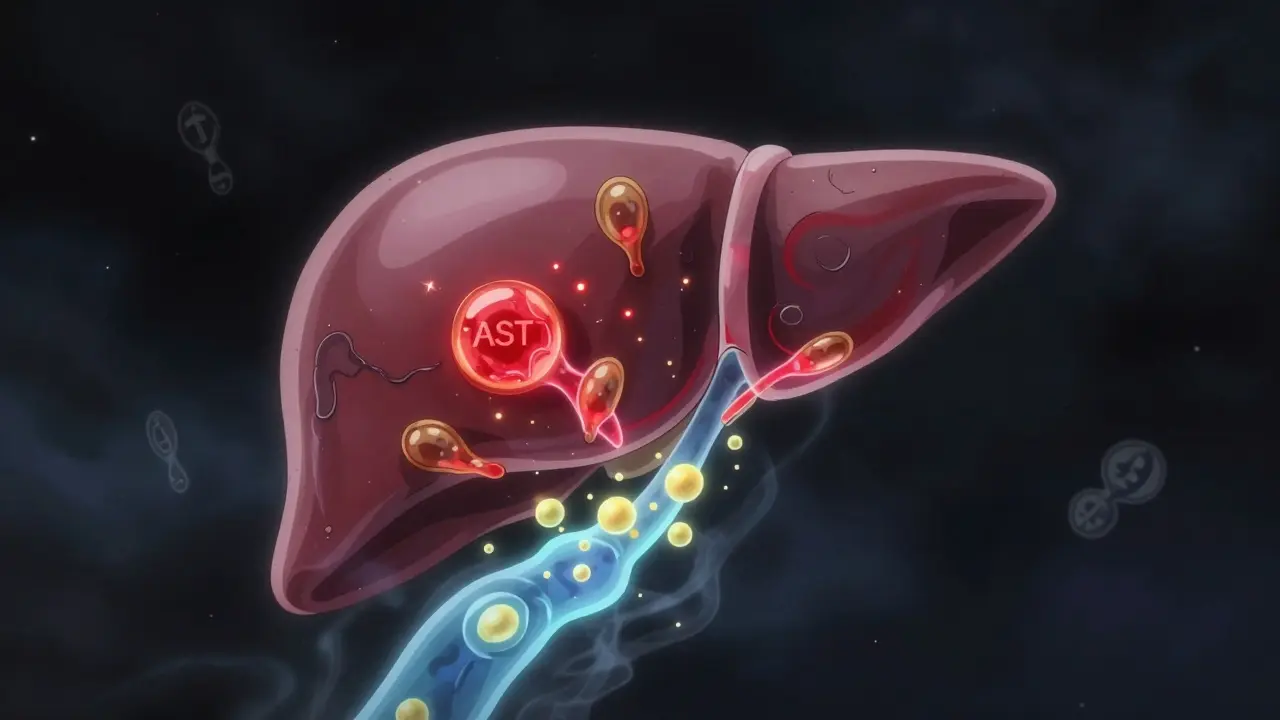
When your doctor orders a liver function test, it’s not because they think you have liver disease. More often, it’s because something small is off-a slight fatigue, a weird blood test result, or maybe you’ve been drinking more than usual. But what do those numbers actually mean? ALT, AST, bilirubin-these aren’t just random lab values. They’re clues. And if you understand them, you can stop worrying about every tiny spike and start knowing what really matters.
What Liver Function Tests Actually Measure
Despite the name, liver function tests don’t measure how well your liver is working. They measure damage. Think of it like checking the oil light in your car. The light doesn’t tell you how well the engine runs-it tells you something’s broken. Same with ALT and AST. These are enzymes found mostly inside liver cells. When those cells get injured, the enzymes leak into your blood. Higher levels mean more damage.
The standard panel includes ALT, AST, alkaline phosphatase (ALP), gamma-glutamyl transferase (GGT), bilirubin, albumin, and prothrombin time. But not all of them are equal. ALT and AST are your early warning signs. Bilirubin tells you about bile flow. Albumin and prothrombin time tell you if your liver is still making the proteins it needs. The real trick? Looking at the pattern-not just one number.
ALT: The Most Liver-Specific Marker
ALT, or alanine aminotransferase, is the most specific to the liver. About 90% of it lives in liver cells. When you see ALT up, it’s almost always liver-related. Normal levels? Around 7 to 55 U/L. But here’s the catch: normal isn’t the same for everyone. Men tend to have higher normal ranges than women. And if you’re overweight-with a BMI over 30-your normal might be 10 to 15% higher than someone lean.
ALT spikes above 1,000 U/L? That’s a red flag. It usually means acute injury: viral hepatitis A or B, acetaminophen overdose, or ischemic liver damage from low blood flow. In acute viral hepatitis, ALT can be 10 times higher than normal. In fatty liver disease (now called MASLD), it’s usually only 1.5 to 2 times higher. And here’s something few doctors mention: ALT has a half-life of 47 hours. That means if your ALT was high last week and dropped by half this week, your liver is healing.
AST: The Less Specific Clue
AST, or aspartate aminotransferase, is trickier. It’s in the liver, yes-but also in your heart, muscles, kidneys, and even red blood cells. So if your AST is high and you’ve been lifting weights or had a heart attack, that could be why. But when AST and ALT are both up, the ratio between them tells a story.
If AST is more than twice as high as ALT, alcohol is likely the culprit. In alcoholic hepatitis, that ratio is usually above 2.0. If they’re about equal, it’s more likely viral hepatitis or fatty liver. If AST is way higher than ALT and you’re not a drinker? Think about muscle damage or even a thyroid issue. AST drops faster than ALT-its half-life is only 18 hours. So if AST normalizes before ALT, your liver is healing.
Bilirubin: The Yellow Clue
Bilirubin is what turns your skin yellow when you have jaundice. It’s a waste product from broken-down red blood cells. Your liver processes it and sends it out in bile. If bilirubin builds up, something’s blocking that flow-or your liver can’t process it anymore.
Total bilirubin normal range? 3 to 17 μmol/L. But the real split is between direct (conjugated) and indirect (unconjugated). High indirect bilirubin? Think hemolysis-your body is breaking down too many red blood cells. High direct bilirubin? That’s cholestasis. Bile isn’t flowing. This often goes with high ALP and GGT. If bilirubin is high but ALT and AST are only slightly up, your problem is likely in the bile ducts-not the liver cells themselves.
Isolated bilirubin elevation without other enzyme changes? That’s Gilbert’s syndrome. Harmless. Common. Affects up to 10% of people. It’s just your liver being slow to process bilirubin, especially when you’re stressed, fasting, or sick. No treatment needed.

ALP and GGT: The Bile Duct Signals
ALP, or alkaline phosphatase, is found in the liver and your bones. If ALP is high and GGT is also high, it’s almost certainly liver-related. But if ALP is high and GGT is normal? Look at your bones. A fracture, Paget’s disease, or even growing children can raise ALP without touching the liver.
GGT is the most sensitive marker for bile duct problems. It rises early in alcohol use, even before ALT. It also goes up with medications, obesity, and metabolic syndrome. In fatty liver disease, GGT is often the only thing elevated. That’s why some doctors now use GGT as a red flag for metabolic health-even more than ALT.
Albumin and Prothrombin Time: The Real Liver Function
Here’s where most people get confused. ALT and AST show damage. But albumin and prothrombin time show if your liver is still doing its job. Albumin is a protein your liver makes. Normal? 3.5 to 5.0 g/dL. If it’s low, your liver has been struggling for months-or years. Because albumin’s half-life is 20 days, it doesn’t drop quickly. A low albumin means chronic liver disease: cirrhosis, long-term alcohol damage, or advanced hepatitis.
Prothrombin time (PT) measures how fast your blood clots. Your liver makes clotting factors. If PT is prolonged, your liver isn’t making enough. This is urgent. It can mean acute liver failure. PT changes fast-within hours. So if your PT spikes while your ALT is normal? That’s a warning sign. Your liver is failing, even if it doesn’t look damaged.
Putting It All Together: The Patterns
Doctors don’t look at one number. They look at the pattern.
- Hepatocellular pattern: ALT and AST way up (especially ALT), ALP and bilirubin normal or only slightly up. This is viral hepatitis, fatty liver, or drug injury.
- Cholestatic pattern: ALP and bilirubin way up, ALT and AST only mildly elevated. This is bile duct blockage, gallstones, or primary biliary cholangitis.
- Mixed pattern: Everything up. This happens in drug-induced injury, autoimmune hepatitis, or severe alcohol damage.
- Isolated GGT: Often fatty liver or early alcohol use.
- Normal enzymes, low albumin, high PT: Advanced cirrhosis. Your liver is failing, even if it doesn’t look inflamed.
One big mistake? Panicking over mild elevations. If ALT is 60 U/L and you’re healthy, it’s probably nothing. Up to 15% of healthy people have ALT slightly above normal. But if ALT is over 500 U/L-or rising fast, like more than 100 U/L per week-you need to act. That’s not normal. That’s an emergency.

What to Do If Your Results Are Off
Don’t Google. Don’t panic. Do this:
- Check your history. Did you take extra Tylenol? Drink more alcohol? Start a new medication? Start intense exercise?
- Look at the pattern. Is it ALT dominant? ALP dominant? Is albumin low?
- Ask for a repeat test in 4 to 6 weeks. Many mild elevations go away on their own.
- If it’s still up, ask about a fibrosis score like FIB-4. It uses age, platelets, ALT, and AST to estimate liver scarring-no biopsy needed.
- If you have risk factors (obesity, diabetes, heavy drinking), get an ultrasound. It shows fat, fluid, or scarring.
Most people with mildly elevated liver enzymes never develop serious disease. But if you’re overweight, have type 2 diabetes, or drink regularly? Don’t wait. Your liver is silently changing. And the best way to fix it? Lose weight. Cut back on sugar. Stop drinking. Move more. The liver is the only organ that can regenerate. But only if you give it a chance.
Common Misinterpretations
Doctors get this wrong more than you think. A 2022 JAMA study found that 37% of primary care doctors ordered CT scans or MRIs for ALT levels between 41 and 80 U/L-levels that are often normal for someone with a higher BMI or who exercises regularly. That’s unnecessary radiation, unnecessary cost, unnecessary stress.
Another myth? That high AST means alcoholism. Not true. You can have high AST from intense workouts, heart problems, or even thyroid disease. And low ALT doesn’t mean a healthy liver. In advanced cirrhosis, enzymes can be normal while albumin is low and PT is long. That’s when things get dangerous.
The truth? Liver tests are a map-not a destination. They point you in the right direction. But only you, with your history, your habits, and your body, can tell the full story.
What’s Next?
Science is moving fast. The term NAFLD is being replaced with MASLD-Metabolic dysfunction-Associated Steatotic Liver Disease-because it’s not just about fat. It’s about insulin resistance, inflammation, and metabolism. New blood tests like the ELF test can detect liver scarring earlier than any imaging. In 2024, a Lancet study showed that combining ELF with AST/ALT ratio detected advanced fibrosis with 92% accuracy.
But for now? Stick to the basics. Know your numbers. Understand the patterns. And don’t let a single high result scare you. The liver is resilient. But it won’t heal if you ignore the signs.
pascal pantel
December 20, 2025 AT 04:05ALT and AST aren't diagnostics-they're red flags that demand pattern analysis. Most GPs treat them like glucose levels, but that's a catastrophic oversimplification. If your ALT is 65 and you're a 32-year-old male with a BMI of 31, you're not 'pre-cirrhotic,' you're just metabolically average. The real villain here is the algorithmic interpretation of labs without context. And don't get me started on GGT being used as a metabolic syndrome proxy-it's a nonspecific enzyme with 12 different isoforms. The literature is littered with papers that conflate correlation with causation. This post is better than 90% of what's out there, but still underestimates the noise-to-signal ratio in routine hepatic panels.
Gloria Parraz
December 20, 2025 AT 15:56I’ve been reading this over and over because it finally made sense. My ALT was 78 last year and I thought I was dying. Turns out I’d been working 80-hour weeks, eating takeout daily, and drinking two glasses of wine to ‘unwind.’ I cut out sugar, started walking 30 minutes a day, and six weeks later? My ALT was 49. No meds. No biopsies. Just listening to my body. The liver doesn’t need miracles-it needs rest. Thank you for writing this like a human, not a textbook.
Sahil jassy
December 21, 2025 AT 14:17Chris Clark
December 23, 2025 AT 03:57Man I love this. I'm an EMT and I see so many patients freak out over liver panels. One guy came in after his wife found his ALT at 112 on a wellness check-he thought he had hepatitis C and was gonna die. Turned out he'd been doing CrossFit 5x a week and chugging protein shakes. AST was higher than ALT-classic muscle damage. We didn't even run HCV. Just told him to chill and come back in a month. His enzymes normalized. Point is: don't let a number scare you into a spiral. Your liver is tougher than your anxiety.
William Storrs
December 25, 2025 AT 03:23You’re not alone if you’ve panicked over a high ALT. I’ve been there. But here’s the truth: your liver regenerates faster than you think. One study showed that even with 70% damage, it can fully recover in 30 days if you remove the stressor. Cut out the booze. Ditch the soda. Move your body. Sleep. That’s it. No magic pills. No expensive tests. Just simple, brutal honesty. You’ve got this. The liver doesn’t care about your stress-it just wants a chance to heal. Give it that.
James Stearns
December 26, 2025 AT 09:06While the content presented herein is superficially informative, it suffers from a conspicuous absence of epistemological rigor. The conflation of enzyme elevation with tissue injury, while clinically convenient, lacks the nuance required for a truly scientific discourse. Furthermore, the casual dismissal of imaging modalities for ALT elevations between 41 and 80 U/L constitutes a dangerous precedent, potentially compromising diagnostic integrity. One must not conflate accessibility with accuracy. The liver, as a complex organ of homeostasis, cannot be reduced to a series of heuristic algorithms. A more rigorous approach, grounded in histopathological correlation and longitudinal cohort data, is imperative.
Carolyn Benson
December 26, 2025 AT 10:58It's funny how we treat our bodies like machines you can just 'reset' with willpower. The liver doesn't care if you 'cut out sugar'-it cares if you're chronically inflamed, insulin resistant, and sleep-deprived. You think losing 10 pounds fixes it? Maybe. But what about the silent trauma of cortisol spikes, gut dysbiosis, and environmental toxins? We reduce biology to diet hacks because it's easier than facing the fact that modern life is poisoning us slowly. The liver isn't broken. We are. And we keep asking it to fix itself while we keep scrolling, drinking, and pretending we're okay.
Aadil Munshi
December 26, 2025 AT 13:24Bro the AST/ALT ratio thing is real but nobody talks about how often it's wrong. I had a patient last month-AST 120, ALT 60, ratio 2.0-classic alcohol. But he didn't drink. Turned out he had hypothyroidism and was doing heavy deadlifts. Also, GGT? It goes up if you look at a screen too long. I swear, if you're not a liver specialist, treat every elevated enzyme like a weather report-not a death sentence. Also, MASLD? More like 'My Ass Sucks, Let's Diet.' Just sayin'.