
Predictable vs Unpredictable Side Effects: Understanding Drug Safety

Drug Safety Checker
Check Medication Safety
Enter a drug name to see if it's associated with predictable or unpredictable side effects and whether genetic testing is recommended.
When you take a pill, you expect it to help. You don’t expect it to make you sicker. But side effects happen - and not all of them are the same. Some are common, expected, and even manageable. Others come out of nowhere, with no warning, and can be life-threatening. Understanding the difference between predictable and unpredictable side effects isn’t just medical jargon - it’s the difference between safe treatment and serious harm.
What Are Predictable Side Effects?
Predictable side effects, also called Type A reactions, are the most common. They happen because the drug does exactly what it’s supposed to do - just too much, or in the wrong place. Think of them as an extension of the drug’s main action. If a blood pressure medication lowers blood pressure, it might also make you dizzy. If an antibiotic kills bacteria, it might also wipe out good gut bacteria and cause diarrhea. These aren’t mistakes - they’re side effects built into the drug’s design. These reactions are dose-dependent. That means the higher the dose, the more likely and severe the side effect. For example, taking too much ibuprofen can lead to stomach bleeding because it blocks protective chemicals in the gut lining. A standard dose might cause mild upset, but a double dose? Now you’re at risk for ulcers or internal bleeding. Studies show that 75% to 80% of all adverse drug reactions fall into this category. The good news? They’re usually reversible. Lower the dose, stop the drug, and symptoms often go away. Common examples include:- Sedation from opioids or antihistamines
- Low blood sugar from insulin or metformin
- Kidney stress from NSAIDs like naproxen
- Dry mouth from antidepressants
What Are Unpredictable Side Effects?
Unpredictable side effects, or Type B reactions, are the scary ones. They’re rare - only about 20% to 25% of all adverse reactions - but they’re responsible for most drug-related deaths. Why? Because they have nothing to do with how the drug works. They’re not about dose. They’re about you. These reactions happen because of your unique biology. Maybe you have a gene that makes your body react badly to a certain drug. Maybe your immune system mistakes the drug for a threat. Maybe your liver processes it in a way no one else’s does. The drug could be perfectly safe for 9,999 people - and deadly for you. Examples are terrifying because they’re sudden and severe:- Stevens-Johnson syndrome - a blistering skin reaction from carbamazepine or sulfonamides
- Anaphylaxis - a full-body allergic reaction to penicillin or aspirin
- Drug-induced hemolysis in people with G6PD deficiency
- Toxic epidermal necrolysis after a single dose of acetaminophen
Why the Difference Matters
The difference between these two types isn’t academic - it changes how doctors treat you. For predictable side effects, the solution is simple: adjust the dose. Switch to a different drug in the same class. Add a protective medication. If you’re on NSAIDs and get stomach pain, your doctor might give you a proton-pump inhibitor. If you’re on a diuretic and get too dehydrated, they’ll check your electrolytes and maybe lower the dose. These are routine fixes. But for unpredictable side effects? There’s no fix once it happens. You can’t dose your way out of anaphylaxis. You can’t reduce your way out of a skin condition that destroys 30% of your body surface. The only defense is prevention - and that means knowing your risks before you take the drug. That’s why genetic testing is becoming more common. Testing for HLA-B*1502 before giving carbamazepine to people of Asian descent cuts the risk of Stevens-Johnson syndrome by 90%. Testing for HLA-B*5701 before abacavir prevents deadly reactions. But here’s the catch: we only have tests for a handful of these reactions. The FDA says current genetic tools can only predict about 30% of severe unpredictable reactions. That means most people still take drugs with no idea if they’re at risk.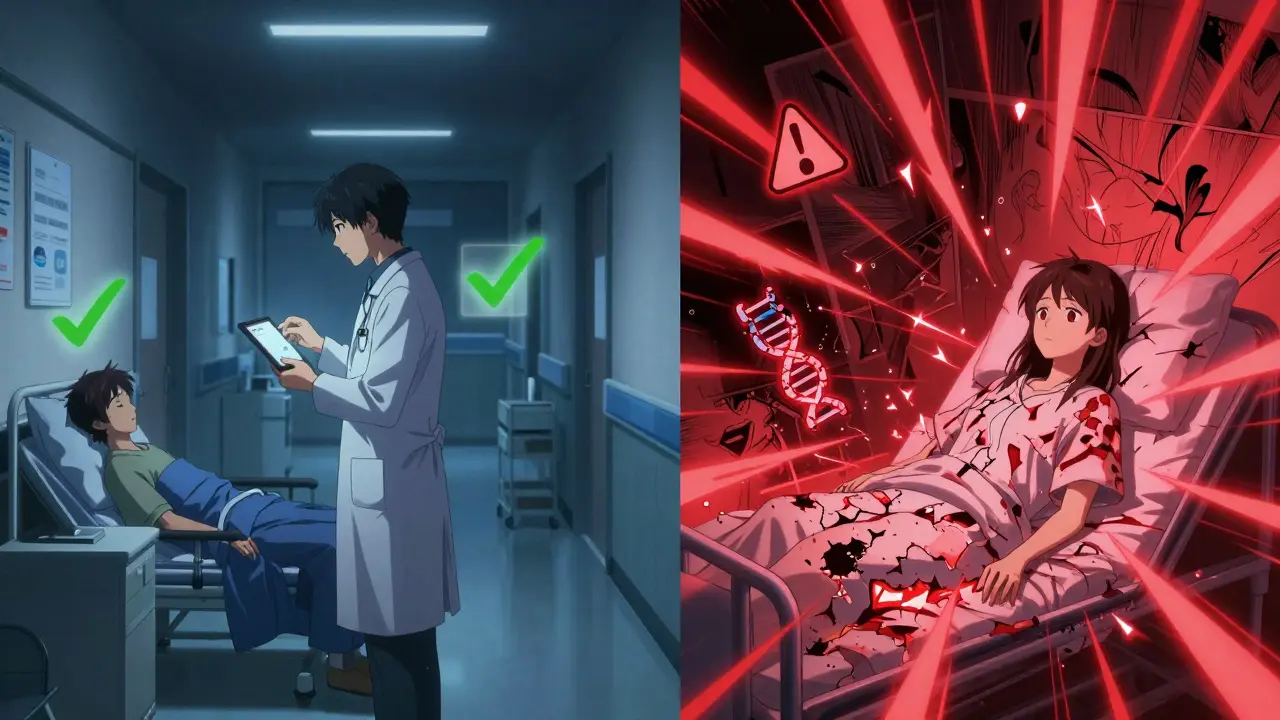
Real-World Impact
The numbers are staggering. In U.S. hospitals alone, adverse drug reactions cause over 770,000 injuries and deaths each year. Type A reactions make up most of those - but Type B reactions are the ones that end lives. A 68-year-old patient on metformin develops severe low blood sugar. That’s predictable. The doctor adjusts the dose. The patient recovers. A healthy 24-year-old takes sulfamethoxazole for a UTI - and wakes up with blisters covering their skin. They die within days. That’s unpredictable. No warning. No prior history. No way to know. A 2021 study in the Mayo Clinic Proceedings showed that 78% of physicians saw NSAID-related stomach bleeding as their most common predictable reaction. But 63% said penicillin allergy was their most feared unpredictable one. Why? Because you can’t always test for it. A patient might say they’re allergic - but are they? Or did they just get a rash once as a kid? Mislabeling allergies leads to worse drugs being used - which increases the risk of other side effects.What’s Being Done?
The healthcare system is waking up. The FDA now requires special safety plans - called REMS - for drugs with high-risk unpredictable reactions. Pharmacies must verify patient education before dispensing certain drugs. Hospitals are starting to use electronic health records that flag genetic risks automatically. Pharmacogenomics - using your genes to guide drug choices - is growing fast. In 2015, only 5% of U.S. hospitals tested for genetic risks. By 2023, that number jumped to 38%. The FDA approved its first pharmacogenomic tool in 2023 to help doctors dose warfarin correctly, reducing bleeding risks. But progress is slow. AI systems trained on millions of patient records can predict predictable side effects with 89% accuracy. For unpredictable ones? Only 47%. Why? Because they’re not just about genes. They’re about gene-environment interactions - how your genes, your diet, your infections, your stress levels, and your medications all interact in ways we barely understand.
What You Can Do
You don’t need to be a doctor to protect yourself. Here’s what works:- Know your family history. If someone in your family had a bad reaction to a drug, tell your doctor. It might mean you’re at risk too.
- Ask about genetic testing. Especially if you’re starting a drug like carbamazepine, abacavir, or allopurinol. Ask: “Is there a genetic test for this?”
- Report side effects. If you feel something strange - rash, fever, swelling, unusual fatigue - tell your doctor. Even if it seems minor. That data helps everyone.
- Don’t assume allergies. If you were told you’re allergic to penicillin as a child, get tested. Most people aren’t truly allergic. Avoiding penicillin means using broader-spectrum drugs, which increase antibiotic resistance and other side effects.
What’s Next?
The future of drug safety lies in personalization. Imagine a world where your first prescription comes with a genetic profile. Where your doctor doesn’t guess which drug to give you - they know, because your body’s response has been mapped. Where a drug that’s dangerous for 1 in 10,000 people is never given to you because your genes say no. That’s not science fiction. It’s the goal of the International Serious Adverse Events Consortium - to cut severe unpredictable reactions by half by 2030 through widespread genetic screening. But until then, awareness is your best defense. Knowing that side effects aren’t all the same - that some are predictable, and some are silent bombs - gives you power. Ask questions. Share your history. Don’t accept ‘it’s just a side effect’ as the final answer.Drugs save lives. But they can also harm - sometimes in ways we still don’t fully understand. The more you know about the difference between predictable and unpredictable side effects, the safer you are.
Are all side effects dangerous?
No. Many side effects are mild and temporary - like nausea, drowsiness, or dry mouth. These are often predictable and don’t require stopping the drug. Dangerous side effects are usually the ones that are unexpected, severe, or life-threatening - especially unpredictable reactions like allergic responses or organ damage.
Can you prevent unpredictable side effects?
Sometimes - but not always. For a few drugs, genetic testing can prevent serious reactions. For example, testing for HLA-B*1502 before prescribing carbamazepine prevents fatal skin reactions in high-risk populations. But for most unpredictable reactions, there’s no test yet. That’s why reporting any unusual symptom to your doctor is critical - it helps build the data needed to predict future cases.
Why do some people react badly to drugs while others don’t?
It comes down to biology. Your genes affect how your body breaks down drugs, how your immune system responds, and how your organs react. One person might have a gene that makes them process a drug too slowly, leading to buildup and toxicity. Another might have an immune system that mistakes the drug for a virus. These differences are unique to each person - which is why drug reactions can’t be predicted for everyone.
Is it safe to take a drug if I’ve never had side effects before?
Not necessarily. Unpredictable reactions can happen on the very first dose - even if you’ve taken the drug before without issue. That’s because they’re not about past exposure. They’re about your current biology. A change in your health, age, or other medications can trigger a reaction you never had before.
Do over-the-counter drugs have unpredictable side effects?
Yes. Even common OTC drugs like ibuprofen, aspirin, or acetaminophen can cause severe unpredictable reactions. Aspirin can trigger Reye’s syndrome in children. Acetaminophen can cause rare but fatal liver damage in some people. Ibuprofen can cause Stevens-Johnson syndrome. Just because a drug is available without a prescription doesn’t mean it’s risk-free.
Natanya Green
February 24, 2026 AT 00:20Okay, but like… have you ever taken ibuprofen and then felt like your stomach was trying to escape your body? 😭 I thought it was just me… turns out, it’s NOT just me?!?!?!
Also, I had a rash from acetaminophen once. I thought it was just ‘allergies’… until my dermatologist said, ‘Honey, that’s Stevens-Johnson. You got lucky.’
Now I carry a medical alert card. I’m not even mad. I’m just… wow.
Why isn’t this on every pharmacy label???
Steven Pam
February 24, 2026 AT 19:22This is actually one of the most important things I’ve read this year. Seriously.
I used to think side effects were just ‘bad luck’ - like, ‘oh, I got dizzy, guess I’m just sensitive.’ But no - some of it’s just biology, and some of it’s a ticking time bomb you didn’t know you were holding.
I’m 32, healthy, never had a problem… then I got prescribed an antibiotic and woke up with a fever and blisters. Turned out I had a rare gene variant. No one tested me. No one asked.
Now I push everyone I know to ask: ‘Is there a genetic test for this?’ It’s not paranoid. It’s survival.
Also - OTC drugs? Yeah. They’re not ‘safe.’ They’re ‘common.’ Big difference.
Brandice Valentino
February 25, 2026 AT 17:44OMG I JUST REALIZED I’VE BEEN TAKING IBUPROFEN FOR 8 YEARS AND NEVER KNEW IT COULD CAUSE MY STOMACH TO JUST… EXPLODE??
Also I think I’m allergic to air now lol
Wait… is this why my mom died? She took a statin… then… poof… liver failure? No one ever said ‘maybe it’s your genes’…
So… what now? Do I get my whole genome sequenced??
Larry Zerpa
February 26, 2026 AT 01:24Let’s be real - this entire post is a glorified pharmaceutical marketing piece wrapped in pseudo-science.
Yes, Type A reactions are predictable. Yes, Type B are rare. But you’re implying that genetic testing is some magic shield - when in reality, less than 30% of unpredictable reactions have any genetic marker at all.
Meanwhile, 90% of adverse events are caused by polypharmacy, poor monitoring, and doctors prescribing 7 drugs to a 70-year-old.
Blaming biology instead of systemic incompetence is lazy. And dangerous.
Also - ‘report side effects’? The FDA’s MedWatch system has a 0.3% response rate. Who are you kidding?
Gwen Vincent
February 27, 2026 AT 14:44I really appreciate how this breaks down the difference between predictable and unpredictable reactions. It’s not just about the drug - it’s about us.
I’ve had two friends die from reactions no one saw coming. One from an OTC painkiller. One from an antibiotic.
I don’t push fear. I just ask people: ‘Have you ever had a weird rash, fever, or swelling after a new med?’ If yes - tell your doctor. Even if it was years ago.
It’s not paranoia. It’s just… paying attention.
Nandini Wagh
February 27, 2026 AT 18:35Let me just say - I’m Indian, and I’ve been on carbamazepine for 12 years. No issues. No testing. No problems.
But here’s the thing: the HLA-B*1502 test exists because of a population-level risk, not because every person with that gene explodes.
Meanwhile, I’ve seen white Americans get allergic to penicillin because they got a rash at age 3 - and now they’re on vancomycin for a sinus infection.
That’s worse. Far worse.
Genetic testing isn’t a panacea - it’s a tool. And misuse creates new problems.
Also - ‘report side effects’? Yeah, sure. I reported my reaction to tramadol. They sent me a thank-you email. And then nothing.
System is broken. Stop pretending science alone will fix it.
Holley T
March 1, 2026 AT 00:01Look - I get it. Predictable side effects are manageable. Unpredictable ones are terrifying. But let’s not romanticize pharmacogenomics as some kind of futuristic utopia.
Here’s the reality: we have genetic tests for maybe a dozen drugs. Out of thousands.
Most people don’t even know what ‘pharmacogenomics’ means. Insurance won’t cover it. Doctors don’t bring it up. Hospitals don’t have the infrastructure.
And yet we’re told to ‘just get tested’ like it’s a free Apple Watch.
The real issue isn’t ignorance - it’s inequality. The people who need this the most - low-income, elderly, rural - are the least likely to get it.
So yes, knowledge is power. But power without access is just a hashtag.
Also - ‘don’t assume allergies’? Please. I’ve had 3 ER visits because I said ‘I think I’m allergic to penicillin’ and they ignored me. Then I got the real allergy test - and I’m not allergic. But now I’m labeled ‘non-compliant’ because I ‘lied.’
It’s not about trust. It’s about systems that don’t care.
Maranda Najar
March 1, 2026 AT 12:41Let me begin by stating, with the utmost gravity and solemnity, that the narrative presented herein - while ostensibly well-intentioned - is, in fact, a profound misrepresentation of the fundamental epistemological limitations of modern pharmacovigilance.
It is not merely insufficient to say that Type B reactions are ‘unpredictable’ - we must interrogate the ontological underpinnings of what ‘predictability’ even means in a biological system as staggeringly complex as the human organism.
Consider: we have mapped the human genome, yet we cannot predict how a single nucleotide polymorphism in CYP2D6 will interact with a dietary flavonoid, a latent Epstein-Barr infection, and a morning cup of espresso - all while the patient is under chronic psychosocial stress.
The notion that genetic screening will ‘solve’ this problem is not just naive - it is dangerously reductionist.
And yet - the pharmaceutical industry, in its infinite wisdom, has convinced the public that personalization is the answer - while simultaneously lobbying against mandatory adverse event reporting, refusing to fund population-wide screening, and patenting genetic tests at $3,000 a pop.
So yes - I applaud the awareness.
But let us not mistake awareness for action.
And let us not mistake hope for justice.