
Taking Medications with Food vs Empty Stomach: When It Matters

Medication Timing Calculator
Check Your Medication Requirements
Select a medication to see your timing instructions and food interactions.
Why This Matters
Taking with food can reduce thyroid medication effectiveness by half, leading to persistent symptoms and unnecessary dose increases.
Without food, NSAIDs can cause stomach ulcers, bleeding, and hospitalization. Food reduces stomach irritation risk by 70%.
Ever taken a pill with your morning coffee and wondered why it didn’t seem to work? You’re not alone. Many people don’t realize that food can make or break how well their medication works. It’s not just about stomach upset-it’s about science. A pill taken the wrong way can lose half its power or turn into a side effect factory. The difference between taking your medicine with food or on an empty stomach isn’t a suggestion-it’s a medical requirement backed by decades of research.
Why Food Changes How Medicines Work
Your stomach isn’t just a passive container. It’s a chemical factory. When you eat, your body shifts into digestion mode: acid levels drop, bile flows, and food slows down how fast things leave your stomach. All of this changes how drugs get absorbed. Some medicines need high acid to break down. Others need fat to dissolve. And some get blocked by calcium in milk or iron in spinach. For example, levothyroxine (Synthroid), used for thyroid problems, absorbs 20-50% less when taken with food. That means your TSH levels stay high, you feel tired, and your doctor might keep raising your dose-when all you needed was to wait 30 minutes after eating. The same goes for alendronate (Fosamax), a bone drug. Take it with breakfast? You might as well have skipped the pill. Studies show absorption drops by 60%. On the flip side, ibuprofen and naproxen can tear up your stomach lining if taken alone. Food cuts that risk by up to 70%. Aspirin? Same deal. Without food, 25% of people get stomach pain. With food? It drops to 8%. That’s not luck-that’s pharmacology.Medications That Must Be Taken on an Empty Stomach
These drugs need your stomach to be clear. No snacks. No coffee. No juice. Just water.- Levothyroxine (Synthroid): Take it first thing in the morning, 30-60 minutes before breakfast. Even a cup of coffee with cream can cut absorption by 30%. Many patients report wild TSH swings until they switch to taking it at 4 a.m. and waiting 90 minutes.
- Alendronate (Fosamax): Must be taken with a full glass of water on an empty stomach. Stay upright for 30 minutes after. Food, calcium, or antacids within 30 minutes can make it useless.
- Sucralfate (Carafate): Works by coating ulcers. Food gets in the way. Take it 1 hour before meals.
- Ampicillin: A common antibiotic. Food reduces peak levels by 35%. Take it 30 minutes before or 2 hours after eating.
- Zafirlukast (Accolate): Used for asthma. Food slashes absorption by 40%. Take it 1 hour before or 2 hours after meals.
- PPIs like omeprazole and esomeprazole: These block acid production-but only if taken before food triggers acid release. Take them 30-60 minutes before breakfast. (Pantoprazole is the exception-it works either way.)
Medications That Need Food to Work Right
Some drugs are like plants-they need soil to grow. In this case, food helps them get absorbed or protects your body.- NSAIDs (ibuprofen, naproxen): Take with food or a snack. Without it, you risk ulcers, bleeding, and hospitalization. Over 10,000 people are hospitalized each year from NSAID-related stomach damage-most could’ve been avoided.
- Aspirin (high-dose): For pain or inflammation, always take with food. Low-dose aspirin for heart protection can be taken without food, but check with your doctor.
- Duloxetine (Cymbalta): This antidepressant causes nausea in half of users on an empty stomach. With food, nausea drops by 30%.
- Statins (atorvastatin, simvastatin): Food boosts absorption. But here’s the catch: grapefruit juice. Even one glass can spike statin levels by 300-500%, raising the risk of muscle damage by 15 times. Avoid it completely.
- Antibiotics like tetracycline: Dairy, calcium, iron, and antacids bind to these drugs and stop them from working. Take them 2 hours before or after milk, yogurt, or supplements.

The Science Behind the Rules
It’s not magic-it’s chemistry and biology. When you eat, your stomach pH rises from 1-2 (super acidic) to 3-5. That’s bad news for penicillin V, which breaks down faster in less acid. Food also triggers bile release, which helps dissolve fat-soluble drugs like griseofulvin-absorption jumps by 50%. Calcium and iron in food latch onto tetracycline like magnets, making it useless. And high-fat meals can delay stomach emptying by 2 hours, which throws off timing for drugs like levothyroxine. The FDA now requires drug makers to test new medications with both high-fat (800-1,000 calories) and low-fat meals. That’s how they know if food matters. Between 2018 and 2022, 68% of new drugs needed specific food instructions. That number keeps rising.What Happens When You Ignore the Rules
Skipping food instructions isn’t just a small mistake. It’s dangerous. A 2023 report from the Institute for Safe Medication Practices found 12,000-15,000 medication errors each year are tied to food timing. Levothyroxine errors make up 22% of those. One patient took Synthroid with her morning oatmeal and coffee for two years. Her TSH stayed high. Her doctor kept increasing her dose. She was overmedicated-because of breakfast, not the pill. PPIs taken after meals? Healing rates for esophagitis drop from 93% to 67% in eight weeks. That means more pain, more endoscopies, more risk of complications. A 2022 survey of 10,000 patients showed 65% never checked food instructions. Of those, 41% said their meds didn’t work as well. 29% had worse side effects. The most common mistake? Taking ibuprofen on an empty stomach-58% did it. And 73% of those ended up with stomach pain.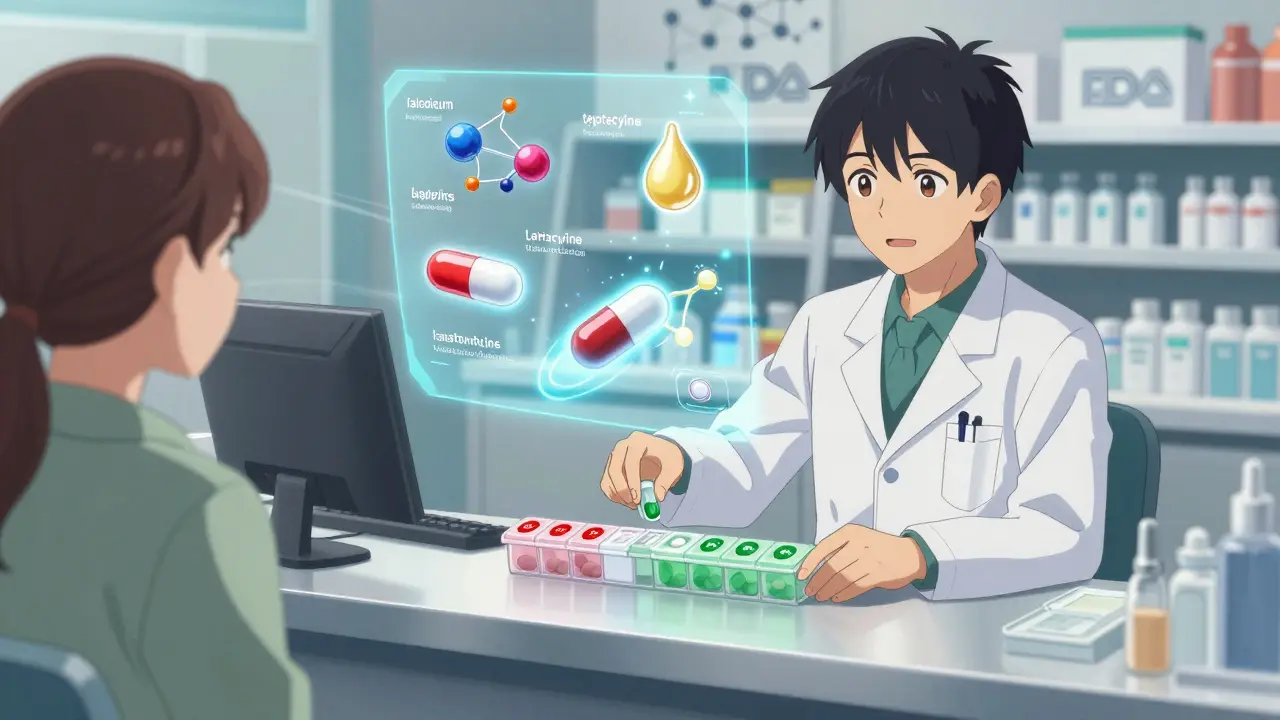
How to Get It Right Every Time
You don’t need to memorize a list. Use these simple tools:- The 2-1-2 Rule: For empty stomach meds-take them 2 hours after eating, or 1 hour before your next meal. That’s the sweet spot.
- Color-coded labels: Many pharmacies now put red stickers on bottles for empty stomach meds, green for with food. In a 2021 study, this boosted correct use from 52% to 89%.
- Pill organizers: Get one with AM/PM compartments labeled “Before Food” and “With Food.” A 2022 study showed this improved adherence by 35%.
- Apps like Medisafe or GoodRx: They send alerts: “Take Synthroid now-wait 60 minutes before eating.” Users reduce errors by 28%.
- Stagger your doses: If you take multiple meds, space them out. Empty stomach med at 7 a.m., breakfast at 8 a.m., then food-requiring meds at 8:30 a.m.
What’s Changing in the Future
The good news? Science is catching up. Johnson & Johnson’s new version of Xarelto uses a special coating that works the same whether you eat or not. It’s a game-changer-only 8% variability versus 35% in the old version. The University of Michigan is testing nanoparticles that deliver levothyroxine past stomach acid entirely. Early results? 92% consistent absorption, no matter what you ate. The FDA is even proposing to drop food-effect testing for 37% of generic drugs where data shows food doesn’t matter. That could speed up cheaper generics. But here’s the catch: experts say 75% of today’s prescriptions still require food timing rules. Even with new tech, you still need to know the basics.What to Do Right Now
Don’t guess. Don’t assume. Don’t wait until you feel worse. - Open your medicine bottle. Look for the label. Does it say “take on empty stomach” or “take with food”? If it’s unclear, call your pharmacist. They’re trained for this. In fact, 92% of pharmacists give food timing advice-only 45% of doctors do. - If you’re on levothyroxine, stop taking it with coffee, dairy, or breakfast. Try it 30 minutes before your first sip of water in the morning. - If you take ibuprofen daily, keep a snack by your pill bottle. A banana, a cracker, a handful of nuts-it’s enough. - If you’re on statins, check your fridge. Is there grapefruit? Toss it. Even one glass can be dangerous. - Use your phone. Set a reminder: “Take Cymbalta with lunch.” It’s that simple. Your medicine isn’t just a pill. It’s a tool. And tools work best when used correctly. Food timing isn’t a minor detail-it’s the difference between healing and harm.Can I take my medication with water if it says "on an empty stomach"?
Yes, water is fine. In fact, it’s recommended. The key is avoiding food, coffee, milk, juice, or supplements for at least 1 hour before and 2 hours after. Water doesn’t interfere with absorption.
What if I forget and take my pill with food?
Don’t panic. Don’t double up. If you took a pill that needs an empty stomach with food, wait until your next scheduled dose and take it correctly then. For most drugs, one mistake won’t cause harm-but doing it regularly will reduce effectiveness. If it’s a critical drug like levothyroxine or alendronate, call your pharmacist or doctor for advice.
Does it matter if I eat a snack instead of a full meal?
Yes. Even a small snack can interfere. A handful of nuts, a granola bar, or a piece of fruit can trigger stomach changes that affect absorption. For drugs like levothyroxine or alendronate, treat a snack like a meal. Wait 1 hour before and 2 hours after.
Why do some medications need food but others don’t?
It depends on how the drug is absorbed. Acid-sensitive drugs (like penicillin) need low pH (empty stomach). Fat-soluble drugs (like statins) need fat to dissolve. Drugs that irritate the stomach (like NSAIDs) need food as a buffer. And some drugs bind to minerals in food (like tetracycline and calcium). Each drug has its own chemistry.
Can I take my morning meds with my coffee?
Only if your doctor or pharmacist says yes. Coffee can interfere with many drugs-not just because of caffeine, but because of additives like milk, cream, or sugar. For levothyroxine, even black coffee can reduce absorption. Wait at least 30-60 minutes after taking your pill before drinking coffee.
If you’re unsure about any medication, ask your pharmacist. They’re the experts on how your pills work-and they’re paid to give you clear, accurate advice. Don’t wait for a side effect to realize you’ve been taking your medicine wrong.
Jeremy Hendriks
December 22, 2025 AT 09:43Food isn't just fuel-it's a chemical gatekeeper. I used to take my Synthroid with coffee like it was a morning ritual. Turns out, I was basically pouring bleach on my thyroid meds. Now I take it at 5 a.m. with a glass of water, wait 90 minutes, and suddenly my energy’s back. No joke. Science isn’t optional. It’s the difference between feeling like a zombie and actually living.
And don’t get me started on grapefruit and statins. That stuff isn’t fruit-it’s a drug amplifier. One glass and your muscles start screaming. I know a guy who ended up in the ER because he thought ‘natural’ meant ‘safe.’ Spoiler: it didn’t.
Aliyu Sani
December 23, 2025 AT 03:44bro i was takin my alendronate w breakfast like a champ till i read this. 60% absorption? that’s like payin for a steak n eatin air. now i take it at 6am, stand like a statue for 30 mins, no coffee, no milk, nothin. my bones feel stronger. not magic, just chem. also, why do docs even give pills w/o explainin this? we ain’t robots.
pls someone tell the pharma giants to put ‘DO NOT EAT’ in big red letters on the bottle. thx.
Gabriella da Silva Mendes
December 24, 2025 AT 14:03OMG I CAN’T BELIEVE I’M THE ONLY ONE WHO KNEW THIS?? 🤯 Like, I’ve been taking my Cymbalta with peanut butter toast for 3 years and I thought I was just ‘lucky’ my nausea was gone. Turns out I was doing it RIGHT. Meanwhile, my cousin is on 80mg of ibuprofen on an empty stomach and complains about ‘digestive issues’-Duh. Your stomach isn’t a trash compactor, Karen.
Also, why is the FDA still letting companies sell PPIs without a warning label that says ‘IF YOU EAT BEFORE THIS, YOU’RE WASTING MONEY’? I’m so mad I could cry. 🇺🇸🔥
Kiranjit Kaur
December 25, 2025 AT 10:46Thank you for this!! I’ve been taking my levothyroxine with my green smoothie and wondering why I’m still tired. 😅 Now I’m doing it with water, 30 mins before breakfast, and I swear I feel like a new person. Also, I started using Medisafe and it sends me little voice reminders-‘Hey, take your pill, then wait!’ It’s like having a nurse in my pocket. 🙏
PS: Grapefruit juice is EVIL. I threw mine out. No regrets. 💪
Candy Cotton
December 26, 2025 AT 06:36While the general information presented is not without merit, the casual tone and lack of citation to peer-reviewed literature undermines the credibility of the claims. The FDA does not mandate food-effect testing for all new drugs-only those where pharmacokinetic variability is suspected. Furthermore, the assertion that 68% of new drugs require specific food instructions is misleading without a source. One must exercise caution when generalizing pharmacological principles to lay audiences without contextualizing the underlying clinical trials.
Moreover, the recommendation to take levothyroxine at 4 a.m. is not standard of care. Guidelines from the American Thyroid Association suggest 30–60 minutes prior to breakfast, not pre-dawn administration. This may induce unnecessary sleep disruption.
Professional advice must be grounded in evidence, not anecdote.
Ajay Brahmandam
December 26, 2025 AT 22:37Man, this is gold. I used to take my tetracycline with yogurt because I thought probiotics would help. Nope. Turned out the calcium just locked the antibiotic in place like a vault. My infection didn’t budge for weeks. Finally asked my pharmacist-she laughed and said, ‘You’re not the first.’
Now I take it 2 hours before breakfast, no dairy, no supplements. And yeah, I keep a banana by my meds. Just one. That’s enough.
Pharmacists are the real MVPs. Doctors? They’re busy. But your pharmacist? They know every pill you’ve ever taken. Talk to them.
Tarun Sharma
December 27, 2025 AT 18:22Accurate and well-structured. The distinction between food interactions based on pH, fat solubility, and chelation is scientifically sound. The 2-1-2 rule is a practical heuristic for patient adherence. Further research into nanoparticle delivery systems for levothyroxine is promising and aligns with recent advances in controlled-release formulations. Recommended reading: Journal of Clinical Pharmacology, 2021, Vol. 61(4), pp. 512–520.
Jim Brown
December 29, 2025 AT 03:31There’s a quiet poetry in how chemistry governs our daily rituals. We swallow pills as if they were prayers-blind, hopeful, disconnected from the machinery of our own biology. Yet the stomach, that ancient furnace, does not care for our routines. It responds to fat, to acid, to calcium like a symphony conductor-each ingredient a note that alters the melody of absorption.
Levothyroxine, taken with coffee, is not a failure of will-it is a failure of understanding. We are not merely bodies that take pills. We are ecosystems. And like any ecosystem, balance is everything.
Perhaps the most revolutionary drug of the 21st century isn’t a molecule at all-it’s education. The quiet, unglamorous act of reading the label. The humility to ask, ‘What does this really do?’
And yet, we rush. We multitask. We trust the bottle to know us better than we know ourselves. That, more than any side effect, is the real tragedy.
Sai Keerthan Reddy Proddatoori
December 29, 2025 AT 08:13They don’t want you to know this. Big Pharma makes more money if you keep taking double doses because your meds don’t work. That’s why they don’t print ‘DON’T EAT WITH THIS’ in neon on every bottle. They profit from your ignorance. They profit from your TSH being high so they can sell you more Synthroid. They profit from your stomach bleeding so they can sell you PPIs. It’s all connected.
And why is grapefruit juice still legal? It’s a weapon. The FDA knows. But they’re bought. Watch the videos. The truth is buried. I found a whistleblower document from 2019-ask me for it.
Take your meds with water. Only water. And pray.
Cara Hritz
December 29, 2025 AT 09:53Wait so if i take my ibuprofen with a cracker is that okay? or do i need a full meal? i just ate a pop tart so am i screwed? 🤔 i think i spelled cracker wrong. anyway this was super helpful i had no idea about the grapefruit thing omg i drink that every day 😭
Jamison Kissh
December 31, 2025 AT 01:29What’s wild is how little we question the systems we’re handed. We’re told to take a pill, and we do-no questions, no context. But the body doesn’t operate on convenience. It operates on biochemistry. The fact that we’ve normalized taking medication with coffee, milk, or a snack says more about our culture than our pharmacology.
I’ve started keeping a small log: what I took, when, and what I ate. It’s changed everything. I used to think my fatigue was ‘just aging.’ Turns out, it was my 8 a.m. oatmeal.
Maybe the real innovation isn’t in new drugs-but in teaching people to read the fine print like it’s a contract with their own life.